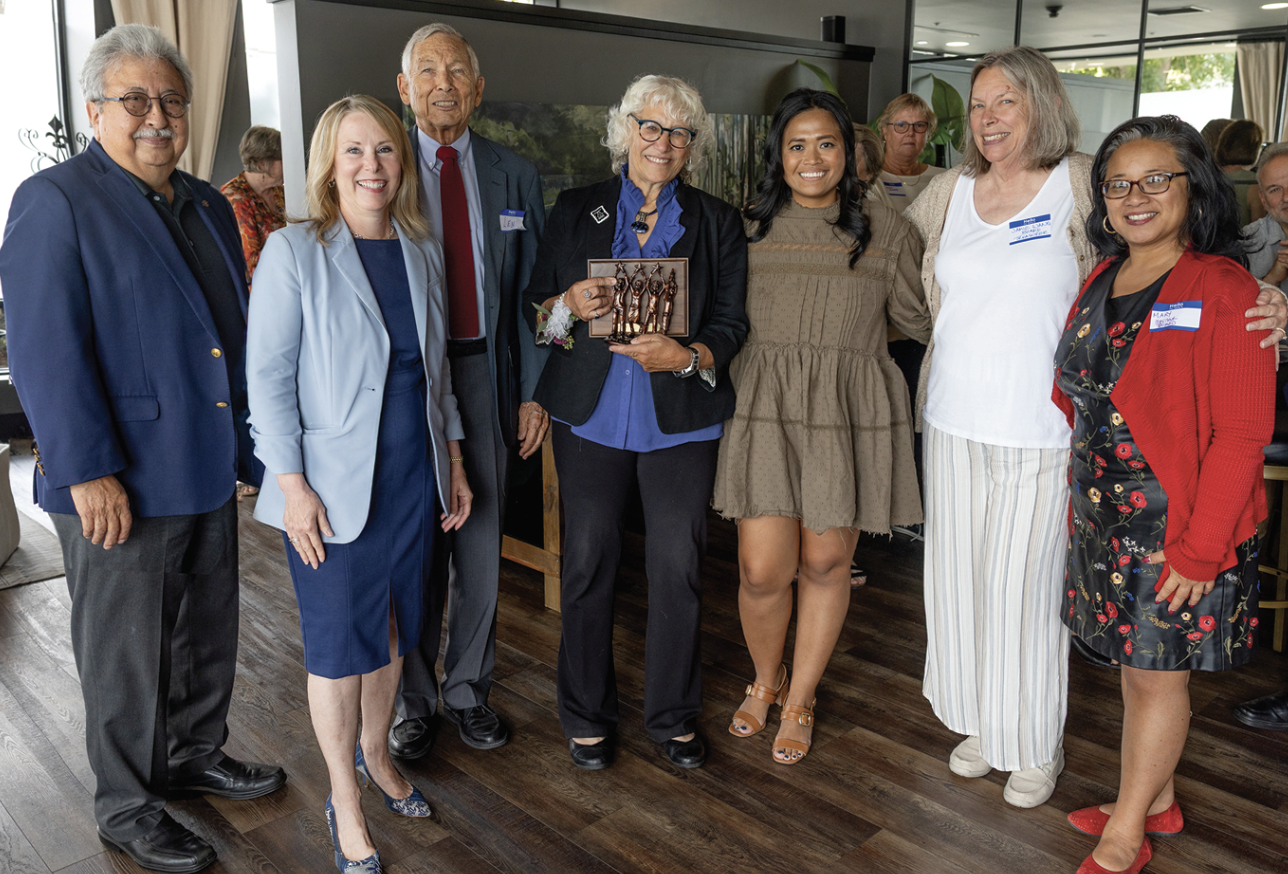
For 25 years, Dana Bunnett, a resident of Los Altos for 22 years who now resides in Santa Cruz, has shown through her leadership and her work to address the importance of being involved in every aspect of a child’s life.
Bunnett retired this past June as the co-director of Kids in Common (KIC), a nonprofit within Santa Clara County that aims to improve the lives of children by sharing insights with organizations such as the Santa Clara County Board of Education – using data and research – to inform them on policy and system changes at the county and state levels. Bunnett was honored with a luncheon last Thursday by the KIC board of directors, which includes Dr. Mary Ann Dewan as the chair and Judge Leonard Edwards as the vice chair, to celebrate her advocacy for keeping children safe and healthy.
Bunnett said that before working at KIC, she worked in parks and recreation, assisting children and families with disabilities. She also spent some time working with the Red Cross’s Safe Rides Program. She said she has always been drawn to helping children reach their special milestones and that the context when going into KIC was her openness to doing good work.
“I kind of believe things go the way they’re supposed to and for me at least,” she said. “I was like 42 when I took this role. You never think your career is gonna be dedicated to this work. And it’s really true. I came in and felt like a baby, specifically around children’s issues, and I’ve never been bored in the 25 years. I’ve been doing the work because there’s always something to learn.”
Bunnett said she enjoyed the aspect of creating systems of change to see every student thrive. Through her job, she learned how hard it is to be a parent with limited resources. Bunnett is a parent herself and believes being a mother was the hardest job. She said it was a different level seeing that role with families who can’t afford to provide medicine to their sick children or to feed their families. She said her compassion for families has grown since taking the role.
“I began to wake up sometimes feeling angry that people didn’t care as much as I did or people needed to get their act together and really care about kids,” she said. “But then you realize that people are working in systems, and they have to have compassion for them, because the systems don’t let them do their best work sometimes.”
She said it is important to see the big picture when caring for the kids. Although she doesn’t work directlhy with families, her work advocates for children in a different way by bringing together people from different sectors in government to address systemic issues. Her accomplishments include the creation of the Bill of Rights for Children and Young Adults, a guideline of promises that the Santa Clara Board of Supervisors adopted in 2010 that ensure all children and young adults would have the right to health care, mental health services, guidance, life skills, education and many more areas.
She said the county really believes that children need to be at the center of policy-making. She said the county has even adopted a children’s budget to track how much money is being spent on children and to keep them in the narrative. Some of the big targets that the organization is looking at the homelessness and the hardships some children face with immigration issues. She said they are also looking at the effects of social media and finding solutions on how children can take control over the many implications of it.
“Kids need meaningful adult connections because those adults and peers, too, can help them process what they’re seeing, hearing and doing. I think there’s not enough going on.”
Bunnett and her team collect data from secondary sources such as census data, state databases on school outcomes and demographics, public health data from the county and survey data such as Project Cornerstone, a YMCA of Silicon Valley program that works with struggling students. They then use this data to collect information on students for their work and report. KIC every year publishes an amalgamation of the data points in their Children’s Data Book that reflects the need for investments or advancements of “advancing racial, economic, health, education justice, and the intersectional context of sexual orientation, gender identity, and disability.”
She said the organization was small when she started and is proud of everyone who stuck by her because they “weren’t paying anybody to be at the table.” People showed up to her organization who wanted to make a big difference in the county. She said her organization does not lead or make policy, but provides for a cross-sector of different parts of a child’s life, such as education, health care and mentorship. She is excited to see how Joy Murrieta, the current executive director of KIC, flourishes and is confident in her new ideas.
“She brings a different perspective,” she said, “She comes from working with children in the arts, which I think is also so important for kids. She even knows social media, which I didn’t really do very well. I think that it’s just important to have new people.”
To learn more about KIC, visit kidsincommon.org.