The plan to replace the Flint Center is moving forward, with Chancellor Judy Miner presenting a timeline for the project at last week’s Foothill-De Anza Community College District board meeting and a town hall meeting slated for next month.
“We wanted to share very publicly all the steps that are involved,” Miner told the board at Monday’s meeting.
Per the timeline, in December 2020 the board will review the nature and scope of the project. At that meeting, Miner said, the intention is for the board to vote on a plan that lays out what will replace the Flint Center, the 48-year-old performing arts center on the De Anza College campus in Cupertino.
Construction is not slated to commence until the winter of 2023, to be completed by the winter of 2026. A number of factors lead to the long runway before construction can begin, including the time it will take to complete an environmental impact report, prepare construction documents and secure state approval. A year is set aside for receiving approval from the Division of the State Architect alone.
Facing a nearly $50 million price tag to make the building structurally safe, the board voted in June to permanently close the Flint Center. Students have argued that the district ought to prioritize creating student housing, while some community members have pushed for a performing arts space.
Combining housing and arts
According to Miner, the goal of publishing the timeline is to make clear what the project will involve and how long it is expected to take.
“There have been so many discussions that seem to pit housing against the arts, as though we actually can’t serve both by moving forward with this particular project,” Miner said in an interview.
However, Miner said that isn’t true, and that the aim is to include both elements. She envisions two buildings on the site: a hall with space for performances and another building for housing. The concepts are still preliminary, and nothing has been officially decided or voted on by the board.
The idea is that the hall would be available for use by the college, as well as by members of the public, Miner said. The building’s entrance would potentially face out onto Stevens Creek Boulevard, unlike the Flint Center, the back of which currently faces the major road.
“I’m thinking about this as the new entrance to De Anza,” Miner said. “That this becomes the way for the community to think about themselves being welcomed to the campus.”
Set back behind the hall would be housing. Miner said the structure will need to stand multiple stories to be able to include enough units, but how many stories isn’t yet clear.
“The fact that we’re pursuing housing is really a new venture for us and so we really want to make sure we’re getting this right,” she said.
Whether the housing would be set aside for faculty, students or some combination of the two has not been announced. However, Miner said her dream is for there to be enough units so that there is some space available for employees of nearby districts.
“It’s that balancing act that is just so challenging,” she said. “We definitely want to have something that could serve as many persons as possible.”
The community college district may also end up constructing housing beyond that which is planned for the Flint Center site. There is the possibility of creating housing on Foothill College’s main campus or the Foothill College Sunnyvale Center, which is near the intersection of 237 and 101.
The district also has agreed to put $600,000 toward a project spearheaded by Santa Clara County Board of Supervisors President Joe Simitian to build subsidized teacher housing on a 1.5-acre plot of land at 231 Grant Ave. in Palo Alto.
Financing the center’s replacement
The community college district is currently reviewing whether to place a bond or parcel tax measure before voters, but Miner said some have erroneously conflated that discussion with the plan to replace the Flint Center.
“We need to move forward whether or not the board approves a bond ballot,” Miner said of the Flint Center project.
Multiple options are being considered to fund construction on the Flint Center site, including a public-private partnership. There is precedent for such a model. The county is partnering with two nonprofit developers to help construct the units in Palo Alto.
A bond or parcel tax measure, on the other hand, would be used to fund broader campus initiatives, such as instructional equipment, deferred management and energy management. If the board decides to move forward with a bond or parcel tax, it may decide to place the measure on the ballot in March or November 2020, Miner said.
The district is in the process of gauging community support for a ballot measure. A mailer was recently sent out with a feedback survey asking respondents to rate the importance of various campus priorities.
Community outreach
As for the Flint Center project, Miner said the plan is to solicit a wide array of community feedback.
“There really are incredible opportunities for a lot of input both from within the campus as well as the larger community,” Miner said.
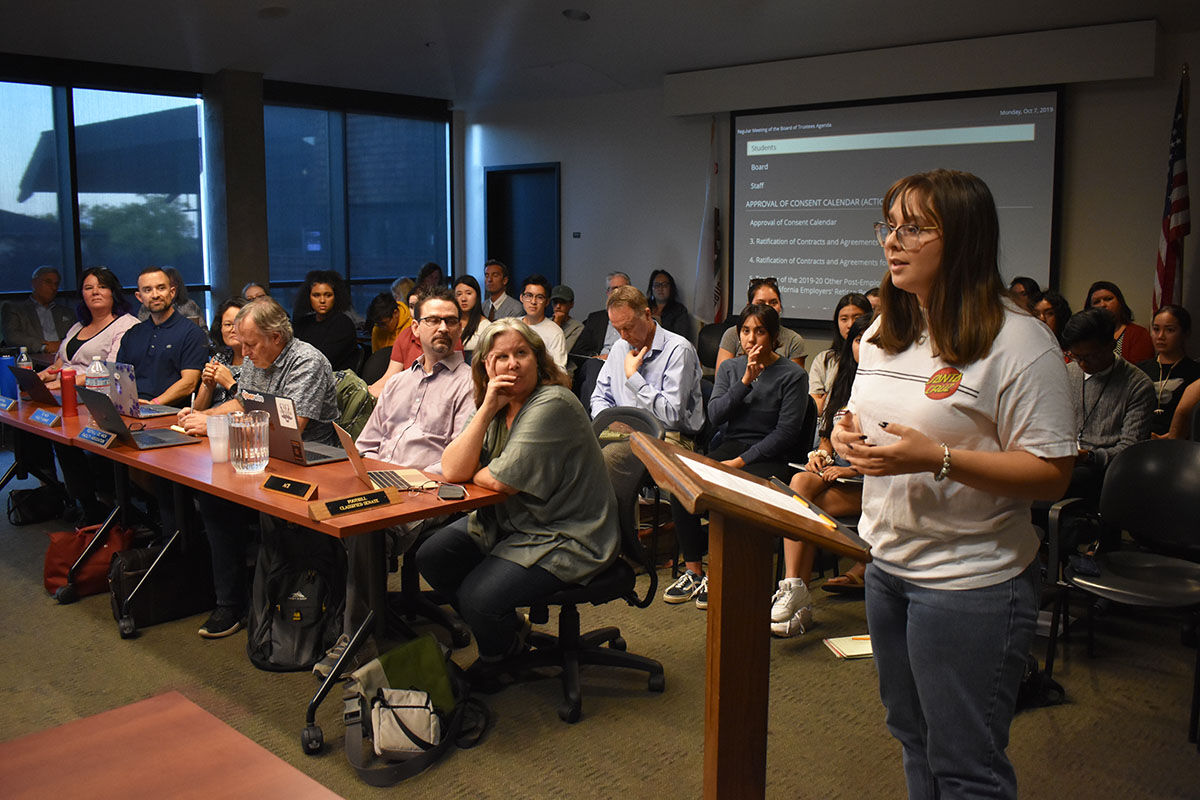
Students have consistently shown up at recent board meetings, pushing board members to prioritize building student housing, either on the Flint Center site or elsewhere.
At the June meeting where the board voted to permanently close the Flint Center, in addition to student speakers urging housing, some local residents instead argued for keeping the Flint Center open for use as a performing arts venue.
Over the coming months, the district plans to continue a public outreach campaign to gather feedback about what different groups want to see on the Flint Center site.
A town hall meeting is scheduled 4 p.m. Nov. 12 at De Anza College to present the timeline and initial concepts.
“There’s been so much sorrow about the Flint disappearing,” Miner said. “But I think we can replace it with something that serves even more people in more ways than the Flint ever could.”