As you may have read, there has been a hiccup in the smooth transition from fossil fuels to electric vehicles. The cancellation of federal tax credits and the move to reduce Corporate Average Fuel Economy (CAFÉ) standards remove incentives for manufacturers to make and drivers to buy zero-emission vehicles.
Dodge was among the automakers trying to convince its clientele to convert, introducing its new Charger sedan and coupe as an electric vehicle. The backlash from said customers, who have been described to me by a representative of the company as “traditionalists,” was fierce, forcing Dodge to start offering that new car designed for the EV age with as many gasoline-powered twin-turbo six-cylinders as the factory could crank out.
Y’see, Dodge has stayed alive 26 years into the new millennium by being the bad boys of the car world. Without the resources of Ford, much less GM or Toyota, Dodge has kept older designs relevant and profitable by shoving big engines under the hood and then watching customers arrive at the dealership with substantial amounts of cash or financing and leave with a smile in a cloud of tire smoke.
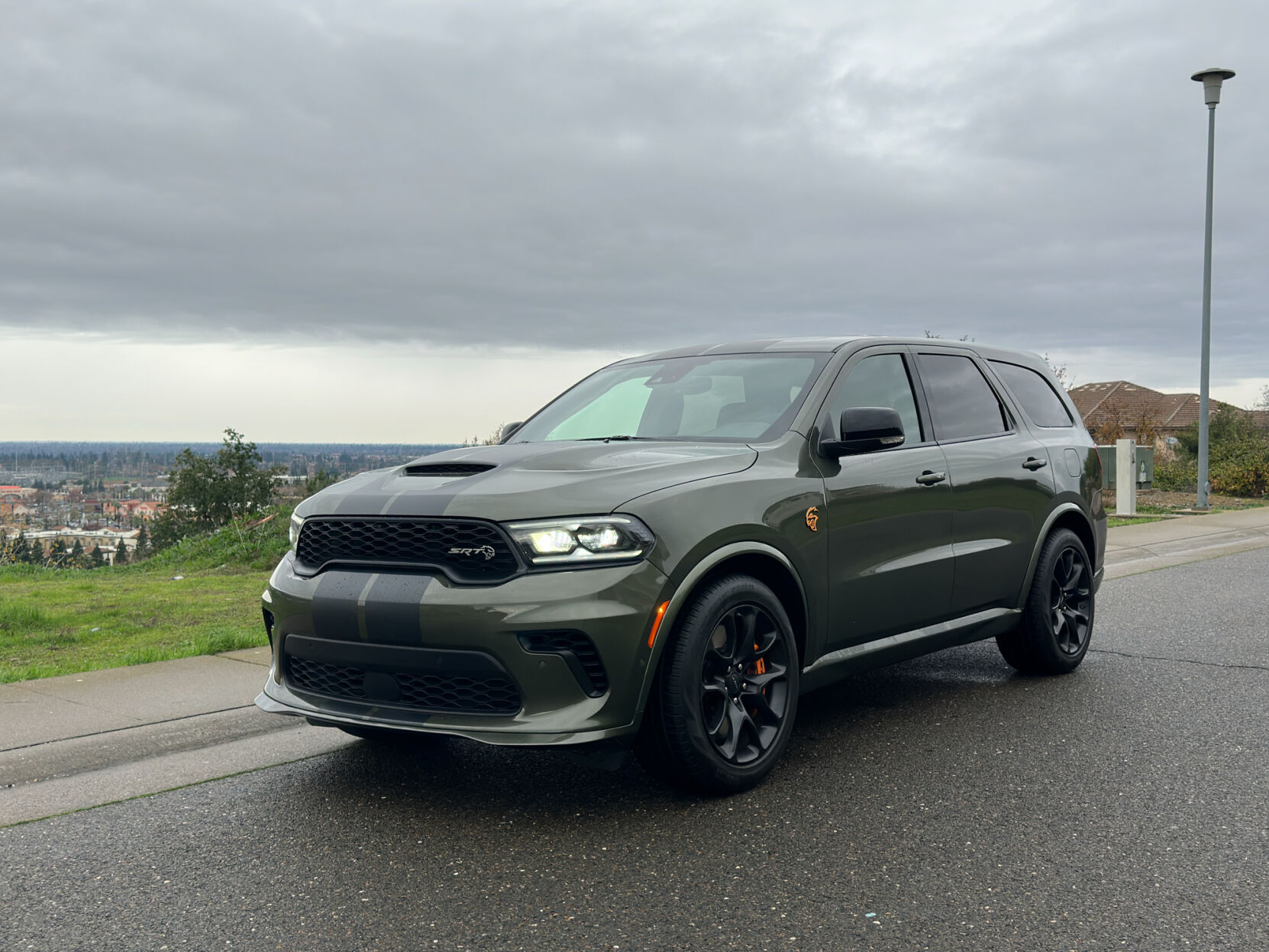
Maybe the best illustration of the Dodge approach is the 2026 Dodge Durango SRT Hellcat Jailbreak.
Yes, “Hellcat.”
And yes, “Jailbreak.”
The Dodge Durango is a family SUV that has been around for 28 years. This generation, its third, is in its 16th model year, having been introduced in 2011. But even in its mildest trim levels, it leans into a performance image.
The base model is the Durango GT, and the V6 engine makes 295 horsepower. And, without options, you can get one for under $40,000. Those and the one-step-up GT Hemi V8 are powerful enough that the California Highway Patrol has bought 100 of them, painted in subtle colors, to blend in with traffic and catch speeders.
There are five more rungs on the Durango performance ladder, and the top is the Durango SRT Hellcat Jailbreak. The cost is more than double that of the base Durango GT, but then so is the muscle. Under the hood is a 6.2-liter supercharged Hemi V8 that makes 710 horsepower.
Seven. Hundred. And. Ten.
Zero to 60 happens in 3.5 seconds. In a drag race, it’ll do the quarter-mile in 12 seconds.
It is the fastest gasoline-powered SUV in America.
For its base price of $79,995 ($81,990 including destination), Dodge did way more than stuff a big engine under the hood. The Durango SRT Hellcat Jailbreak has all-wheel drive standard, along with an eight-speed automatic transmission. Brembo brakes with two-piece front rotors, four-wheel traction control, an electronic limited-slip differential rear axle, a competition suspension, high-performance exhaust and performance-tuned steering all help keep that power under control.
Should I mention it also gets a special 200-mile-per-hour speedometer? (The vehicle is electronically limited to 180.)
There are also non-performance standard equipment items we should mention – a nine-speaker Alpine audio system with amplifier and subwoofer with wireless Apple CarPlay, wireless Android Auto, and a basic suite of active safety features.
The test vehicle also had a substantial list of extra-cost options: Green Machine paint ($595), Customer Preferred Package 2XM – the Jailbreak badge and forged carbon fiber interior accents ($995), a trailer towing group ($1,195), the Premium Group – premium door trim panels, “Supercharged” sill plates, advanced braking assist, an upgraded 19-speaker, 825-watt Harman Kardon audio system with subwoofer, a premium instrument panel, enhanced lane-departure warning, automatic high beams, full-speed forward-collision warning plus and adaptive cruise control with stop ($1,995), sepia-colored seat belts ($495), a suede headliner ($495), sepia-colored seats ($2,995), a power sunroof ($1,495), orange SRT Hellcat fender badges ($595), low-gloss gunmetal dual stripes ($1,495), black exhaust tips ($195), a leather and suede-wrapped steering wheel ($495) 20-inch “Lights Out” aluminum wheels ($1,295) and orange brake calipers ($595).
All told, the as-tested price is $96,920.
For such a fearsome beast, it’s actually quite civilized to drive around town. The always-present rumble of the V8 is there to let you know it’s ready, but you can use it as a regular family SUV.
The magic that can’t be worked is with the fuel consumption. The EPA fuel economy estimate is 12 city/17 highway. As they say in the ads, your mileage may vary and mine did. Driving it very gently, at legal city street and freeway speeds for 20 miles before doing the photography, I got 8.8 miles per gallon.
That means I used two-and-a-quarter gallons of premium fuel to do that 20 miles worth of everyday driving.
Ouch.
The window sticker warns you up front – the Durango SRT Hellcat Jailbreak AWD will cost $15,500 more in fuel over five years than the average new vehicle. It also shows the lowest possible fuel economy, greenhouse gas and smog ratings possible – a one on a scale of one to 10.
There are electric vehicles that can beat the Durango SRT Hellcat Jailbreak to 60 and in the quarter-mile without using a drop of gasoline and without putting a particle of tailpipe pollution in the air. EVs that won’t cost $15,500 more than the average car in fuel costs alone.
For now, and for the foreseeable future, though, they’ll have to co-exist with fossil fuel hot rods like the Durango SRT Hellcat Jailbreak, and we’ll have to mull the irony of dinosaurs that run on dead dinosaurs still roaming the earth.