PhysioFit Physical Therapy & Wellness recently hosted “Ask a PT – Q&A Friday,” a live Zoom session led by our physical therapy team. Our goal was to provide a convenient opportunity for local residents to learn from board-certified PTs about a variety of health-related topics. Our last Q&A Friday was a great success – we heard tons of good questions, including a few that inspired the topic of our next live Q&A session.
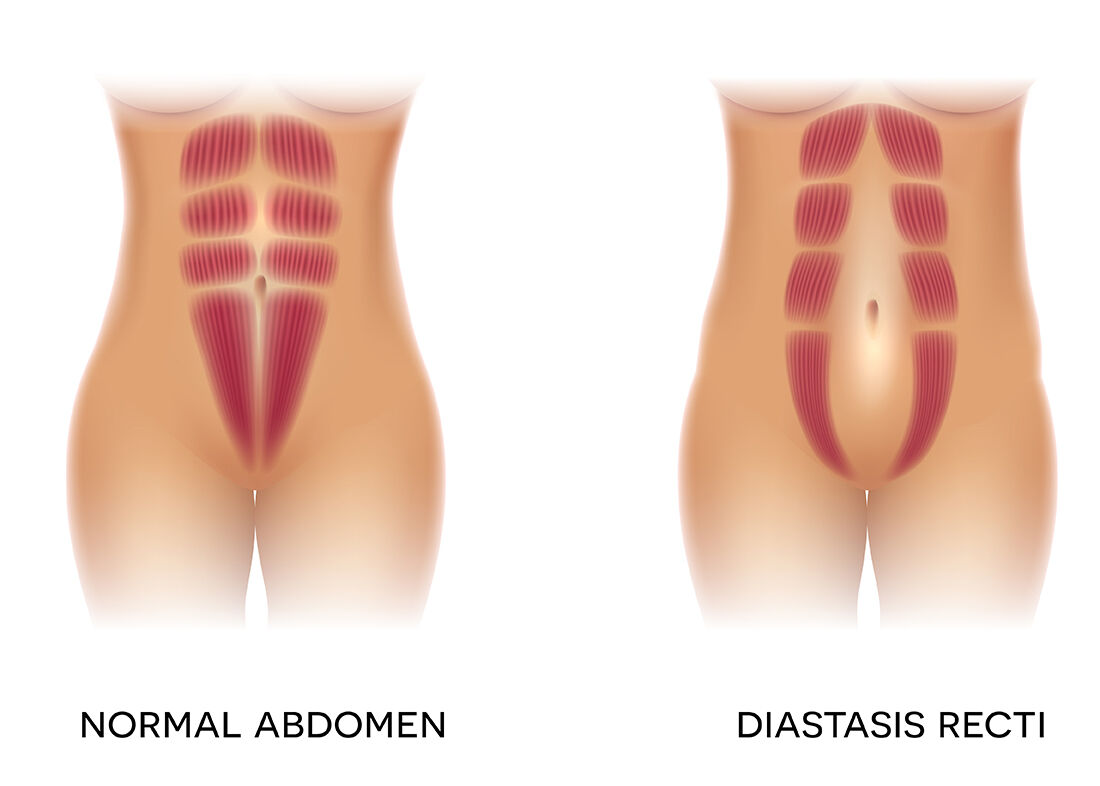
A common health concern that was raised at the session affects women during pregnancy and postpartum life: diastasis recti.
Understanding diastasis recti
Diastasis recti, or ab separation, occurs when the fibrous connective tissue running down the middle of the torso thins and stretches out. This connective tissue, called the linea alba, holds together the right and left abdominis recti muscles (the “six pack” muscles). The fibrous tissue making up the linea alba also spreads out to form a sheath-like encasement around other muscles on the sides of the abdomen, including the transverse abdominis and external and internal obliques.
A growing baby bump (along with pregnancy-related hormonal changes that promote ligament laxity) causes the linea alba to stretch out when you’re expecting, and a good thing it does, because this helps make room for your developing baby. In fact, diastasis recti during pregnancy isn’t just common – it’s essentially unavoidable. Peer-reviewed research published in Manual Therapy in 2015 found that 100% of pregnant women have some degree of ab separation toward the end of their pregnancy, and nearly 40% still have it six months postpartum.
Factors such as age, posture, breathing patterns and whether you’ve had multiple pregnancies or multiple babies at once can affect the degree of ab separation you experience.
Common signs and symptoms
Your core muscles – including your pelvic floor – do not operate independently of one another. They are interconnected both anatomically and neurologically. So, when one group of core muscles experiences dysfunction, your entire core unit can exhibit abnormal signs and symptoms.
This is why women experiencing diastasis recti during and after pregnancy may notice a range of issues, including:
• Doming or bulging on the front of the abdomen.
• A palpable or visible gap in the middle of the stomach, often more prominent when bending forward.
• Pelvic floor dysfunction, including constipation or urinary incontinence.
• Low back pain or pelvic pain.
• A sense of weakness or flabbiness in the torso.
Self-check for diastasis
You can use the following technique to check for diastasis recti yourself.
1. Lie on your back with your knees bent and feet flat on the ground.
2. Gently press two fingers (pointing down toward your pelvis) on the center of your torso, just below your rib cage.
3. Perform a mini-crunch by raising your head and shoulders slightly off the ground.
4. Notice the width of the gap that develops underneath your fingers. A gap wider than two fingers could indicate ab separation. The depth of the
gap and softness of the area under your fingers can also indicate the degree of ab separation.
Diastasis recti can occur at, above, or below the level of your belly button, so when you perform a self-check, be sure to feel for it at all levels. As you might imagine, the only way to know for sure if you have diastasis recti is to check with a health-care professional, such as a physical therapist.
Healing from ab separation
Completely preventing diastasis recti during pregnancy isn’t truly possible, nor desirable, for that matter. Your bun in the oven needs room to grow, after all! But it is possible to prevent excessive ab separation and help it heal more fully after labor and delivery, especially when you receive individualized help from a postpartum physical therapist.
A postpartum physical therapist can help you minimize or heal your diastasis recti by:
• Prescribing safe exercises that strengthen core muscles and improve breathing patterns.
• Teaching correct posture during daily activities.
• Providing manual therapy to alleviate tension and optimize mobility.
Kim Gladfelter is owner of PhysioFit Physical Therapy & Wellness in Los Altos, which offers both in-person and virtual physical therapy and therapeutic fitness. For more information, call (650) 887-6046 or visit physiofitpt.com.