I know the calendar says six weeks and a groundhog in Pennsylvania may have his own opinions, but spring is going to be a long time coming.
In the spring of this year (no specific date at press time), Ford electric vehicles will be able to use Tesla’s Supercharger network. You know, the one that has a large number of conveniently located chargers that are exceptionally reliable both in terms of output and of just plain working in the first place.
Until then, we’re on our own. Or at least it sure feels like it.
In my review of the Lexus RZ 450e (On the Road, January 2024), I vented at some length about how the public EV charging experience is getting worse, not better. And it was worse still during my week with the F-150 Lightning.
Four Electrify America chargers, all of them less than a year old. Three of them 350kw machines, one 150kw.
Three of them were inoperable, and the one working 350kw machine maxing out at 65 kw — which I learned after waiting 45 minutes for the guy in front of me to get to 80% in his Polestar.
It’s not an uncommon experience at a time when more and more people have EVs and there’s increased demand for public charging.
The not-uncommon experience may finally be having an impact on demand. In December, Ford announced it was cutting production for the Lightning by half.
All of this is a real shame because the Lightning plays an outsize role in the greater acceptance of EVs in the United States. If an electric version of a full-size half-ton pickup truck — the gasoline version of the best-selling vehicle in North America — can be a success, that pretty well says any vehicle can be an EV.
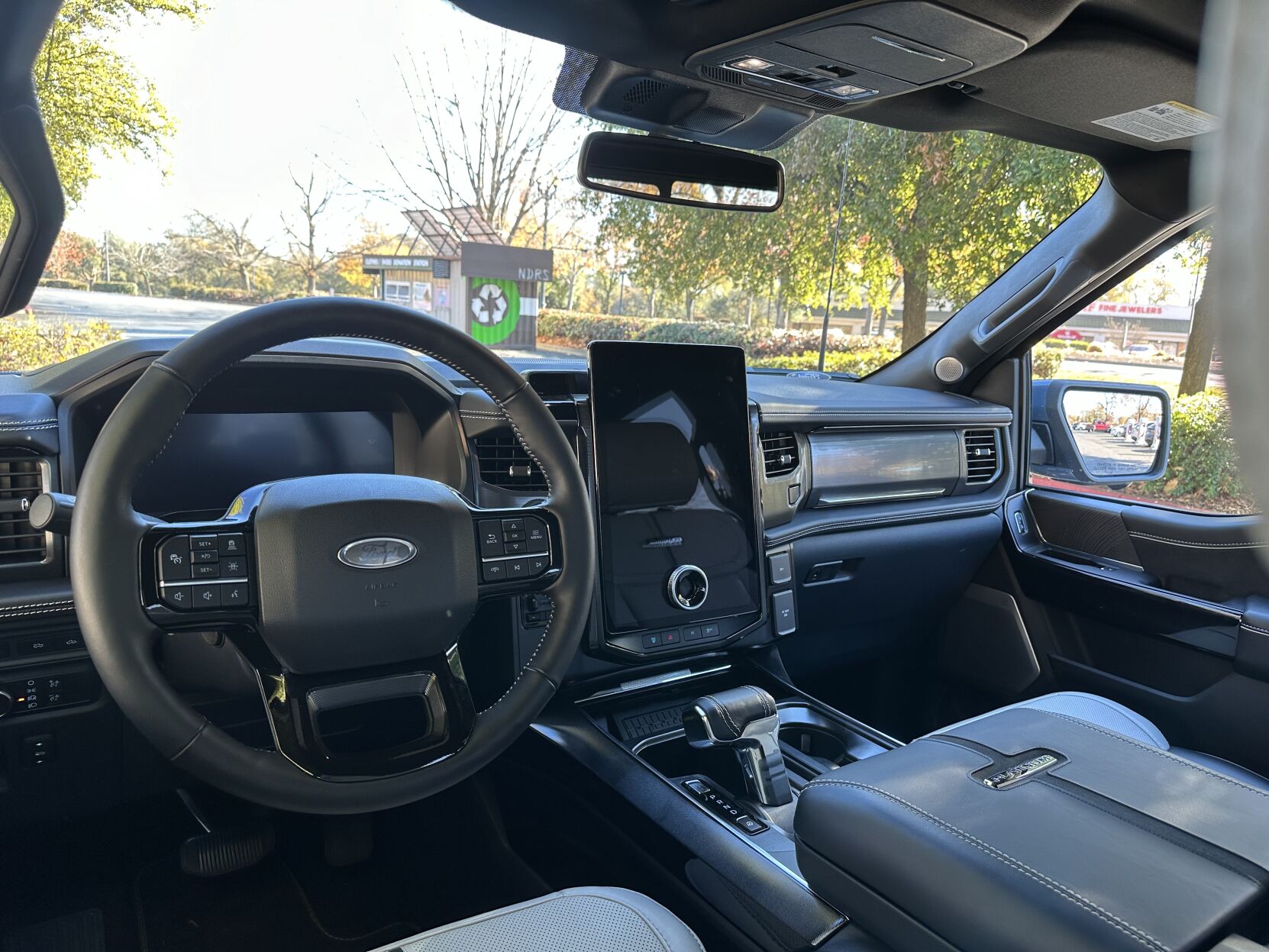
There are two versions of the Lightning. One gets an EPA-estimated 230 miles range from a single charge, the other 320. Not that there aren’t issues. Owners and journalists who load up the bed or try to tow something — an empty trailer — have learned that range plummets. There’s work for the engineers to do.
And then, of course, there’s the price. The base price, including destination, of a 2023 Ford F-150 Lightning 4X4 Platinum SuperCrew is $98,669 — almost $28,000 more than the base price of a gasoline-powered F-150 4X4 Platinum SuperCrew.
Our F-150 Lightning had an extra-cost Azure Gray metallic paint ($795) and a spray-in bedliner ($595). But that was offset by four deletions that were apparently hangovers from the supply chain crisis — $650 off for the lack of an onboard scale and smart hitch, minus $1,295 for a missing Ford Charge Station Pro, $300 knocked off for lack of multicontour seats and $140 refunded because the steering wheel wasn’t heated.
Bottom line on the window sticker: $97,674.
If the truck had come with everything it was supposed to, it would have been $100,059.
With that price tag and its inability to do trucky things without significant range loss, the Ford F-150 Lightning clearly has its specific headwinds.
Regular readers know I’ve been optimistic about the transition to EVs and, until recently, had good experience with the charging infrastructure. But there’s been a degradation there. It isn’t what it was — and it’s letting us all down.
Access to the Supercharger network for drivers of EVs made by companies who’ve secured that deal beginning this year can’t come soon enough.
Mike Hagerty, past vice president of membership for Western Automotive Journalists (waj.org), has been writing about cars since 1997. Read more of his reviews at (MikeHagertyCars.com) and follow him on X, formerly known as Twitter (twitter.com/mikehagertycars).