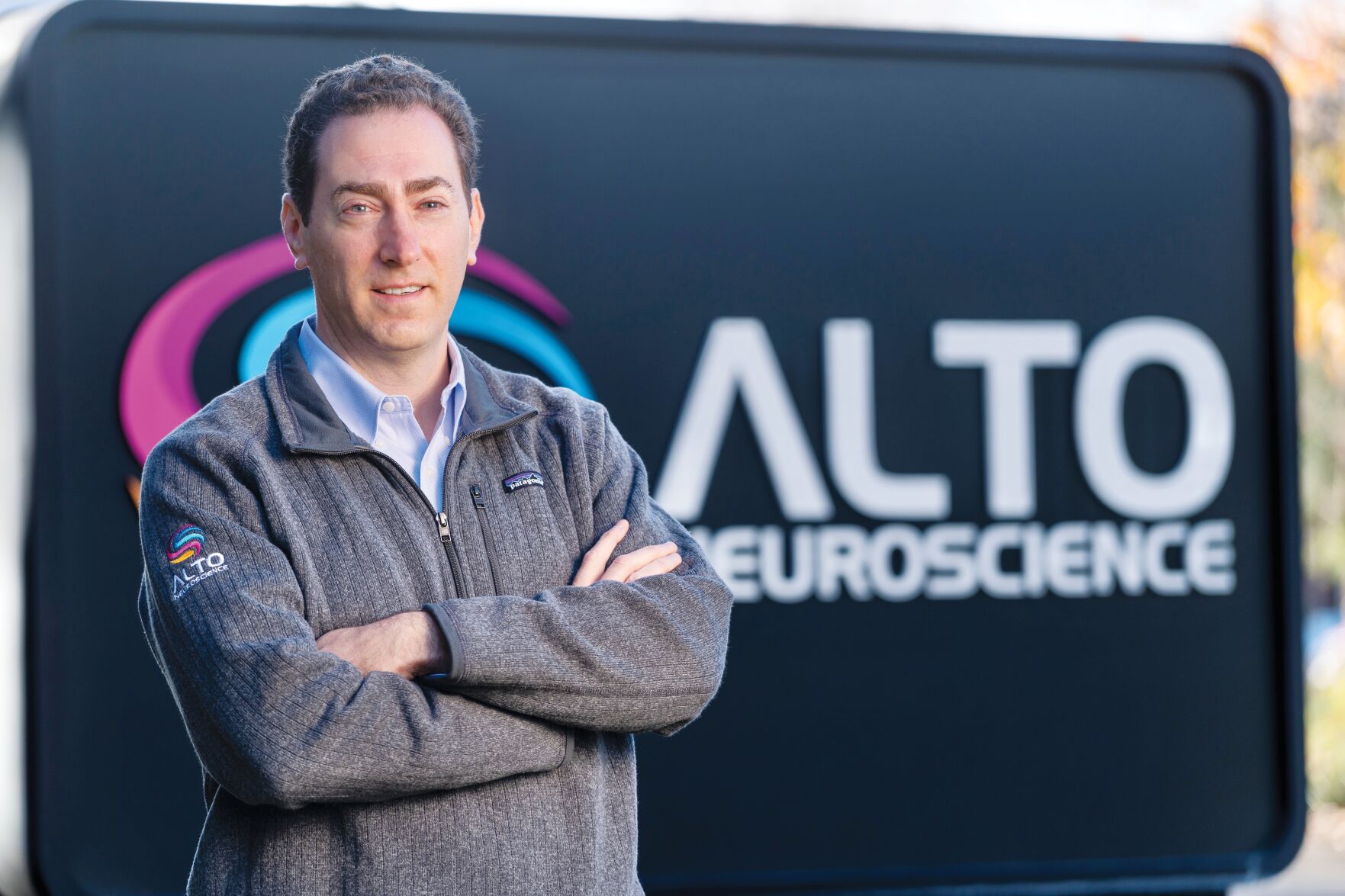
If you’ve driven down San Antonio Road across from downtown Los Altos, you’ve likely seen a sign that reads “Alto Neuroscience.”
But what you don’t see is that within the unassuming brown building, psychiatrist and neuroscientist Dr. Amit Etkin and his team are developing a system to accurately treat people suffering from mental health conditions.
“As a psychiatrist, you understand very acutely the frustration of not finding the right treatment,” Etkin said. “As a patient, the need for something new is paramount.”
Etkin explained that people with the same psychiatric disorder can respond differently to the same treatment. Because of this, traditional psychiatry operates through a trial-and-error approach, where patients are prescribed drugs until finally one works. However, this approach prolongs personal suffering, and patients may give up before the proper drug is prescribed.
How can the problem be solved? Etkin and his team developed an artificial intelligence-enabled biomarker platform that matches biomarkers in patients’ brains with the correct drugs. Therefore, a patient displaying a particular biomarker can be matched with a particular drug.
“Our clinical timelines and stages are such that within the next few years, I think we’ll have some pretty good answers, and a few years after that, some drugs on the market,” Etkin said. “It’s no longer like a science project. It’s really a high-impact company looking to change a really big sector of health care and of just how people experience the world around mental health.”
Reaching new heights
Etkin always knew he wanted to be a scientist. As a 10-year-old, he idolized Albert Einstein and was fascinated by thought experiments. After earning his medical degree and doctorate, he became a professor at Stanford University, running a lab focused on determining why people with the same psychiatric disorder respond differently to the same drug.
But he wanted to solve problems, not just write about them.
“When you’re in a university and publishing papers, you’re doing basic science – you don’t really know how true and important the work that you’re doing is,” Etkin said. “But applied science is where you’re trying to solve real problems – that’s really where the impact is to be had.”
He left Stanford in 2019 to start Alto Neuroscience, naming it after both Palo Alto and Los Altos – Palo Alto for its Stanford origin and Los Altos for its location. The word “Alto,” Latin for “high,” also symbolizes the company’s goal of hitting the heights of bringing science to impact.
Now, over three years later, Alto Neuroscience comprises a team of
approximately 60 people, has raised $100 million to date and is conducting mid- and late-stage clinical trials.
“This is a shift in how we think about psychiatric disorders,” Etkin said. “We’re no longer just talking about symptoms. Now, we’re diagnosing you as having a particular type of brain process of interest for a drug. It becomes, ‘Here’s what’s going on in my brain; here’s why I’m taking this medication.’ I think that changes a lot – that changes stigma, that changes the desire of people to engage with and maintain in treatment.”
So now when you drive down San Antonio and see the “Alto Neuroscience” sign, just know that like mental health, there’s more inside than what you can see.
“We’ve really enjoyed being part of this community, and hopefully people are proud of us as a Los Altos company,” Etkin said.
For more information on Alto Neuroscience, visit altoneuroscience.com.