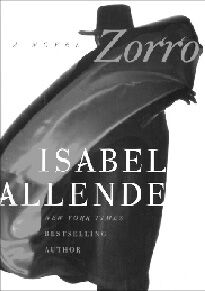
Ladies, if you can read “Zorro,” by Isabel Allende (HarperCollins, 2005), without growing fond of Zorro, you should see your cardiologist for a checkup. Never has an action hero been so playfully, sweetly, heroically imagined.
Gentlemen, if you like swashbuckling adventure stories, you may or may not like Allende’s “Zorro.” It depends on your tolerance for extensive character development.
Allende is, after all, a serious literary author; developing character is her job. We learn the life history of almost every person in the book who has a speaking part. Mercifully, when characters reappear many chapters after their introduction, we are reminded who they are.
There is plenty of swashbuckling – swordfights, a duel, daring rescues, pirate attacks and a wonderful sequence with a bear. And Zorro never fails to fight on the side of justice.
Although Zorro and the main characters are fictional, the action takes place against a backdrop of apparently well researched history.
Allende provides astonishing details of everyday life in the late 1700s and early 1800s, but she is a novelist, not a journalist – she probably invented some of her “facts.”
She became famous for writing magical realism, in the vein of Nobel Prize-winning Gabriel Garcia Marquez. A realistic story suddenly turns fantastical, which can be annoying for readers mired in reality.
There is no magic in “Zorro.” It’s fiction, but possible fiction, never defying the laws of physics. (Allende is disparaged by some serious scholars of Latin literature for being a popularizer of magical realism because she writes bestsellers.)
The original Zorro story, a pulp-fiction magazine invention of Johnston McCulley, appeared in the early 1900s, making Zorro (Diego de la Vega by day) the first superhero with dual identities, before Superman or Batman. Subsequent movies and a TV show developed the legend of a Hispanic nobleman who fought (in disguise) for the poor and disadvantaged in the Spanish colonial days of early California.
Allende’s Zorro is the California-born son of a Spanish aristocrat (male) and a ferocious Native American rebellion leader (female). The book follows him from his birth in 1795 through his youth and coming of age.
The heirs to the rights to the Zorro story asked her to write the book. Now a resident of Marin County, Allende, the niece of Salvador Allende, the former liberal president of Chile, was raised in that country. Her social consciousness enlivens and enriches Zorro’s quest.
Allende, the author of several best-selling, critically acclaimed books, is a natural, spellbinding storyteller.
This is a book that makes you crave more time to read. It’s not really a page-turner, or a can’t-put-down, but it’s deeply, richly good. You miss it when it’s done.
On the other hand: Do you have a friend who is a fabulous storyteller? You love to listen to the stories, but do you sometimes secretly wish that your friend would just get to the point?
“Zorro” is a great book, but there might be a few places where you think, “This is too much information.”
Even so, time spent with a great storyteller is time well spent.