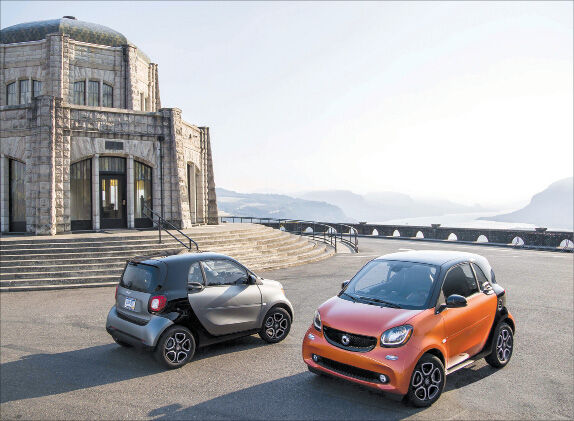
The Smart Fortwo is at the low end of the affordability scale for a practical, energy-efficient car that can be used primarily for local transportation.
It’s been largely redesigned and re-engineered for 2016 by Mercedes-Benz Cars. The car sells for under $20,000 fully equipped.
The penalty for being first to market with a new concept is that other manufacturers follow with similar designs that fix the problems with the original concept. Such was the case with the Smart, the first production version of a half-sized, two-passenger urban vehicle introduced by Mercedes in 1998.
However, as we recently discovered on a 150-mile scavenger hunt through Portland, Ore., and the surrounding region (Did you know that there’s an iPhone app for scavenger-hunt parties?), the 2016 version has corrected many of the car’s earlier shortcomings.
The major changes are in the engine and transmission, though they’re still tucked discreetly under the cargo shelf behind the seats and drive the rear wheels. The 898cc engine (co-developed with Renault) still has only three cylinders but now produces 89 horsepower and 100 pound-feet of torque – an improvement of approximately 25 percent.
That torque will push the car from a stop to 60 mph in a respectable 10.1 seconds with the new five-speed manual transmission. A thoroughly modern six-speed dual clutch automatic transmission (a $590 alternative) still managed to get to this speed in 10.5 seconds. The added torque had another benefit. An extended climb up a long, steep grade to a lookout point above the Columbia River was no problem at all for this trendy urban utility vehicle.
The new engine also addresses a significant sore point in the earlier engine – gas mileage. The current version delivers a respectable 36 mpg in combined city and highway use, an improvement over the older edition.
The Smart has been extensively and attractively restyled within its distinctive Tridion safety cell exoskeleton, with rounded corners and even a slight hood that meets European pedestrian-collision standards.
Chassis refinements not only make the car more stable, but also allow it to do a 360-degree turn within a circle less than 23 feet in radius. Once we got used to that capability, it made correction of wrong turns on narrow side streets on our scavenger hunt not only easy, but also entertaining for us and those walking by.
An extended list of safety systems has been borrowed from Mercedes-Benz (division of Daimler AG). Perhaps the most useful – from an unlikely source – is the crosswind assist developed for the Sprinter vans. When we took to the highway by the Columbia River, we were pleased to see that the car didn’t wobble like its predecessor, even when passing big trucks.
Allowing customers to select the exact image they wish to project, the Smart will be available in four trim levels. The base Pure version is priced at $15,400, plus dealer preparation. The Passion adds $1,490 to the price for heated mirrors, interior color choices and a cargo cover. The Prime model adds $2,480 to the Pure price and begins to look like a real Mercedes on the inside, with heated leather seats and a panoramic sunroof. And for that hipster feel, at a price $3,830 above the Pure, the Proxy features a postmodern white exterior with a blue interior, JBL sound system and 16-inch wheels.
The new gas Smart will be on sale later this fall. The previous generation all-electric Smart will be sold for another year or so, but we expect the redesigned version to be electrified by the end of 2016.