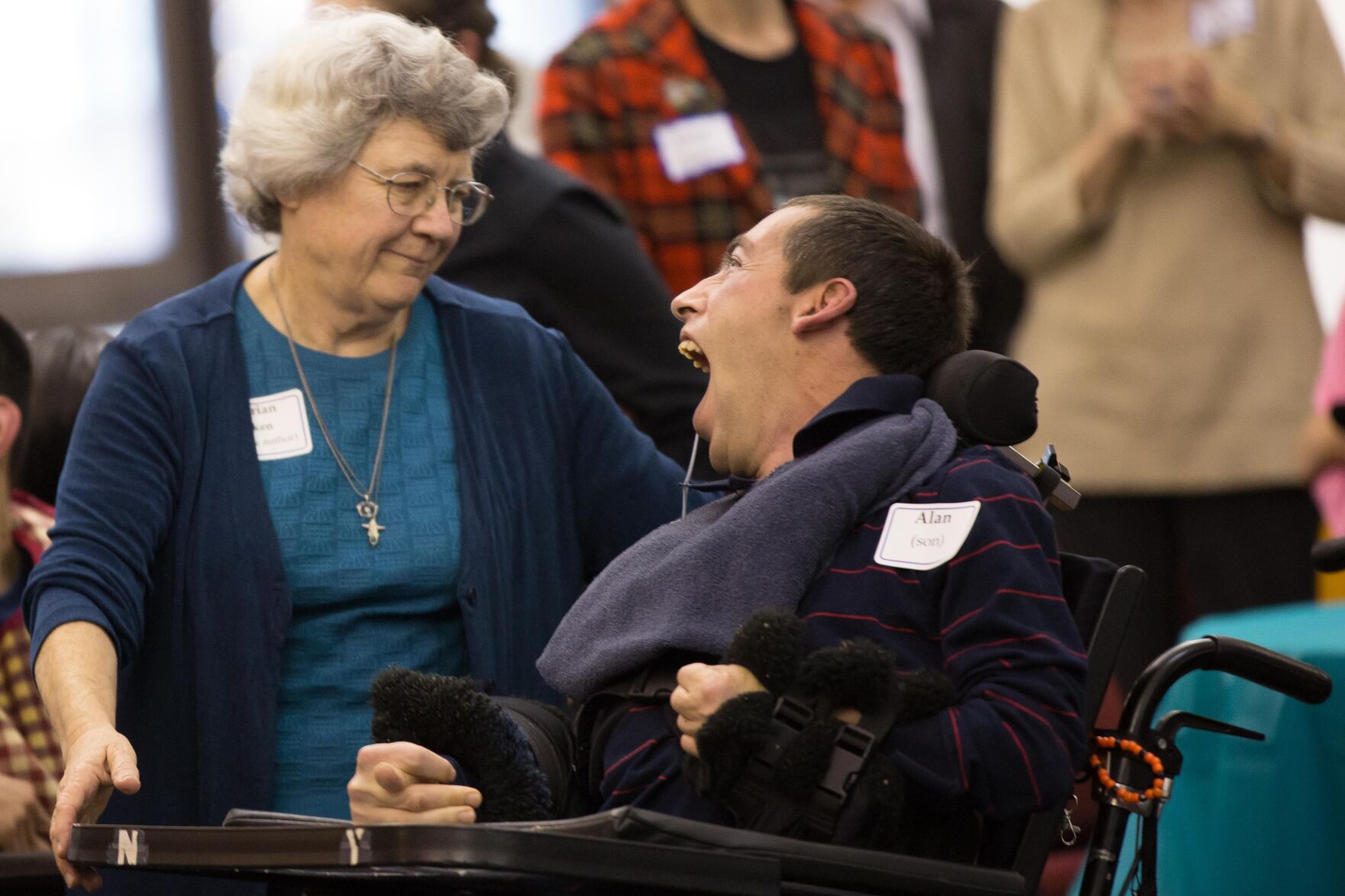
Los Altos resident Marian Aiken’s lifelong commitment to providing a secure home for foster and adopted children with physical disabilities began the minute she signed “I love you” to baby Derek and chose to give him a chance.
Like any new parent, Aiken was overwhelmed with happiness and anxiety when she welcomed her first child into her life in 1979. As Aiken cradled Derek – who was deaf and terminally ill – in her arms, a connection sparked.
During the 35 years to follow, she has welcomed 26 more adopted and foster boys into her home. Aiken stopped adopting children five years ago. If it weren’t for the physical toll that years of caregiving took, she might be a mom to even more children.
To help her transition into a new phase of life, she wrote a book about adopting Derek – “Derek: A Story of Acceptance, Love and Advocacy for Children Living with Special Needs” (CreateSpace, 2014), available on Amazon.
Although Aiken is a humble woman, she noted that exposing her vulnerabilities in her memoir is worth the risk if “it shows people that these children are worth something and that they have a reason to be on earth.”
‘A gift within me that blossomed’
Before adopting Derek, Aiken had no experience working with physically challenged or nonverbal kids. In her early career as an educator at the West Virginia School for the Deaf, however, Aiken interacted with many children – including some foster youth – who thrived at boarding school but returned home to families that could not communicate with them. The experience strengthened her desire to adopt.
“For whatever reason, there was a gift within me that blossomed,” she said. “It’s not something I learned or was taught.”
As a young, unmarried deaf woman, Aiken wondered whether she would be able to provide all the support Derek and her other adopted children needed.
Despite her insecurities and the medical problems Derek faced in his first months with Aiken, she forged ahead with the adoption. Although Derek passed away as a teen, he brought infinite joy to Aiken’s life.
Challenges others might characterize as burdens Aiken saw simply as symbols of parental love.
“Derek was not a burden, but my first son, my companion and a sibling to my other sons,” writes Aiken in her book. “Can’t you see beyond the oxygen tank, the wheelchair, the labored breathing and the spastic limbs? … Derek had not been able to do many things, but I focused on the things he could do and the love he received and gave in return.”
Potential in every child
Aiken credits her hearing impairment with helping her see things other people overlook, a skill that enables her to bond with physically challenged children. Her heart made space for each child she brought into her life – they were not numbers, but individual lives.
It’s easier to adopt to boys because girls find homes faster. Once Aiken had Derek, it was also cheaper – clothing- and equipment-wise – to stick with boys.
All but three of Aiken’s 27 adopted and foster sons show physical or orthopedic impairments, so caring for them has not been easy. After losing Derek and other children to their illnesses, Aiken continued to open her home to severely disabled boys with nowhere else to go.
As a mother and an advocate, she found ways to empower her sons to discover their unique skills and abilities.
“Although a lot of them have cerebral palsy and are in wheelchairs, they each have personalities, and the way you communicate with them is different,” said Aiken of overcoming the physical, emotional and intellectual challenges her children confront to find a way to connect with them.
When doctors told Aiken that Derek would never be able to communicate, she insisted that she saw and felt more. Aiken deciphered Derek’s expressions and understood his personality.
“Some of them did stuff I didn’t think they could do,” she said of her sons. “If someone doesn’t have arms and wants to flip an egg, you think, ‘They can’t do it,’ but they find a way.”
It was difficult for Aiken to let go and even more difficult to convince teachers to see beyond her sons’ physical challenges to foster their potential. Despite the stares and stereotyping they have received, some of her sons went on to work, drive cars and start families.
“Some of them go out in public, and they have a lot of courage to go out and face society,” Aiken said with pride.
According to Aiken, caring for a houseful of boys was a far cry from caring for roses. Loading wheelchairs into a van and responding to the boys’ physical and emotional demands tested her patience and physical strength.
“A lot of the boys had built-in anger issues when they arrived,” she said, citing bonding problems that some boys faced due to organic brain damage from drug or alcohol exposure when they were in utero. “Some bonded more than others. … I’m not going to say that they all like me.”
Being able to take her hearing aids out at home helped her separate herself from the chaos one might find within any family. She hasn’t always endorsed her sons’ behaviors, nor does she enjoy the sound of video games and the occasional burst of profanity.
“If I weren’t deaf, I wouldn’t be able to live in this house,” she joked. “It’s a big advantage not to hear everything going on.”
Finding balance
With seven adult children still living with her – four who require full physical care – Aiken keeps busy but tries to find balance through other endeavors.
Part therapy, part business, Aiken designs and sews custom wheelchair bags, table runners, iPhone and iPad cases, aprons and even tooth-fairy pillows for clients. She also makes pillowcase dresses for orphans in Africa through her church.
In addition to being a full-time caregiver, she tutors beginning American Sign Language students. Although most of her sons’ medical expenses are covered by insurance, the supplementary income helps her afford better-quality equipment for her boys. A wheelchair with an elevator with tilt was among her recent purchases.
Neighbors and friends at Los Altos United Methodist Church provide support to Aiken and her family. When her van caught fire, her church family bought them a new vehicle. The church established a fund for house repairs or special medical needs not covered by insurance.
“I just try to live a life and hope other people can see the positives,” Aiken said.
Being a mother to 27 boys may seem like an incredible feat, but Aiken insists that she is simply living by example. Whether or not her experience inspires people to adopt, Aiken would be happy if her story encourages others to show more empathy toward people with disabilities.
“If anybody would say, ‘OK, maybe I can do that, I’ll give it a try, I’ll give a child a home,’ then a child finds a home,” she said. “It doesn’t matter how complex the situations are, there is almost always someone out there who can help that kid in some way.”
For more information, visit marianaiken.com. ✦
Mariam Aiken writes book about adopted sons
Photos by Ellie Van Houtte/Town Crier