The Mexican army’s victory over the French at the Battle of Puebla May 5, 1862, has become, particularly in Puebla and the United States, an occasion for vibrant Cinco de Mayo parties, bursting with song, dance, flavorful foods and the bold color of spring flowers.
Often, at the center of this joyful commotion, amid the chilaquiles, guacamole and agua frescas, a cool flan luxuriates under its cape of golden caramel.
Flan is a plain dessert, more understated than Tres Leches Cake, but still rich, like buttery, powdered-sugar-dusted Mexican tea cakes. It’s a staple in Spanish-speaking countries. But perhaps if the Mexican militia hadn’t outdone Napoleon III’s army in Puebla in 1862, we would be eating a different kind of flan in America today.
Though they share the same word origins, the flans of France and Mexico place them in different culinary as well as military camps.
The word can be traced to the Old French “flaon,” which comes from Latin and essentially designates custard. The Greeks were familiar with custards consisting of eggs and milk, often sweetened with honey. The Romans cooked them in shallow open dishes called “patinas.” In Spain and Portugal – and, via culinary and cultural influence, in most Spanish-speaking countries – flan has remained just such a custard.
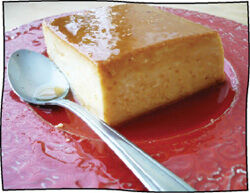
Rich with eggs and cream, lightly flavored with vanilla and sweetened with sugar or thick syrupy ribbons of sweetened condensed milk, flan is firm, smooth and silky. Making flan begins with the delicate task of swirling sugar in a saucepan until it turns amber, then coating a dish with this caramel before pouring in the eggs and milk to bake. Once the flan has cooled and been inverted carefully onto a plate, the caramel drips tantalizingly down its flanks.
In France, this dessert has another name: crème caramel. “Flan” means something slightly different to the French. French “flan patissier” is essentially a custard tart in a thin puff pastry crust. With fewer eggs, a lighter milk base (often thickened with a bit of cornstarch), its texture is more like panna cotta, not as rich and silky as crème caramel (Mexican flan). The most common variation boasts deep-red cherries embedded in the custard, their pink juice forming rosy aureoles around them. Bakers sell their flan tart in hefty slices, and it’s a classic after-school treat for children. But it’s not what we’re serving on Cinco de Mayo.
Like the meaning of “flan,” the Battle of Puebla’s outcome was ultimately less straightforward than one might expect. General Zaragoza’s victory over the French only held off the Europeans for a year. It wasn’t long before they returned to capture Mexico City and install their own Archduke Maximilian of Austria, a favorite of Napoleon III.
But, as a food, flan is beautifully simple.
Eve Hill- Agnus teaches English and journalism and is a freelance writer. Her interest in specialty pastries is influenced by her French roots. Contact her at [email protected].