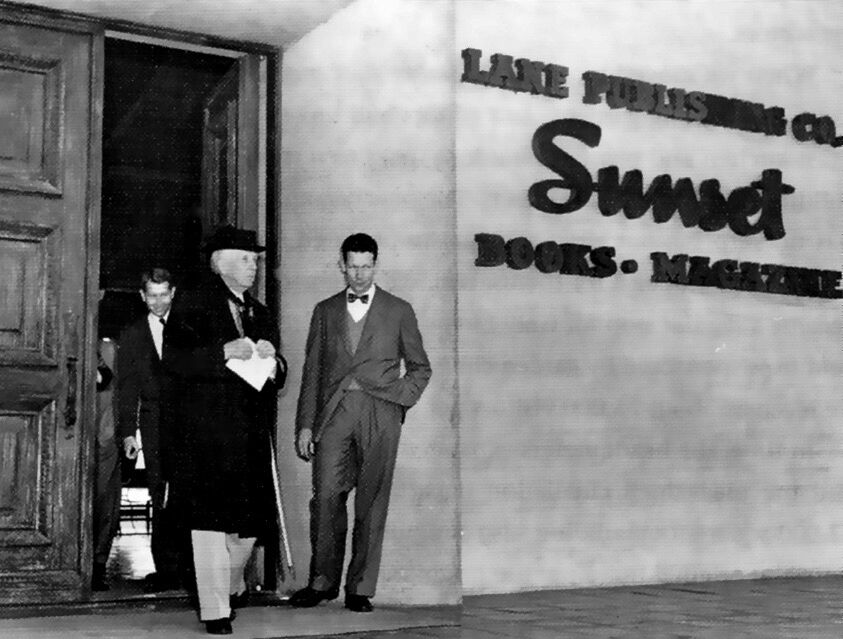
Frank Lloyd Wright was nearly 87 years old when he came to speak at Stanford University in February 1954, though he fudged a bit and told reporters he was 84. He was candid, however, about the architecture he saw, which he called, “a confused mass of disassociated buildings in a bastard style of architecture.”
Then he toured the new headquarters of Sunset magazine in Menlo Park and cheered up.
“Sunset magazine is the best building I’ve seen all day,” he said.
The Mission Revival Sunset building opened in 1951 and was nestled within 7 acres of gardens. Over the more than 50 years it served as the magazine’s headquarters, it attracted millions of visitors. In 2014, Time Inc., which had acquired Sunset in 1990, sold the property to investors to generate cash. Today, with land values soaring and a mandate from Sacramento for California cities to build more housing, the famous building at 80 Willow Road faces two proposals for dense redevelopment.
Local resident B.J. Sorensen stopped by Sunset’s headquarters one day in the 1950s looking for a part-time job and ended up with a career there as one of its best-known tour guides.
“I was devastated when I heard it might be demolished,” she said.
Today, Sorensen, 95, lives in a sunny home at the Sequoias Portola Valley.
“The Sunset headquarters was beautiful. Thinking it might be gone forever brought tears to my eyes,” she said, touching her fingers to her face and making a motion like teardrops falling as she spoke.
Also among the guides was Julie Lane-Gay, daughter of Mel Lane and niece of Bill Lane, who inherited the magazine from their father.
Lane-Gay said she began helping out on tours and in the Sunset kitchen during her school days.
“I had tremendous parents,” she said. “But honestly the magazine was the best family member of all. And the headquarters? You don’t see beautiful spaces like that anymore. To think of destroying that history is heartbreaking.”
The Sunset site is swathed in layers of California history. Indigenous people appear to have lived along San Francisquito Creek, at the edge of the property. Later, the land was part of Rancho de la Pulgas, a grant to Don Jose Dario Arguello, Spanish governor of Alta California in 1815.
The land subsequently was part of an estate owned by Mark Hopkins, one of the Big Four who built the Central Pacific Railroad over Donner Pass to link up with the Union Pacific and complete the first transcontinental railroad.
Coincidentally, Sunset magazine was started by the Southern Pacific in 1898 to encourage travel to the West. Purchased by the Lane family in 1929, it was the Lanes who built the ranch-style structure and moved Sunset to the historical spot in Menlo Park in 1951. In 1966, the California Mission Trails Association presented Sunset with a Mission Bell Marker as part of CMTA’s program to promote touring along the old route used by the first Spanish-speaking immigrants to California. The marker, which still stands today, is dedicated to Sunset: “In appreciation of outstanding service in preserving the historic and cultural traditions of the mission trails area since 1898.”
Later, the landscape at the site, designed by Thomas Church and featuring flora from 32 different Western climate zones, won first prize in a U.S. Library of Congress Historic American Landscape Survey.
Now it is up to the city of Menlo Park to determine the future of this piece of our region’s history.
Lane-Gay let out a sigh as she pondered the future.
“I think we’re losing the sense of what it is to live and work in the West,” she said. “We keep tearing down beautiful things, and you just don’t get those back.”
Robin Chapman is a Los Altos native, journalist and author of “The Valley of Heart’s Delight: True Tales from Around the Bay,” published in 2022 by The History Press.