Regular readers will remember my singing the praises of the Volvo V60 (“On the Road,” November 2024). Tragically, Volvo has discontinued one of the last remaining station wagons for sale in America. 2025 was its last model year.
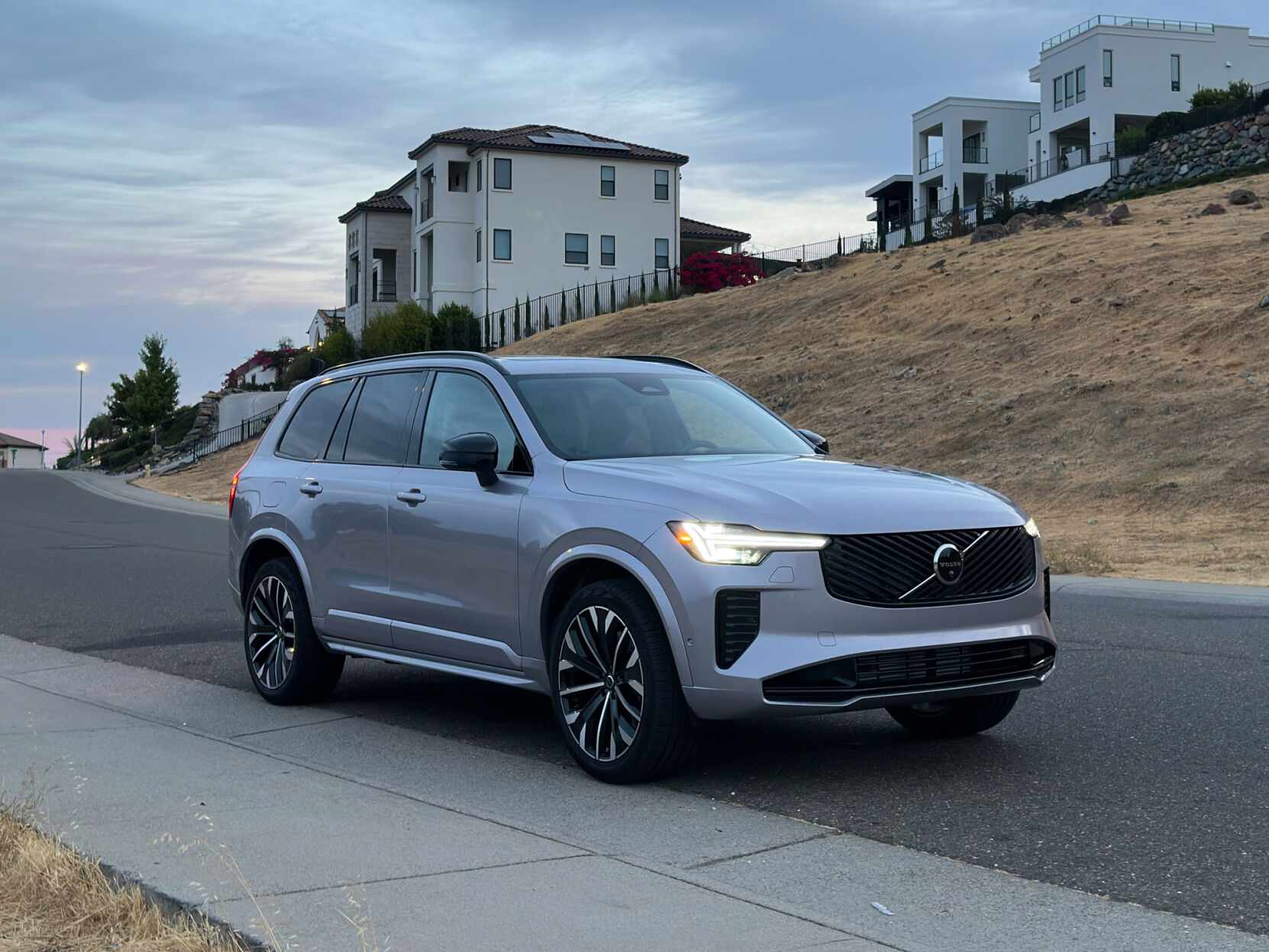
Fortunately, Volvo has made a really good SUV, the Volvo XC90, even better. For 23 years, the XC90 has not just been the thinking person’s premium SUV; it has inspired other automakers.
Whether or not you believe in trickle-down economics, there absolutely is such a thing as trickle-down automotives. The Kia Telluride (“On the Road,” February 2020) would not be here in its current form if there weren’t an XC90 for the Koreans to benchmark.
The changes to the XC90 are subtle in some ways – exterior styling, for example. The new one has a sleeker, more skillfully integrated front grille and headlamps. The interior has had a major revision, with a larger, more robust vehicle display in front of the driver and a larger touchscreen.
This is where I should mention that I have been very critical of Volvo when it comes to its touchscreens. If you’re of a certain age, you’ll remember that most of Volvo’s image centered around safety. In the ’80s, TV commercials showed them being driven off the roofs of multi-story buildings and landing on their nose to demonstrate just how protected the passenger compartments were.
So, I would expect Volvo to resist anything that compromised safety – especially something that required drivers to take their eyes off the road. But Volvo’s first generation of touchscreens was among the most complicated, most time-consuming systems on the market – and to make it worse, they put almost every vehicle function in the screen.
The new screen in the XC90 still has too many functions within, but the layout is now redesigned to reduce the number of clicks and to eliminate scrolling. It’s a massive improvement.
While there is a purely gasoline-powered XC90 (actually a mild hybrid where the electricity is used more for performance than fuel economy), I drove the XC90 T8 AWD, formerly known as the XC90 Recharge.
The XC90 T8 AWD is a plug-in hybrid, a technology I’m a fan of. In the case of the XC90 T8, if you charge it, you get 33 miles of pure electric range. If your daily driving is 33 miles or less and you plug it in when you get home, you can go indefinitely in electric mode – not a drop of gasoline, not a particle of pollutants from the tailpipe. You can double that to 66 if you can charge at work or while you shop.
But if you drive farther, once that juice is used up, you have a gasoline/electric hybrid to take you as far as you want or need to go. With the XC90 T8’s fuel tank capacity of 18.8 gallons and an EPA-estimated combined city/highway fuel economy of 27 miles per gallon, that’s 507 miles, plus that first 33 on electricity, for a total of 540.
For all that environmental consciousness, this Swedish SUV has the heart of a muscle car. The total system output is 455 horsepower and 523 lb-ft of torque. Zero to 60 happens in just 4.5 seconds.
The third row is best left for kids, with only 31.9 inches of legroom, but second-row passengers can stretch out with 37 inches. Cargo capacity is a smallish 12.6 cubic feet behind the third row, but if you fold that, it’s 37.4.
The base price of the 2026 Volvo XC90 T8 AWD is $83,400 ($84,695 including destination), and that includes a long list of standard features including all-wheel-drive, 21-inch wheels, a four-year subscription to Volvo’s Digital Services Package including Google Built-In with Google Maps, Google Play Store and Google Assistant, Volvo Remote App Services including remote start and remote lock/unlock, Apple CarPlay, a trial subscription to SiriusXM satellite radio, a Harman Kardon premium audio system, wireless device charging, a laminated panoramic sunroof with power sunshade, Nappa leather seating surfaces, heated and ventilated front seats, heated rear seats, four-zone automatic climate control, a heated steering wheel, an Orrefors crystal gear shifter, head-up display, laminated side glass, rear door sunblinds, front seat passenger memory and power cushion extension and a comprehensive suite of active safety features.
The one I drove also had an active chassis with air suspension ($1,800) and a Bowers & Wilkins premium sound system ($3,200), so the final tab came to $89,695.
I hate to repeat what I’ve said many times about premium vehicles and premium pricing, but it applies. That near-$90,000 price tag will start to make sense to you the more time you spend with the XC90 T8 AWD.
Mike Hagerty, past vice president of membership for Western Automotive Journalists (waj.org), has been writing about cars since 1997. Read more of his reviews at MikeHagertyCars.com.