We live in a hyper-competitive world where car companies spend a lot of money on consumer research to identify weak spots in their vehicles and fix them in the next update.
Case in point: the Volkswagen Taos. VW was late to the subcompact SUV party four years ago with the Taos, which competes with vehicles like the Kia Niro (“On The Road,” February 2023), Subaru Crosstrek (“On The Road,” January 2018) and Honda HR-V (“On The Road,” September 2022).
Actually, let’s take a step back. The first Taos was supposed to compete with those vehicles. But it was an also-ran at best, hampered by what seemed like a giant Novocain injection. I don’t have a better way to describe it. The Taos just felt numb. You knew you were driving because you were holding a steering wheel, and stuff was going by out the windows, but that was the level of engagement.
There’s a type of isolation you can find in older luxury cars. This wasn’t that – it was more of a disconnect.
2025 brings what’s known as a mid-cycle refresh to the Taos. For most vehicles, that means the vehicle stays largely the same but gets some styling and interior tweaks. Fortunately, Volkswagen took a much more aggressive approach to freshening the Taos.
The engine remains a 1.5-liter turbocharged four-cylinder, but a lot of work’s been done on it – revised piston rings and fuel injectors, a modified turbo housing, a larger intercooler and a new gasoline particulate filter combine to provide a 16-horsepower boost to 174. A new eight-speed automatic replaces the previous seven-speed dual-clutch unit. Fuel economy remains a strong point at 31 mpg combined city/highway for front-wheel drive models (FWD) and 28 mpg combined for all-wheel-drive models (AWD).
Even in “Normal” driving mode, the Taos is more engaging and satisfying – “Sport” mode dials up some additional steering feedback, improves throttle response and provides more aggressive shifting. I’d be inclined to make “Sport” my default.
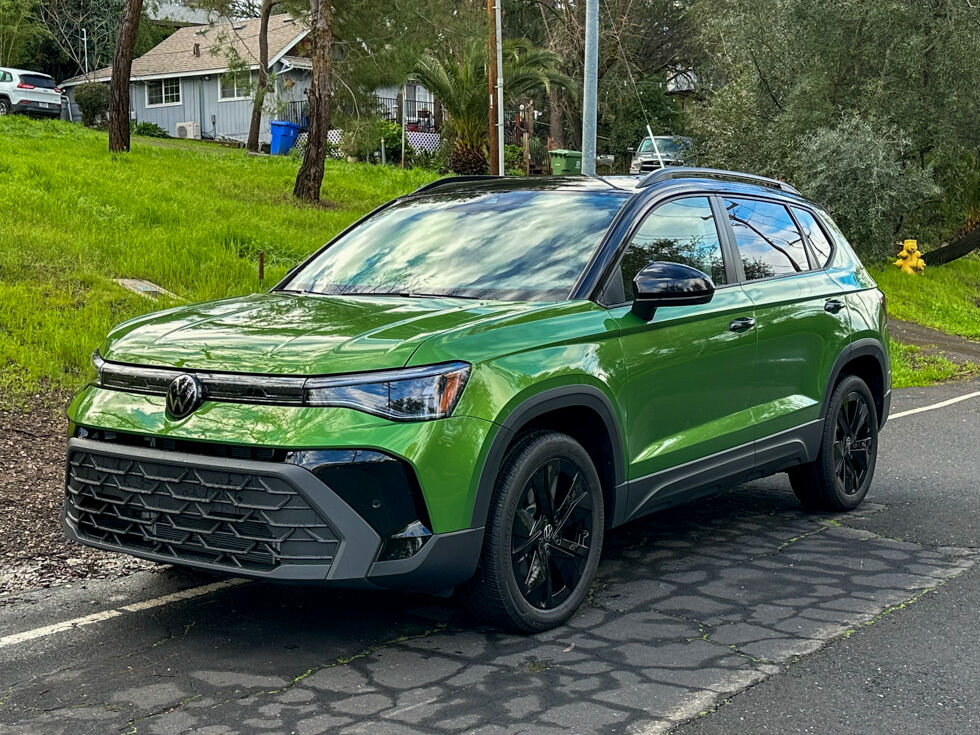
Beyond that, this is a typical refresh – exterior styling has been refined, with squared-off wheel arches and a character line that gives the Taos some perceived ruggedness. And the interior gets a redesigned instrument panel.
Taos’ pricing is attractive – with the base S model starting at $24,995 (without destination charges). From there, the ladder goes to SE, SE Black and SEL.
I drove the SE Black FWD, which is the same as the SE but with a black roof, exterior accents and wheels. The base price is $30,145 ($31,570 with destination charges). Standard at that price are 18-inch wheels, automatic LED headlights, daytime running lights and taillights, adaptive front lighting with dynamic cornering lights, a front grille with integrated light bar, heated, foldable, power-adjustable side mirrors, rain-sensing wipers with heated washer nozzles, a rear window washer and wiper, a power tilting and sliding panoramic sunroof, dual-zone climate control with second-row vents, a heated, leatherette-wrapped steering wheel, a tilting and telescoping steering column, heated front seats, a power driver’s seat, a 60/40 split-folding rear seat, illuminated vanity mirrors and reading lights, an illuminated, carpeted cargo area, keyless access, pushbutton start, remote start, a six-speaker sound system, wireless charging and a comprehensive suite of active safety features. The car was so well-equipped the only extra-cost option was the Bright Moss Green paint at $455, bringing the total as-tested price to $32,025.
Bravo to VW for recognizing room for improvement in the Taos. It’s now a solid contender among subcompact SUVs.
Mike Hagerty, past vice president of membership for Western Automotive Journalists (waj.org), has been writing about cars since 1997. Read more of his reviews at MikeHagertyCars.com.