Another month, and another California electric vehicle that isn’t a Tesla.
Last month, we featured Newark’s own Lucid Air Pure (“On The Road,” April 2025), and now we have the Irvine-based Rivian (with a significant presence just up the street in Palo Alto).
While Lucid makes sedans (with an SUV, the Gravity, on the way), Rivian makes what it calls “adventure vehicles.” So far, there’s an SUV and a pickup, the R1T.
Electric pickups are a diverse group, including the fairly conventional-looking Ford F-150 Lightning (“On The Road,” February 2024), the slightly edgier Chevrolet Silverado EV and GMC Sierra EV, the out-there GMC Hummer EV Pickup, and the – let’s call it “Origami Frigidaire vibe” – of the Tesla Cybertruck.
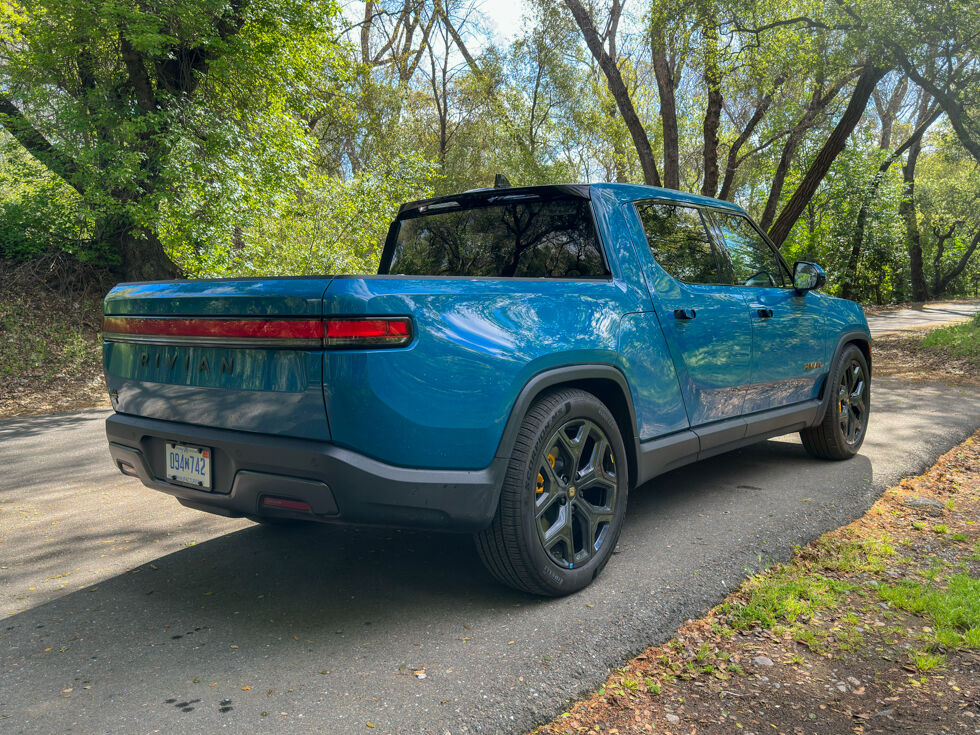
Where the Cybertruck is all edges and angles, the Rivian R1T is all about smoothness with rounded corners and oval headlights. It’s completely counter to the current “my truck wants to eat your house” design language of pickup trucks, but the effect is more unique than alien.
If the sleekness of the R1T suggests speed, that is intentional. Even the least powerful Rivian R1T (the Dual Standard) has 533 horsepower. That’s good for 0-60 in just 4.5 seconds, which rivals the hottest 1960s muscle cars.
Again – that’s the least powerful R1T. Our test vehicle is the 2025 Rivian R1T Tri Max, with three electric motors, 850 horsepower and 0-60 times of 2.9 seconds.
That is one-tenth of a second quicker to 60 than the quickest car I’ve reviewed (until now) here at the Town Crier, the Mercedes-AMG EQS (“On The Road,” January 2023), which did it in 3.0. That Benz had an EPA-estimated range per charge of 277 miles.
The R1T Tri Max? 371 miles, making it a stellar candidate for roadtrips. When it comes time to recharge, a DC fast charger should take you from 10% to 80% in 30-41 minutes.
The maximum towing capacity is 11,000 pounds, which is substantial. We didn’t get a chance to try towing, but you should be aware that towing sharply reduces the range of any electric truck on the market – in some cases, by as much as half.
The rear bed is lockable, with a powered tonneau cover standard on the R1T Tri Max. Payload is 1,764 pounds. Between the bed and the front trunk (“frunk”), there is more than 68 cubic feet of storage, with 12 cubic feet of it in the front trunk (“frunk”).
A key card, looking somewhat like a luggage tag, replaces a physical key or key fob, but it can stay in your pocket. A Rivian smartphone app allows locking, unlocking and other features to be accessed via your phone.
The interior is at once tech-forward and traditional, with two big screens and (in the case of our test vehicle) brown ash wood. The lack of exterior styling gimmicks results in large expanses of glass all around, making visibility a Rivian strong suit.
The instrument display in front of the driver shows more than just speed, state of charge and remaining range. Its combination of 11 cameras, five radar sensors, 12 ultrasonic sensors and a driver-facing camera to monitor fatigue is there to provide Level 2 autonomy (vehicle assisting driver, with constant driver supervision). But even in normal, hands-on driving, the system provides valuable information about what’s around you – showing real-time animation of not just vehicles all around you in traffic but pedestrians on the sidewalk. It’s like watching infrared or heat-sensing video, but clear and beautifully rendered.
The center screen has a variety of vehicle functions, including off-road modes as well as the expected climate control, navigation and entertainment.
Rivian does not offer Apple CarPlay, which is usually a deal-killer for me. But what Rivian does is embed Apple Music, which is what I use for entertainment, into the audio system. Log in via your iPhone, and your entire Apple Music library – in fact, the entire Apple Music catalog – is accessible through the R1T’s killer premium audio system. It’s the same deal for other popular services, including Spotify, Tidal and Alexa.
Rivian’s pricing is extremely transparent, with trim levels added to the window sticker as though they were option packages. So, a Rivian R1T base price is $69,900 ($71,700 with destination). Max (the largest-capacity battery) adds $14,000. And the Tri-Motor AWD setup is $16,000.
We’ve just built an R1T Tri Max. That puts us at a price (including destination) of $101,700.
Standard at that price are air suspension, kinetic roll control, the Ascend interior trim, Rivian Gear Guard (a security system that protects your items while you’re away from the vehicle), perforated vegan leather seating, heated and ventilated seats, with driver and passenger lumbar adjustment, a heated steering wheel, a dynamic glass roof (clear glass that goes opaque at the touch of a button), a premium audio system, plaid floor mats, a utility panel and a powered tonneau cover for the truck bed.
The only extra-cost options on our vehicle were the Rivian Blue exterior paint ($2,500) and 22-inch wheels ($1,000), which gives us a final, as-tested price of $105,200.
About pricing: As I write this, tariffs have been introduced and then paused. The Rivian’s final assembly point is in the U.S. (Normal, Illinois), but some parts’ content may be affected.
Bottom line: I’m stunned. The Rivian R1T is a triumph. A gimmick-free yet unique American pickup truck that does the least possible damage to Mother Earth while still allowing go-fast, go-anywhere adventure.
Mike Hagerty, past vice president of membership for Western Automotive Journalists (waj.org), has been writing about cars since 1997. Read more of his reviews at MikeHagertyCars.com.