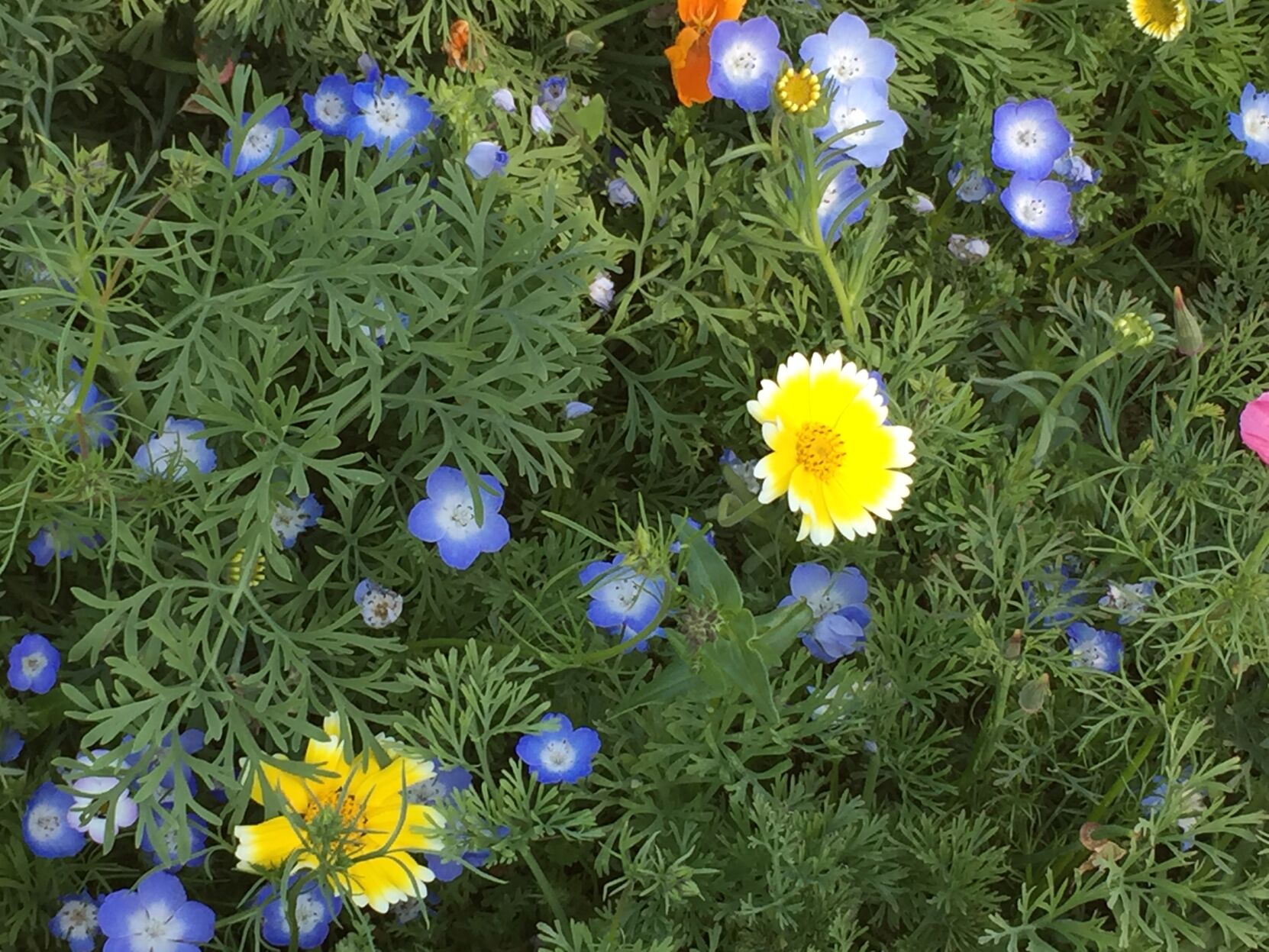
Little things run the world. In nature, the little things that run the world are dynamically balanced. With greater diversity comes a more finely tuned series of checks and balances and a healthier ecological system. A monoculture such as a lawn, or the use of pesticides, reduces diversity and can throw your local ecology out of whack. To bring things back toward balance, or simply to increase diversity, you can add native plants. Natives support the highest diversity of life, from the many caterpillars essential for feeding baby songbirds to the pollinators and other beneficial insects essential for flowers and edible crops. The ideal is a yard planted with at least half natives. But no planting is too small. Even a small container planted with natives can help, since it’s the little things that matter.
For the most colorful springtime flower show, plant native wildflower seeds. The beginning of the rainy season is the best time to sow many of these seeds, but the beginning of winter is not too late.
Many spring-blooming wildflowers are a manageable size, less than a foot high and wide. Wildflowers can fill the space between slower-growing trees or shrubs, add color to a meadow, or define path edges. You can sow them in place, or grow different varieties in 4-inch pots to be transplanted later.
In a container, use a well-draining potting mix. In the ground, choose a weed-free area, then rake them in and walk over the area for good seed-to-soil contact. Birds will eat unprotected seeds! If you are sowing packets of different wildflowers in the garden, it’s a good idea to sow a few seeds of each in small labeled containers so that you will be able to identify emerging seedlings.
Some choices are:
• Pink flowers: Farewell to Spring (Clarkia amoena) and other Clarkias.
• Blue flowers: Bird’s-Eye Gilia (Gilia tricolor), Globe Gilia (G. capitata), Baby Blue Eyes (Nemophila menziesii), Five-Spot (N. maculata), Desert Bluebells (Phacelia campanularia), Lupines, and Chinese Houses (Collinsia heterophylla).
• Yellow flowers: Tidy Tips (Layia platyglossa), Meadowfoam (Limnanthes douglasii), Goldfields (Lasthenia californica), Tufted poppy (Eschscholzia caespitosa) and the orange California poppy (E. californica). Tarweed (Madia elegans) and Sunflower (Helianthus annuus) are tall, robust plants that bloom from summer into fall.
Once the spring flowers set seed, you can leave the seeds for birds to eat, collect them to sow next fall, or if the area is not watered in the summer, let them fall to the ground to see if they flourish again the following year.
Reliable online seed sources for California native wildflowers are Larner Seeds (larnerseeds.com) and Theodore Payne Foundation (theodorepayne.org). For less-common varieties, try Seed Hunt (seedhunt.com) or the California collection at Nature’s Seed (naturesseed.com/california-seeds/). On other sites, such as Amazon, packets of “California wildflowers” often include nonnatives (scarlet flax, calendula and Shasta daisy, for example) that can dominate the mix and become weedy. Instead, look for “California native wildflowers” and carefully read the label.
Finally, the Santa Clara Valley chapter of the California Native Plant Society sometimes offers seeds or plants at the regular meetings (cnps-scv.org). Another alternative is to buy 4-inch pots of native wildflowers. You may be able to find native annuals in late winter to early spring at local nurseries, or at Linda Vista Natives in Saratoga; Yerba Buena Nursery in Half Moon Bay; or Richmond-based Curious Flora or Watershed Nursery.
Tanya Kucak gardens organically. You can reach her at [email protected].