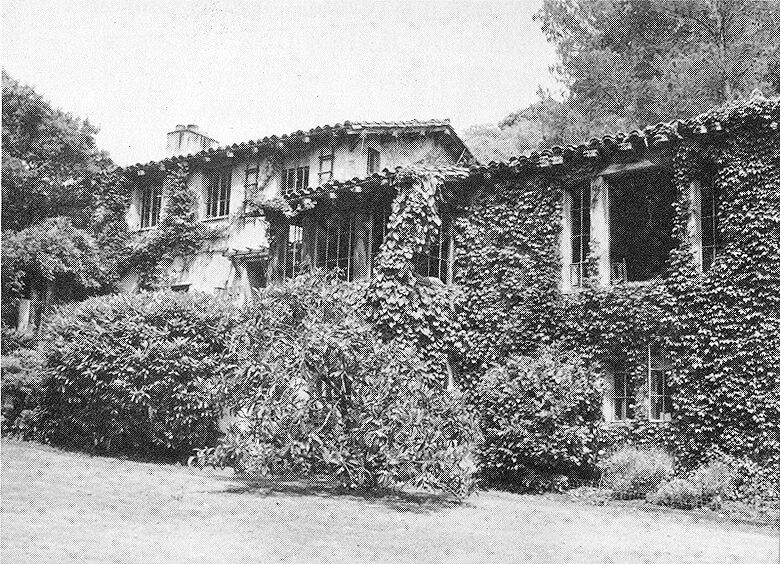
After Hidden Villa in Los Altos Hills canceled all of its summer camps due to an internal staffing crisis, public conversation quickly turned to the most visible manifestations of the conflict – tiles on the Duvenecks’ historical home that contain the symbol commonly known in the U.S. as a swastika.
Given its long history – it was used as a religious symbol for centuries and continues to be used as a symbol in Hinduism and Buddhism – the swastika and its various forms make for a polarizing subject. That’s especially true for the religious communities to which it represents either a symbol of hatred and genocide or a symbol of good luck and tranquility.
For Devon Matsumoto, who is active at the Mountain View Buddhist Temple and serves as president of The Young Buddhist Editorial, understanding the impact of a symbol and the context in each situation is critical.
“As a Buddhist organization, we are really keen on understanding how much, from the Buddhist perspective, our actions impact others, and being mindful of what is going on in various different situations,” Matsumoto said.
He advocates for evaluating the presence of swastikas, or manji as they’re called in his Japanese Buddhist tradition, on a case-by-case basis.
Codifying different meanings
State legislators recently weighed in on when and where such symbols are appropriate with updated language for hate-crimes legislation in Assembly Bill 2282. In crafting the bill, Hindu and Jewish advocates collaborated to differentiate the specific hate symbol, the Hakenkreuz developed by Adolf Hitler, from the spiritual symbol dating back to prehistoric times often described as a swastika – the word means “conducive to well-being” in Sanskrit.
The new law clarifies the difference between the two different terms, noting that the bill intends only to criminalize the display of the Hakenkreuz and not “to criminalize the placement or display of the ancient swastika symbols that are associated with Hinduism, Buddhism, and Jainism and are symbols of peace.”
Rabbi Jonathan Prosnit of Congregation Beth Am in Los Altos Hills said displaying the symbol should be sensitive in any context and generally recommends seriously considering its impact on a diverse audience.
“Anytime a survivor of the Holocaust or a family of a survivor of the Holocaust (sees a swastika), the emotions are raw and painful, even if the symbol means something different,” he said.
Matsumoto also noted that from his research, the tiles at Hidden Villa weren’t functioning in a Buddhist, Jainist or Hindu context.
“I also want to acknowledge those folks (staff) who were harmed by having (the Hakenkreuz) there at an organization that is not religiously or culturally Buddhist,” he said. “I really want to uplift their voices and their hesitancies as to why this symbol is there.”
Even for Buddhists of Asian descent, not all uses of the symbol are positive, Matsumoto added, pointing to the case of a Buddhist temple in Calgary, Alberta, where a Hakenkreuz was spray-painted on a building shortly after a similar graffiti incident in the city targeted Indians.
Although Prosnit opted not to comment on Hidden Villa’s decision to eventually remove the tiles specifically, he said the situation, and ones like it, can open important conversations.
“That’s real learning, if we can hear how these symbols impact people and potentially use people’s stories to create a better world for ourselves and our kids,” he said.
For Prosnit, the key question to ask when a controversy like the one that hit Hidden Villa arises is, “How do we respond in a way that people can express emotions and to not mitigate the severity of seeing a swastika, but also to … have a productive conversation?”
Similarly, Matsumoto wants to avoid using Buddhism as a “wedge between people of color.”
Hidden Villa’s campus is now open to visitors from 9 a.m. until dusk, with farm tours available for groups. Spokesperson Jessica DuVal told the Town Crier that Hidden Villa is working to specify which programs will be available later in the summer, with plans to offer “more specialized programming starting in July.”