Who knows what you might unearth during a construction project.
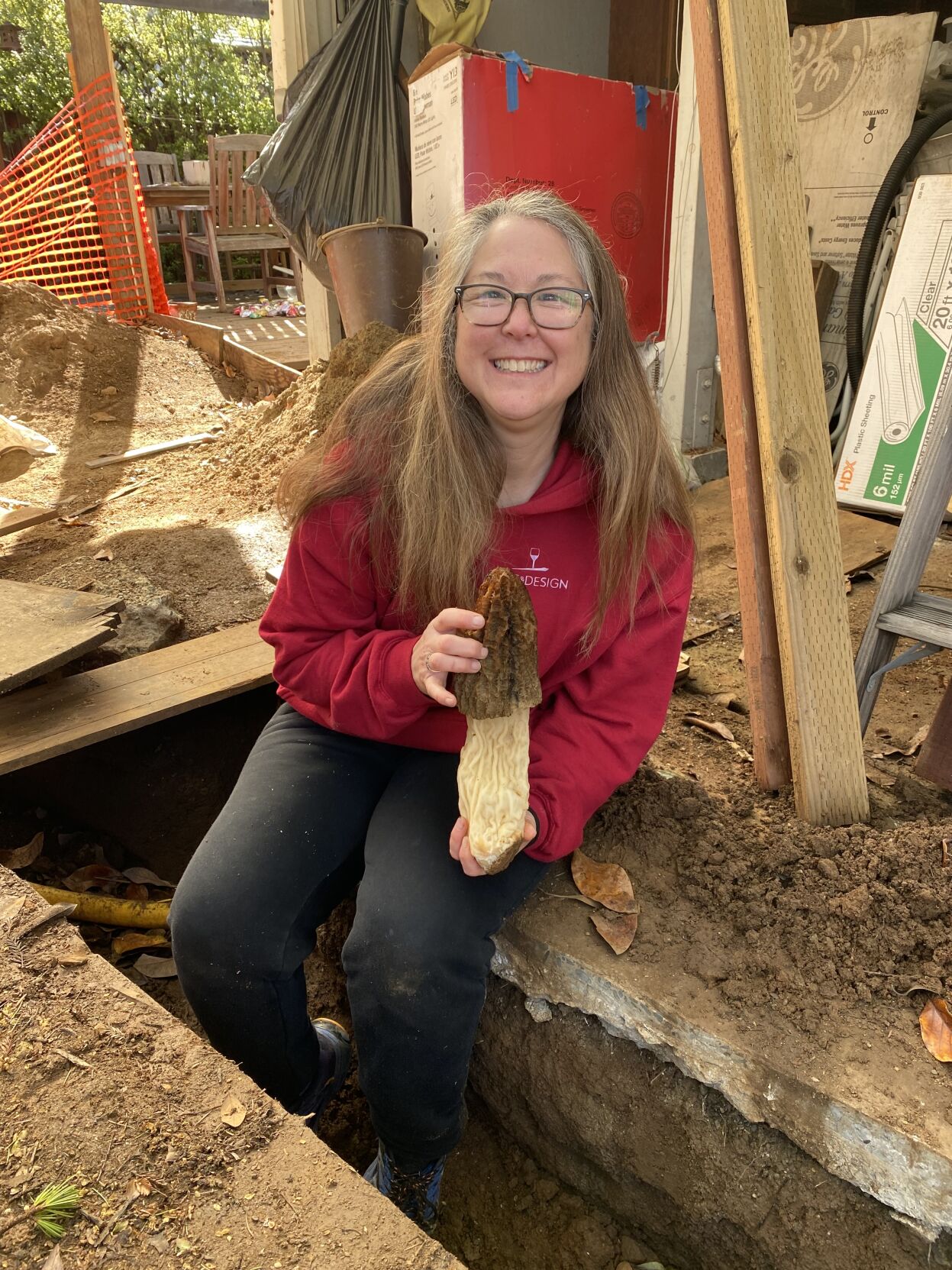
In this particular case, it was a very large – and edible – morel mushroom.
In the process of converting a garage into an accessory dwelling unit, Los Altos resident Tami Shidawara-Vazquez recently discovered the morel (Morchella importuna) while working on a trench. The trench, below a large avocado tree, had been covered with old wooden doors to keep out the winter rain. That provided the dark, cool and humid environment that mushrooms love.
Shidawara-Vazquez, who is related to the Furuichi family of Los Altos Nursery, shared her first reaction: “When I initially saw the morel, I thought it was a plastic bag, but when I got closer to it, I was shocked to see a mushroom that huge! I picked it up with a rake because I didn’t know if it would be poisonous.”
She then sent a picture to her neighbor, Jill Woodford, who has experience with edible landscaping (“a wealth of information and a great resource,” according to Shidawara-Vazquez). After a little sleuthing and some correspondence with a mycologist and a mushroom expert, Woodford determined the fungus could indeed be cooked and enjoyed.
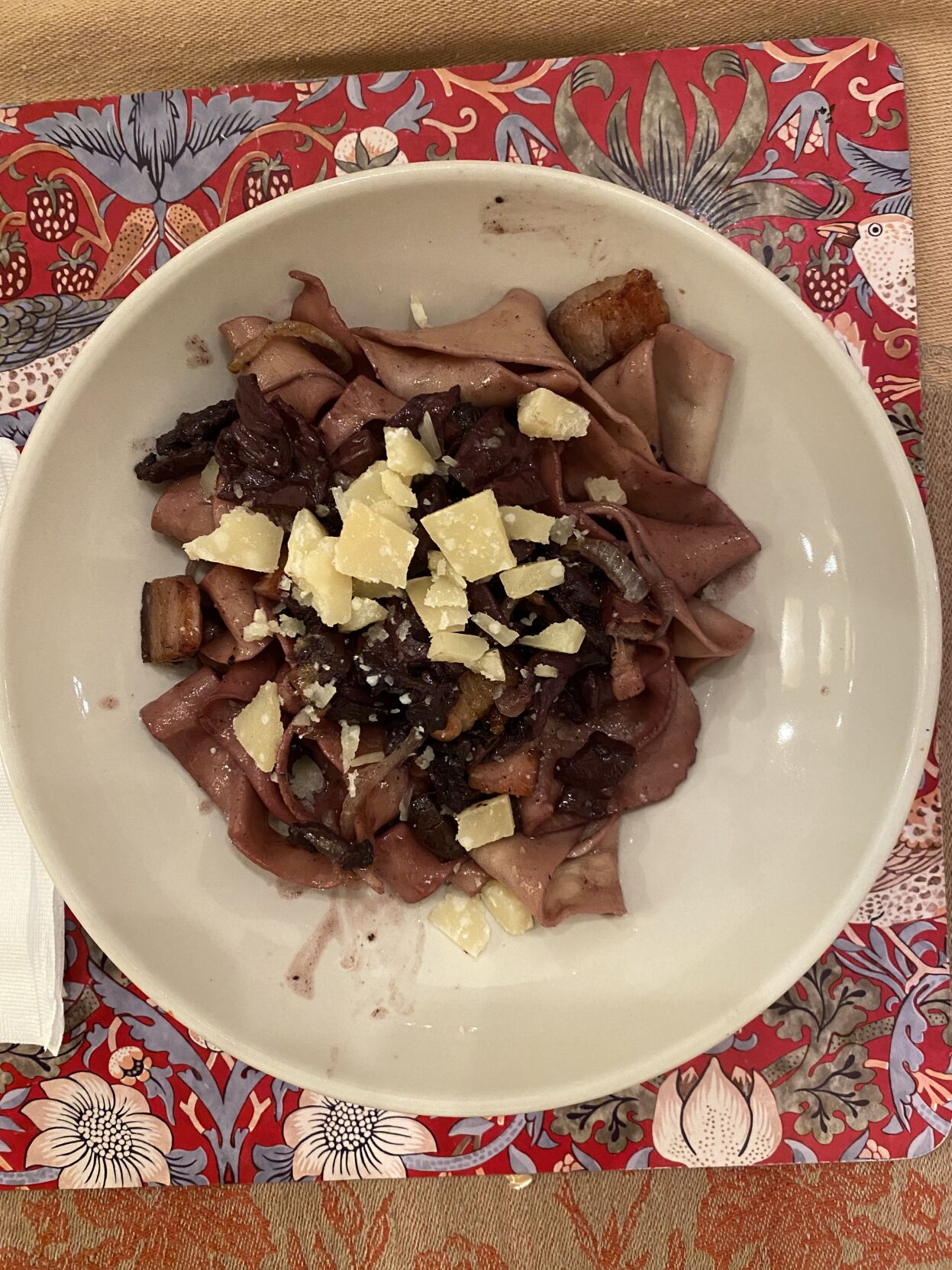
“My husband made homemade pasta and cooked the red wine recipe (provided by a friend in Los Altos Hills),” Woodford said in an email. “I don’t particularly like mushrooms’ flavor or texture, but this was absolutely delicious. The mushrooms had a pleasant texture and tasted just a tad sour, which I very much liked. I’ve never tasted anything quite like it.”
Based on her research, Woodford concluded that this particular morel “is on the large side, maybe one of the largest ever (approximately 13 inches long, including the stem). … What’s particularly interesting is that the only lab I read about that’s been able to grow this variety is in Denmark. They’re especially hard to sprout and grow from spores.”
Growing and foraging
Of course, edible mushrooms can’t always be happened upon in one’s yard, but they can be grown at home, as well as foraged in the field. The North American Mycological Association (namyco.org) provides a wealth of tips for beginners and experienced growers, as well as recipes and information on mushroom forays.
Foraging is a popular activity in many places, including in the greater Bay Area. Group outings are regularly arranged by mycological organizations and other groups (for example, forageSF) and can be the safest way to go, especially for those just starting out.
The Bay Area Mycological Society (bayareamushrooms.org) warns of the dangers of poisoning from eating toxic mushrooms such as Amanita phalloides (the Death Cap), Amanita ocreata (the Destroying Angel) and Galerina marginata (the Deadly Galerina). The group’s website provides the following safety advice.
• Collect many before you eat any.
• Use reputable local field guides.
• Join a local mycological society and/or run your mushrooms by a local mushroom expert.
• Be cautious about where you collect mushrooms; they can absorb toxins from the environment.
• Don’t eat old or spoiled mushrooms.
• Before collecting edibles, learn about the local, poisonous mushrooms, and be able to distinguish them.
• Eat only mushrooms that have been positively identified, and identify every mushroom you plan to eat.
• If you can’t verify every identifying characteristic, don’t eat it. When in doubt, throw it out.
A healthful fungus
Whether they’re purchased, grown or found (and found to be safe), mushrooms are well worth adding to one’s diet.
According to UCLA Health, the health benefits of mushrooms are many. An analysis of 17 cancer studies showed that eating just 18 grams of mushrooms a day – the equivalent of two mushrooms – may reduce one’s cancer risk by 45%.
They can also lower cholesterol levels, decrease one’s risk of mild cognitive impairment, promote gut health and support a healthy immune system.
For more on the benefits, visit uclahealth.org/news/7-health-