It’s bubbling up in preschool meetings and elementary school newsletters: How do we talk about the war in Ukraine as a family?
There are themes in the conflict that are already agonizingly familiar to many parents – refugee and migrant needs, the idea that citizens of a nation might not agree with a leader’s choices, the question of how we can or should help when a crisis occurs far away.
Parents who are following the news, and feeling their own anxiety, are also wondering how to communicate appropriately with their children without over- or undersharing.
Feelings: Yours and theirs
For all but the youngest children, information on current events like the war will be present in their environment – so choosing to avoid talking about them as a family leaves children to get their information elsewhere. Mountain View resident Glenn Teeter, a clinical psychologist who sees adolescents in his private practice, has observed that parents have a highly attuned intuition about their children. That doesn’t mean having hard conversations is easy – but it does mean that parents can trust their ability to appropriately discern what explanatory content won’t be too heavy or scary.
“That’s separate from, ‘Am I just uncomfortable with the topic?’” he said in an interview last week about how anxiety-provoking it can be to tackle topics such as war and social injustice with a young person.
A 3-year-old might not be hearing about the conflict at school, but that doesn’t mean they’re oblivious to what’s on the radio, or what older people around them are discussing – none of us live in a vacuum. Preschoolers might resonate with the idea that sometimes people mistreat each other. Or they might not have questions at all. But by elementary school age, young people will often be talking about anything and everything their parents are attending to.
“There’s a void that’s going to be filled, and as a parent you want to be one of the sources of perspective,” Teeter said.
Ask open-ended questions, offer resources
For the past month, Russian military forces have been attacking a neighboring country, Ukraine. Ukraine’s president has been asking world leaders to help his country stop Russia. Beyond a very simple factual update about the conflict, leading with open-ended questions keeps a conversation oriented around the developmental curiosity of a specific child.
“There’s a pretty wide range of how much they absorb,” Teeter said.
Given that a child will be piecing together fragments of information gradually, open communication will allow for a child to be more comfortable speaking up in their own time when they’re really bothered or frightened by a thought. Imagination can be entirely scary on its own (for grownups as well as for kids) – checking in to see what a child thinks, and asking for more information by asking “What do you mean by that?” can surface what information is needed, and help separate fear from fact.
Child-focused news sources such as TIME for Kids and Junior Scholastic provide focused, simply worded explanations of concepts like sanctions and refugees. TIME’s “War in Ukraine” article, free to all readers online, presents a factual synopsis, context about how the world has responded and age-appropriate current news photos that might be compelling to anyone from kindergarten on up. Junior Scholastic provides a denser account for older (child) readers in “Ukraine Under Attack,” going into greater depth with background on the conflict and what could happen next.
Where to find more
Children’s picture books provide another frame for understanding the ideas and feelings of war and its emotional impact for children who seem hungry for more information. A Town Crier reporter made a test run to the children’s section at Los Altos’ main library last week and found the librarian on duty – who had just put out a recent picture book about an ambulance driver in the Syrian civil war – more than ready with suggestions of books available immediately on the shelf. You can also request books from branch libraries around the county and have them gathered for pickup at the library of your choice.
Some relevant titles:
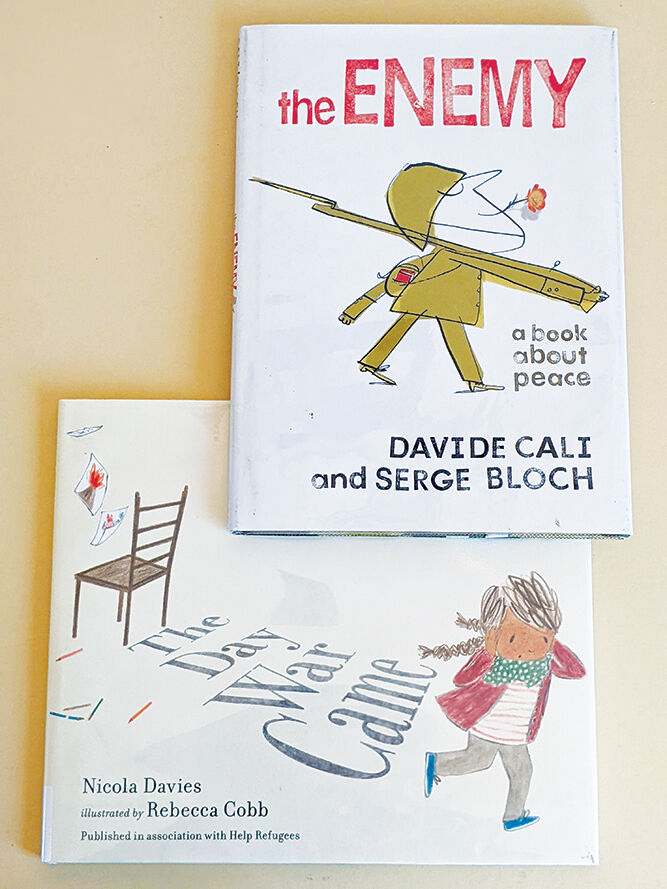
• “The Enemy: A Book About Peace” by Davide Cali (Schwartz & Wade Books, 2009). Cali’s spare, doodle-like line drawings make space to think about war from the viewpoint of two lone soldiers, each experiencing the (il)logic, boredom and dehumanizing costs of conflict. The book is frank yet subtle – rated for older readers, its simplicity also makes it open-ended for younger readers, though there is a page that shows line drawings of people and animals that have been killed.
• “The Day War Came” by Nicola Davies (Candlewick Press, 2018). Written as an illustrated poem, Davies’ text follows a girl who escapes war in her hometown and finds no reception as a refugee until children in a school make space for her, both literally and in spirit.
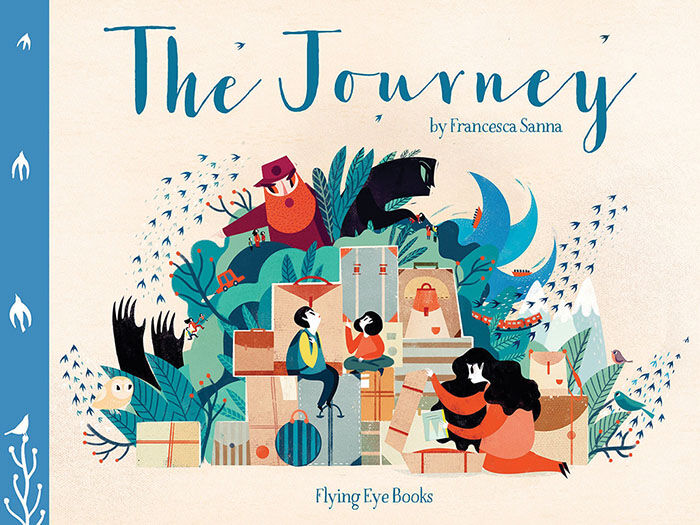
• “The Journey” by Francesca Sanna (Flying Eye Books, 2016). Lavish graphic illustrations show a young child’s experience of fleeing war with her mother and siblings to search for a new, safe place to live after her father is killed in the conflict.
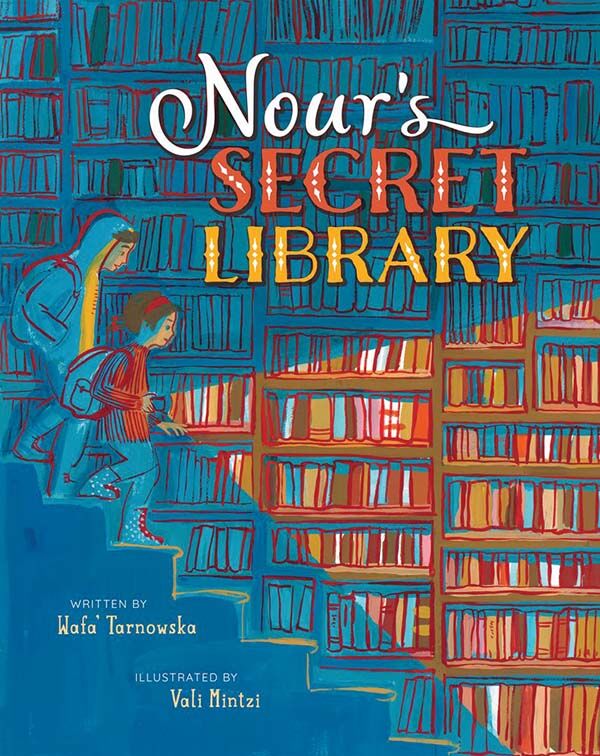
• “Nour’s Secret Library” by Wafa’ Tarnowska (Barefoot Books, 2022). A new picture book coming out this week (so it’s not yet available at the library – but will be on local shelves soon), “Nour’s Secret Library” follows Nour and her cousin as they take shelter from bombings beneath their Syrian city. Based on the author’s true life story, the book follows Nour’s gradual compilation of a secret underground library, and the worlds of safety and hope a book can create during terrible times.
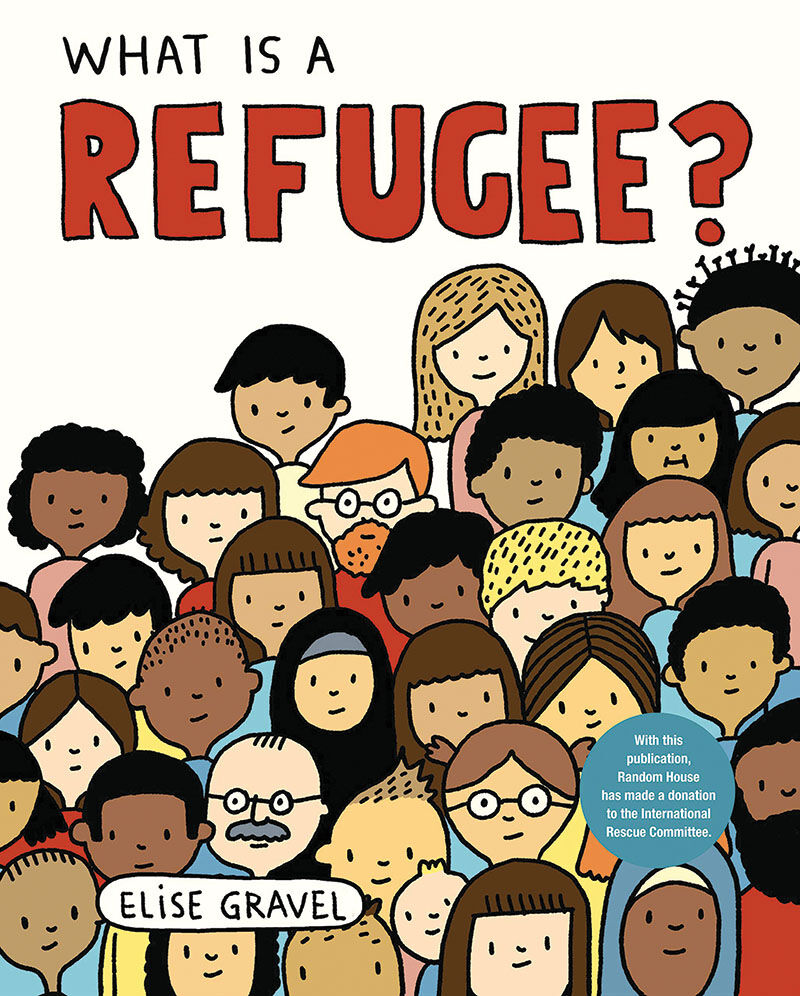
• “What Is a Refugee?” by Elise Gravel (Schwartz & Wade Books, 2019). Gravel shows the many colors, ages and features of refugees around the world, explaining how they are “just like you and me” as they flee danger and hope to find a new country to resume everyday life. Gravel also has created a short comic to explain to kids what a refugee is, and made a high-resolution printable version available for personal and classroom use.