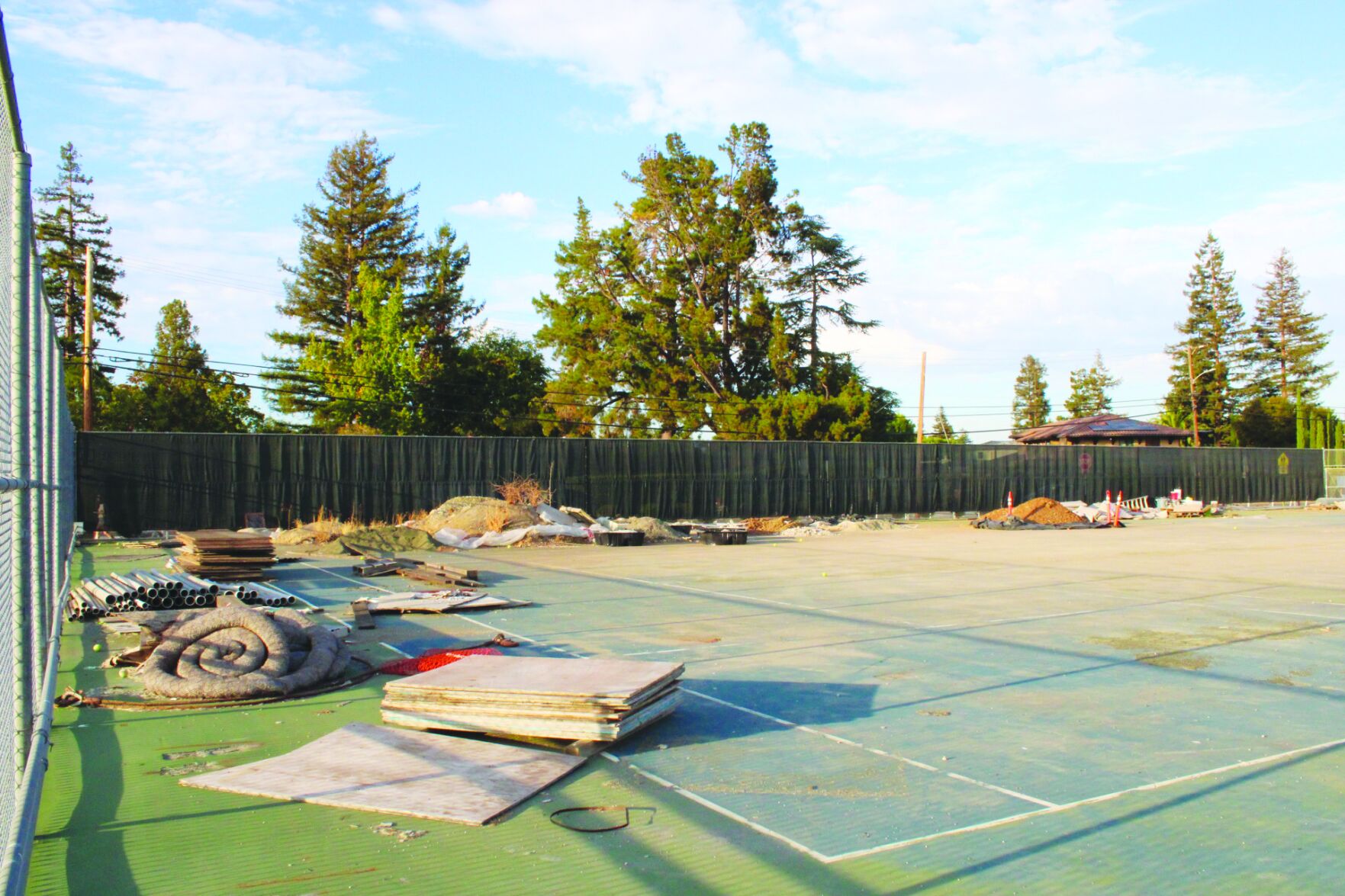
Four tennis courts at Los Altos High School could be converted into a parking lot within the next year, causing mixed community reactions about the potential outcome.
For the past six years, four of the 12 tennis courts at LAHS have been used as a material storage area for the recent Measure E school bond construction projects. The Mountain View-Los Altos Union High School District Board of Trustees discussed at an Aug. 18 special session that the projects are nearing their tail end, and they are now looking at development ideas on how to utilize the space for new parking.
According to the parking lot layouts developed by Mike Mathiesen, the associate superintendent of business services at MVLA, and Quattrocchi Kwok Architects, option one would keep eight courts with 78 parking spots, option two would keep eight courts with 76 parking spots, option three would keep nine courts with 45 spots and option four would keep 10 courts with 31 spots. Option one would remodel the existing closed courts, while the other three options would transform the courts next to the baseball field. Each layout also shows there will be 12 additional parking spaces alongside the existing closed courts.
Eric Volta, the superintendent of MVLA, said at the meeting that he recommends options one and two to maximize the number of spots available. He said for option one, demolition would be easier and that there is a driveway available, but there are concerns that it could be shared with pedestrians and bikes. Option two would also allow for a similar amount of parking spaces, Volta said, and could be a safer option to avoid pedestrians.
By the end of the meeting, Volta and the board said that since the city of Los Altos put stricter parking rules near schools, the need for school parking is important to bring in people for sports and after-school activities. They also are considering whether to make it student or staff parking and to hear from traffic engineers to determine what could be the best option for student safety.
“We want to explore option two pending working with the city engineers, working with the Division of the State Architect (DSA) and so on,” Volta said. “It sounds like option two. We want to continue down that path so long as that’s safer than option one.”
He said there have been no plans submitted to the DSA. Once an option is approved by the board, the DSA will still need to ensure that the site is accessible and contains enough shade. He also said all the numbers of parking spaces are still an estimate, but they hope to have between 70 to 80 more parking spaces.
Volta said the existing closed court still has “lingering supplies” on the site and is still unusable, with no nets and neglected tennis court paint surfaces. He said there is a pause on the site until they can determine where the parking is going to be placed.
“Architects met recently in the city just to understand how the parking lots will interact with the city,” Mathiesen said. “If we have to create a driveway in the sidewalk, we have to coordinate with the city. We don’t want to submit plans to DSA, and then the city says, ‘Wait, you need to do X, Y and Z.’ It’s better to plan all that in advance before the cost determination. Nothing’s been approved, nothing’s gone out to bid. I think cost considerations will need to be taken into account.”
Mathiesen said he has received a few resident complaint emails and is aware of the disruptions that can occur, such as long wait times. He said the tennis courts are popular among residents on the weekends and many groups have the option to obtain a permit to rent the courts out. He said the physical education classes and tennis teams also utilize it all year long. He said there is no data available to see who uses them on an average day.
“I think if we go through with this, the board would approve the funding and the design for it ideally next summer,” Mathiesen said. “A lot of it has to do with DSA and their approval on timelines and review to get it all done.”
Tennis players’ response
Steve Apfelberg, the head tennis coach for the girls’ junior varsity team, said he had been a coach at the school for eight seasons and it wasn’t until going into his third year that they closed off the four courts. He said the team has been able to make the tennis court closures work after all these years, but he said it would be a great benefit for them to have 12 courts. He said that due to the tennis team’s large size, they had to cut some people off the team because there wasn’t enough space to practice per court.
“If we had the four additional courts, or some portion of … (them), we would probably be able to take even a slightly larger roster. And some kids who have a decent tennis background probably would be able to make other high school teams.”
He said this season includes 42 players – 21 girls on varsity and 21 girls on junior varsity. He said both teams practice at the same time on four courts each and while some players are on the court, he makes others do drills so it won’t be overcrowded.
Apfelberg said at the end of the day, it is up to the board to do what is good for the school. However, he is aware of how important the courts are not just to the tennis team, but to the surrounding community. He said that by the end of practice, people are already queued to get on the courts, eager to play and sometimes even going on the court when they see it open for a minute. One of the reasons the courts are open to the public, he said – compared to MVHS and other public schools in the area – is that it is right off of Jardin Drive and not tucked into a campus.
“There’s one gate from Jardin Drive to the court, but we lock the gates that kind of lead into the school,” Apfelberg said. “There’s such a good relationship between the team and the public. I’ve seen other high schools that have tennis courts completely locked down, besides for their high school team and for us – the public’s just completely used to that. The courts are always open to the public, just completely used to sharing.”
Barbara Zieroth-Hoffman, a resident of Los Altos for more than 30 years, said her entire family are tennis players. She used to teach tennis on one of the closed courts and her son used to be involved in the tennis team. She said on any given day, it is crowded, with the mornings during the school week and the weekend from early morning until noon being impossible to play. She estimates that more than 100 people play during peak times.
“There’s like a real variety of players,” Zieroth-Hoffman said. “There’s the regular old timers, the young families, there’s a group such as the ACEing Autism group that comes on Sunday morning. They take four courts, and then, of course, there are instructors giving lessons. So it is very bustling.”
She said there are no other nearby courts or parks in North Los Altos that people can walk to and play tennis. She said Egan Junior High School used to have tennis courts, but they were removed to install Bullis Charter School portables. She said the LAHS courts were crowded before the pandemic, but have exploded in number in the last five years and she would be devastated to see the removal of some considering the community demand for them.
“It’s obvious that there are too many students driving cars,” Zieroth-Hoffman said. “Obviously, there are more students than when my son went there, but there are also more students driving cars. There needs to be an incentive for more students to start biking or walking. I don’t know what the solution is.”