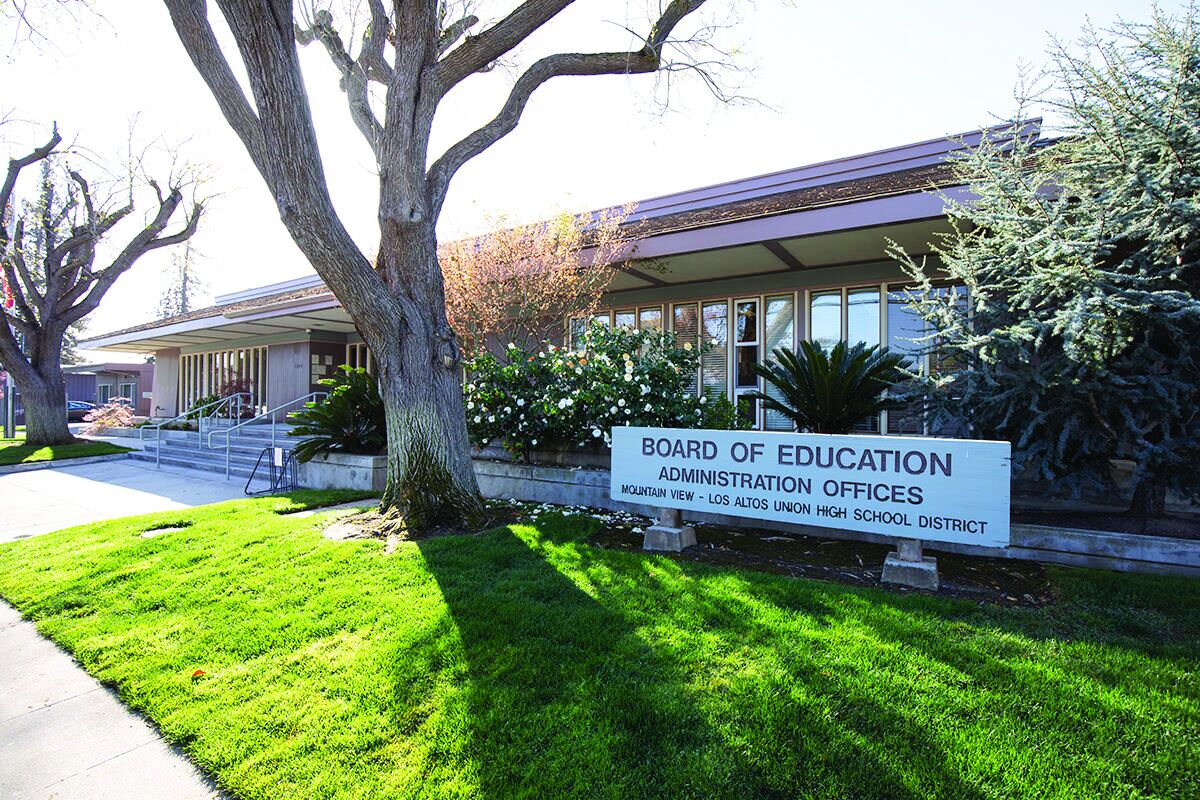
Mountain View-Los Altos Union High School District parents expressed their dissatisfaction with the ethnic studies class at the March 17 district board meeting. Many parents were concerned about its relevance to their children’s education and if it should become an alternative course.
Ethnic studies, a required ninth-grade class at MVLA, was passed as a state-mandated graduation requirement in 2021 and became an official class in the district in June 2023. It wasn’t until the 2024-2025 school year it became a graduation requirement in the district. Ethnic studies looks at a non Eurocentric approach to history, providing students with the historical perspectives of African American, Latino, Native American and Asian American and Pacific Islander studies. It also provides a wider lens of diverse community struggles and contributions.
Esmeralda Ortiz, MVLA board president, said that many parents think they have removed world history from their curriculum but instead, it was moved to the 10th grade. She said she understands parents’ concerns are that the class is divisive and blames white students for past transgressions, but she does not see that as the case.
“The course only looks at laws and practices that were put in place to prevent some from succeeding in hopes that they are not repeated,” Ortiz said. “No blame is given.”
Ortiz said the course was organized by a group of teachers across the state to create the course’s framework. According to the Ethnic Studies Model Curriculum guiding principle requirements, the class must include accurate information and research, promote civic engagement, encourage cultural understanding and critical thinking history lessons. The model curriculum also provides an overview of its history, citing the student movements of the 1960s to have lessons of systems of oppressions and community responsiveness included in K-12 schools lessons.
Lev Stesin, a parent of a Mountain View High School student, said that he has hesitations about the ethnic studies class and believes the district assumes the whole community is on the same page with the course. Stesin does not believe it should be eliminated as a course but offered as another option for students who want to explore other topics. Stesin said he does not think the course adds anything to students who want to become productive citizens and only teaches students about the grievances they have against the government.
“What does it add to our kid’s education?” Stesin said. “It’s the question we should ask ourselves. It is a class where they cover the grievances of every group of people in this country against the United States government and each other. Is that a worthy topic of discussion? Maybe, yes or no? As part of our understanding of this country, we should know its shortcomings. There is no perfect place, and the United States is just a country as any other country, maybe a little better than others, but still far from being perfect.”
Guy Resheff, a parent of a Los Altos High School student, said the ethnic studies class sounds positive with the intention of inclusiveness of other cultures, but it is a mask for studying the belief of Critical Race Theory, where he described it as the “idea that splits people into the oppressed and the oppressors.” Resheff said the idea of ethnic studies divides people and categorizes them based on their beliefs, making it seem the same as a vague course that heightens discrimination.
Resheff also believes the course should be taught later in high school, where the students can first develop a historical context of larger issue and then learn about its complex nature.
“I feel like this is doing a huge disservice to our children because they’re young, they don’t know the world yet,” Resheff said. “They need to understand that there’s balance.”