School newspapers build students up, delivering accurate news on their activities and interests. The stories reflect the community that it reports for and does not shy away from the truth.
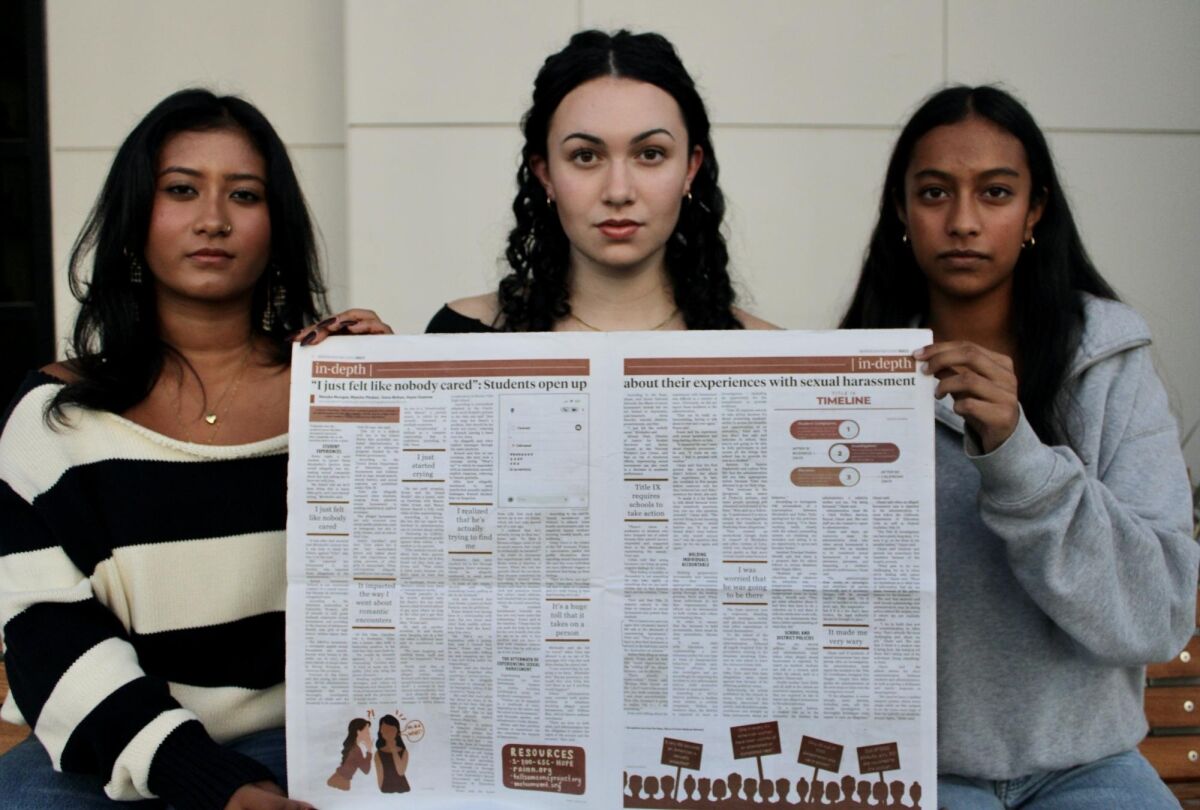
While reporting about various student sexual assault and harassment incidences at local high schools, many student reporters at Mountain View High School’s newspaper, The Oracle, found unexpected backlash and censorship from their school administration. The students believed their First Amendment rights were violated by the staff members through their attempt to shut down the story, removing their newspaper’s advisor and later canceling the school’s Introduction to Journalism course the following year. This has led to an ongoing legal battle between the student reporters’ families and the Mountain View-Los Altos Union School District to acknowledge their violations.
2024-25 co-editor-in-chiefs Myesha Phukan and Renuka Mungee, senior and junior students respectively at MVHS, said that their tasks as reporters are doing “one’s due diligence” in gathering information and being empathetic with their sources. In November 2024, the student reporters alongside Hayes Duenow, Siona Mohan and their 2022-23 editor-in-chief Hanna Olson were awarded the 2024 Courage in Student Journalism Award for standing up for their work and advocating for press freedoms. Phukan said the award validated that their work mattered and that they could help others going through similar situations.
“As scholastic journalists, I think that we play such an important role in informing not only our school community, but the community outside of it,” Phukan said. “I think that that work and art and the quality of the work that we do, was hindered greatly by our principal and our administration’s actions. And so for me, the award is a kind of recognition for the fact that journalists, in general, are so important, and the work that we do is so important. We are grateful to see that that’s being kind of recognized by other people outside of our local community.”
While writing their article on student experiences with sexual harassment in spring 2023, the student reporters were not expecting the topic to become a big issue at their school. They were able to interview many students on their experiences and found textual and photographic evidence to prove the trend in their community.
When it came to interviewing their principal, Kip Glazer, they soon found their story going downhill. Glazer was included in their story to provide context of the district’s Title IX policy and how to report sexual incidents, but once she got word of the explicit information from the reporters’ sources, Phukan and Mungee said that she set up several behind-closed-door meetings to rewrite and cover up information.
“Glazer printed out a copy of our article, and she brought it with her to the meeting, and she (had) highlighted and written notes in the margins of all of the stuff that she didn’t like,” Phukan said. “There was one big example where one of the alleged perpetrators had written a sexually explicit song to a victim, and we had included that, and she wanted that to be taken out, and she thought that it would promote negative dinner time conversations with families.”
The student reporters said that the one thing that have taken away from this experience was to stand their own ground while writing the story and to remember many resources such as the Student Press Law can help one advocate for their editorial decisions. The students believed the principal was trying to frighten them into canceling the story, saying it could hurt the school and it could harm their chances of getting into college. Many of the edits that the students were forced to make were to remove names, quotes and explicit words.
“When we went through the whole thing, I was a freshman in high school, and so we didn’t know very much about censorship and how it could kind of manifest in the form of self-censorship,” Mungee said. “I feel like a really big thing that Myesha and I have been trying to teach other student journalists who are going through something similar or who may go through something like this in the future is to recognize what is happening to them and use the resources to stand your ground and to write your story the way you want it.”
Since writing the story and their recent legal battle, many of the students involved with the story have spoken at various student journalism conventions to talk about their experiences. Mungee said it is important to teach other students that with every story one writes, one is to keep accuracy in mind and worry about the reactions of administrators after it is already written.
“We want to remind ourselves in the future to write the article to the best of our ability, not censor ourselves and to not water down stuff,” Mungee said. “Of course we were intimidated and we did end up taking things out of our own choice. At the end of the day, it was a form of self-censorship.”
In the last year, the dissolvement of the Intro to Journalism course has been hard on The Oracle. Phukan said she and the other co-editor-in-chiefs have to teach the curriculum to new journalists while also balancing the functions of the paper. Phukan said it has been clear that the school does not support print journalism.
“While the changes that principal Glazer did make were extremely detrimental, I think that we’ve been able to make our way through it is a testament to the paper’s resilience and the strength that we have as a publication,” Phukan said. “I hope moving forward she really sees that we do not need her validation. It’s one of the things that I spend most of my time in, and I really hope to see it keep moving on and keep growing.”
To learn more about the courage award visit, tinyurl.com/yuwa7ats.