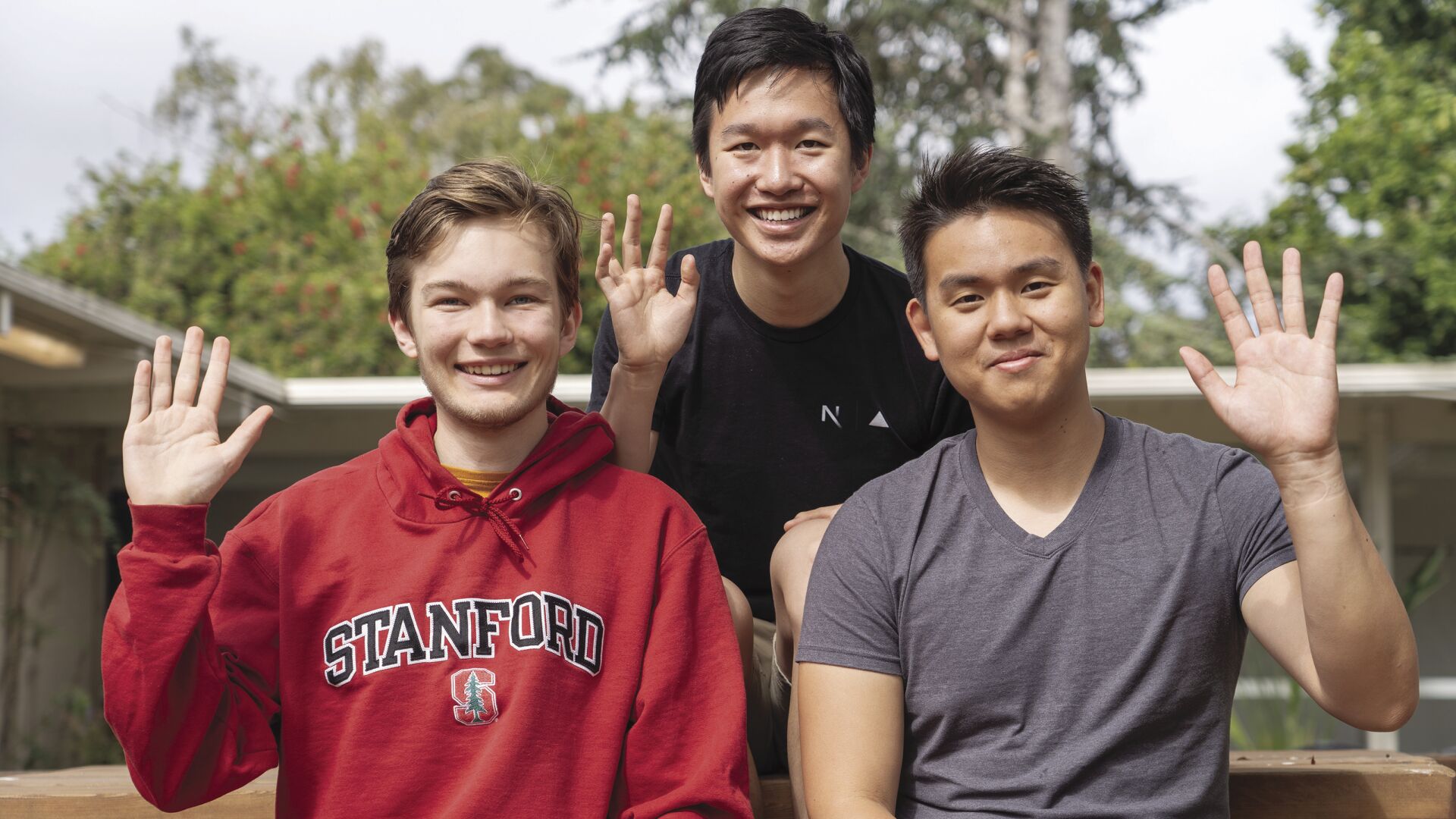
A team of three Stanford University students, including one from Los Altos, has been awarded a Westly Prize for its translation app.
Jason Lin, a Los Altos resident and third-year student at Stanford, co-created Mida, a translation app that uses generative AI. For their work, Lin and classmates Schwinn Saereesitthipitak and Scott Hickman Jan. 20 received one of three Westly Prize awards, which each come with $40,000 in unrestricted funding.
More than 100 teams and individuals applied for the annual prize, of which eight were selected to be finalists, according to Westly Foundation namesake Steve Westly.
Lin said the idea for the app was inspired by his mother, who immigrated to the U.S. in the 1990s.
“She said sometimes she felt like since (her English) wasn’t quote-unquote ‘perfect,’ other people might judge her,” said the Harker School graduate. “And so, I got the idea to build this app, and built it with a couple of Stanford friends of mine.”
Lin added that he and his co-creators, Saereesitthipitak and Hickman, initially released the software as proof of concept and hoped to get 200 likes on a promotional LinkedIn post. Instead, it garnered 1.2 million impressions.
Mida, named after Lin’s golden retriever – “You can tell we didn’t expect this to blow up,” he joked – bears resemblance to popular translation app Google Translate but differs in function. Using a custom version of OpenAI Whisper, a generative AI model adept in audio-to-text transcription, Mida can understand idioms, recognize dialects and translate sentences with mixed languages.
“There’s this Chinese expression which means ‘I was in a rush,’ and Google Translate translates it as ‘my urine was flowing.’ That’s not very ideal,” Lin, 21 said.
Westly said he was impressed with Mida’s purpose of serving immigrant communities.
“I think we live in a period, especially in Silicon Valley, where everybody wants to go out and start the next new great company and make a boatload of money,” said Westly, a Silicon Valley entrepreneur, clean technology venture capitalist and former state controller of California. “We’re looking for young social entrepreneurs, who instead want to use their determination and perseverance and brilliance to do something above and beyond making money.”
Mida is just one of a growing number of apps and programs using generative AI and large language models to improve existing technology.
“It’s gonna be like the car and the horse drawn carriage,” Lin said. “This is a perfect application: (Translation software is) finally able to understand the true meaning of a sentence. We’re no longer gonna say ‘lost in translation.’”
Lin said plans for Mida after winning the Westly Prize include expanding the app’s reach and working on integration with social media platforms popular among immigrant communities, like WeChat and WhatsApp. He also said he hopes to secure a patent for the code and continue working on improving translation quality while keeping the app free to use.
“To get people who are super bright Stanford computer scientists (say) ‘We’re going to do something for the rest of the world instead of just make a gazillion dollars,’ it’s really rewarding,” Westly said. “It makes you feel good about humanity and the future.”
To download Mida, visit trymida.com.