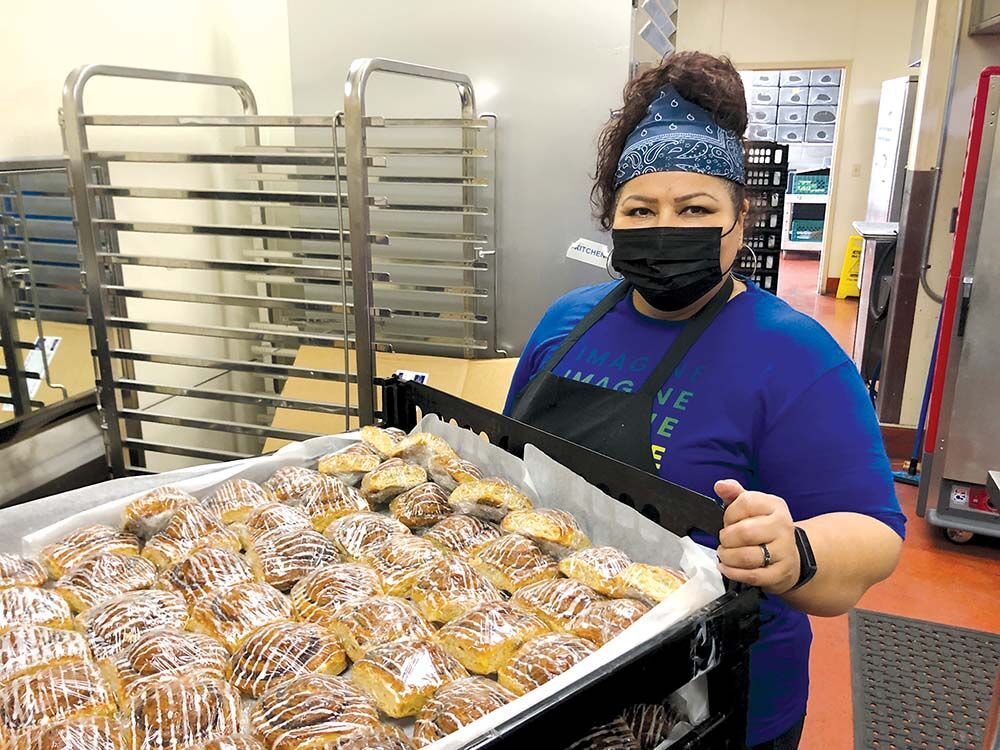
In the first months of the COVID-19 pandemic, schools scrambled to pivot their nutrition programs into flexible, remote meal services that could reach children who were sheltering at home but still needed food support.
Local districts learned as they provided in a new way for families with food insecurity or economic hardship, and school lunch programs haven’t just reverted to the previous status quo.
This year the Mountain View Whisman School District elected to sustain its free-to-all meal policy, offering breakfasts and lunches at no cost to every student. In the past – pre-COVID – families had to undergo a certification process to access subsidized or free meals. During the worst of the pandemic, local agencies had to find ways to distribute food aid without the structure and certification of school lunch lines, and they dropped those requirements. Both locally and on the state level, support grew to make that change permanent. All California schools will offer meals to all at no cost starting next year, but Mountain View’s schools got a head start.
Nearly one-third of students in Mountain View already qualified for free or reduced-price lunch, meaning the program change did not have the same scope of transformation (budgetary and otherwise) in Mountain View compared to the Los Altos School District, where approximately 95% of students currently pay full price when they buy hot lunches. MVWSD already operates a full production kitchen under the auspices of the National School Lunch Program, founded in 1946 to formalize federal support for feeding low-income students.
Funding in flux
MVWSD food services director Debbie Austin said her district has been supporting food distribution to people with the highest need for years, ranging from produce market vouchers to groceries in partnership with Community Services Agency and Second Harvest Food Bank. She said community response to services like a mobile free meal truck, started before the pandemic, had been enormous. During the worst of the COVID shutdown, the district offered three meals a day, seven days a week, but now primarily operates a weekday breakfast and lunch program.
The funding formula for how districts receive federal and state reimbursement is in flux – extra financial support helped balance out the increased needs of the pandemic, but next year the district may face a reimbursement rate set substantially lower than its current per-meal production cost. Right now meals cost approximately $6 each to produce, but the federal reimbursement rate has hovered around $3.50 in recent years.
“The guideline is for the National School Lunch Program to operate at zero budget – it’s supposed to break even, not draw from the general fund,” Austin said, but predicted that without state-level support, for which schools have been lobbying legislators this year, the district will face “operating at a huge loss.”
But, she added, the time-honored lunch lady mandate will endure one way or another: “Yes, we will feed all the children. If you get in my line, I will feed you anyway.”
Austin said she had been contacted by as many as a dozen other school districts that, like Los Altos, have been tasked with expanding no-cost meal programs despite a lack of kitchen facilities. Longtime local vendors like Choice Lunch may have an uncertain future in California’s public schools if they can’t afford to operate under new, drastically reduced reimbursement rates. Austin said MVWSD’s kitchens, a main one at Crittenden Middle School and a smaller one at Graham Middle School, could offer only limited help to neighboring districts – and she anticipates that development across Mountain View will only be increasing local enrollment, and thus meal demand, in upcoming years.
What do we eat?
Because of ongoing efforts to prevent COVID transmission in classrooms, the district centrally prepares meals and delivers them to individual classrooms to eat outside. The meals come individually packaged in compostable trays, but that doesn’t mean they are being reheated from a deep freeze.
“We’re actually (still) doing a lot of scratch cooking. What we’re missing is our salad bars and multiple entrees,” Austin said, adding that the “11 fresh fruits and vegetables” previously available at the salad bar had been a perennial hit, now much missed.
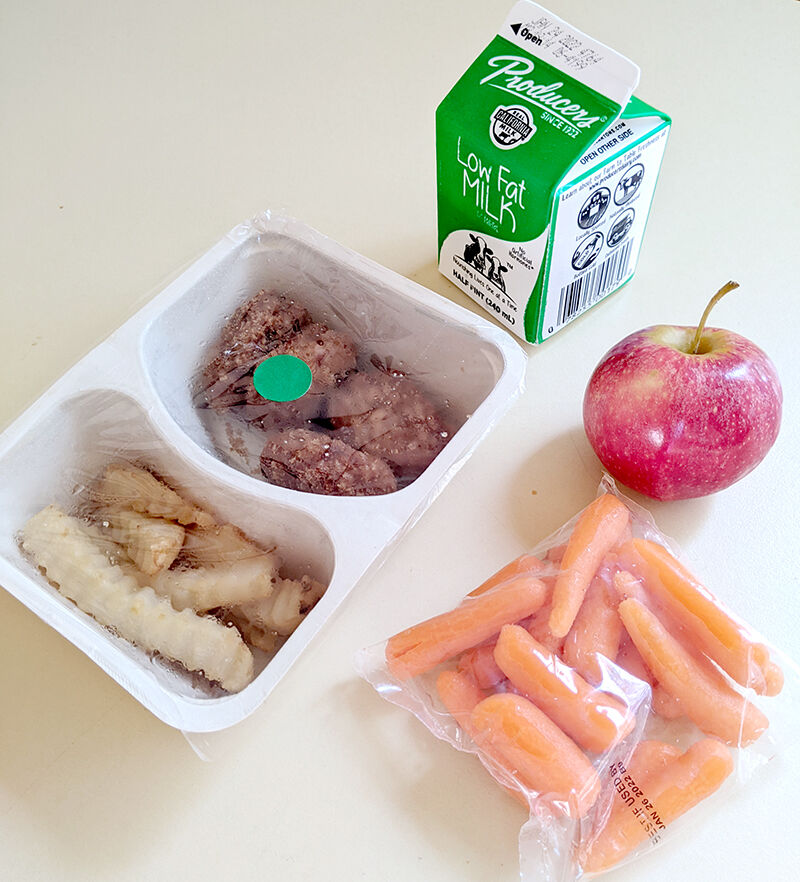
Yet the January hot lunch menu was still enough to stir envy in the hearts of some work-from-home parents who’ve been living off breakfast cereal and crackers for many midday meals. In addition to pizza Wednesdays, the menu included burrito bowls, chili, alternating teriyaki and Swedish meat balls and the frequent recurrence of the crowd favorite, mac and cheese (which comes paired with hot mixed vegetables).
Each day of the week brings a fresh veggie on the side, alternating between carrots and broccoli or cauliflower florets. Breakfast alternates on a weekly calendar, rotating through cereal, pancakes, muffins, bagels and, to celebrate Friday, a fresh-baked cinnamon roll. Every meal comes with milk. Every day offers a vegetarian option, and the district flags meals that contain beef on its color-coded monthly calendar.
That attention to ingredients and cultural preferences is reflected in Austin’s pride in a culinary team that cares about “culturally appropriate” food offerings, meaning an attention to the seasonings and ingredients that, in their variety, reflect what local children eat at home.
“It is actually cheaper to cook from scratch than packaged items – it takes more labor, but it’s a better product,” Austin said.
Economic and supply-chain disruptions have been impacting the kitchen – last year two consecutive milk vendors went out of business, and vegetable deliveries have been plagued with problems.
Tasked with providing just enough, but not too many, meals, Austin has closely observed the eating patterns of students who all receive the same option at the same (free) price. She said demand has gone way up, from 1,200 students per meal to well over 3,000 per meal in a district with only 4,800 students, with peaks of near total participation on some pizza and mac and cheese days.
Asked about meal participation at the MVWSD’s more affluent schools – income distribution is not equal across the district – Austin said they are serving substantially more meals there than at any point in the past, and she thinks meal-time bullying has gone down across the board, now that money has been taken out of the equation. Regardless of income, many parents who may have chosen to pack a lunch in the past fall into the rhythm of joining communal meals.
Austin noted that on a fundamental level, these meals matter because a full stomach makes for a better student – but the social training of learning to eat together, eat nutritionally balanced foods and bond is also a dividend from universal lunch access.
“It helps that it’s the same entree, they’re all eating the exact same thing,” Austin said. “I’ve been in food over 50 years, and it’s the first time I’ve actually witnessed this, and I absolutely love it. It’s something I wished for for years, and it’s finally coming to pass.”