In 2026, the United States celebrates 250 years since the country’s founding. However, as of 1776, large portions of modern America had yet to be incorporated into the new nation.
Here in California, Spanish colonial influence painted a much different history when compared to English colonial influence on the East Coast. Specifically, history was shaped by the often violent treatment of indigenous people.
A lecture on Aug. 19 at the Los Altos History Museum, titled “Junipero Serra and 1776: The West and East Coasts,” discussed these key differences. Lecturers and Santa Clara University professors Robert Senkewicz and Rose Marie Beebe took attendees on a journey through coastal California in 1776, through the eyes of Franciscan missionary Junipero Serra.
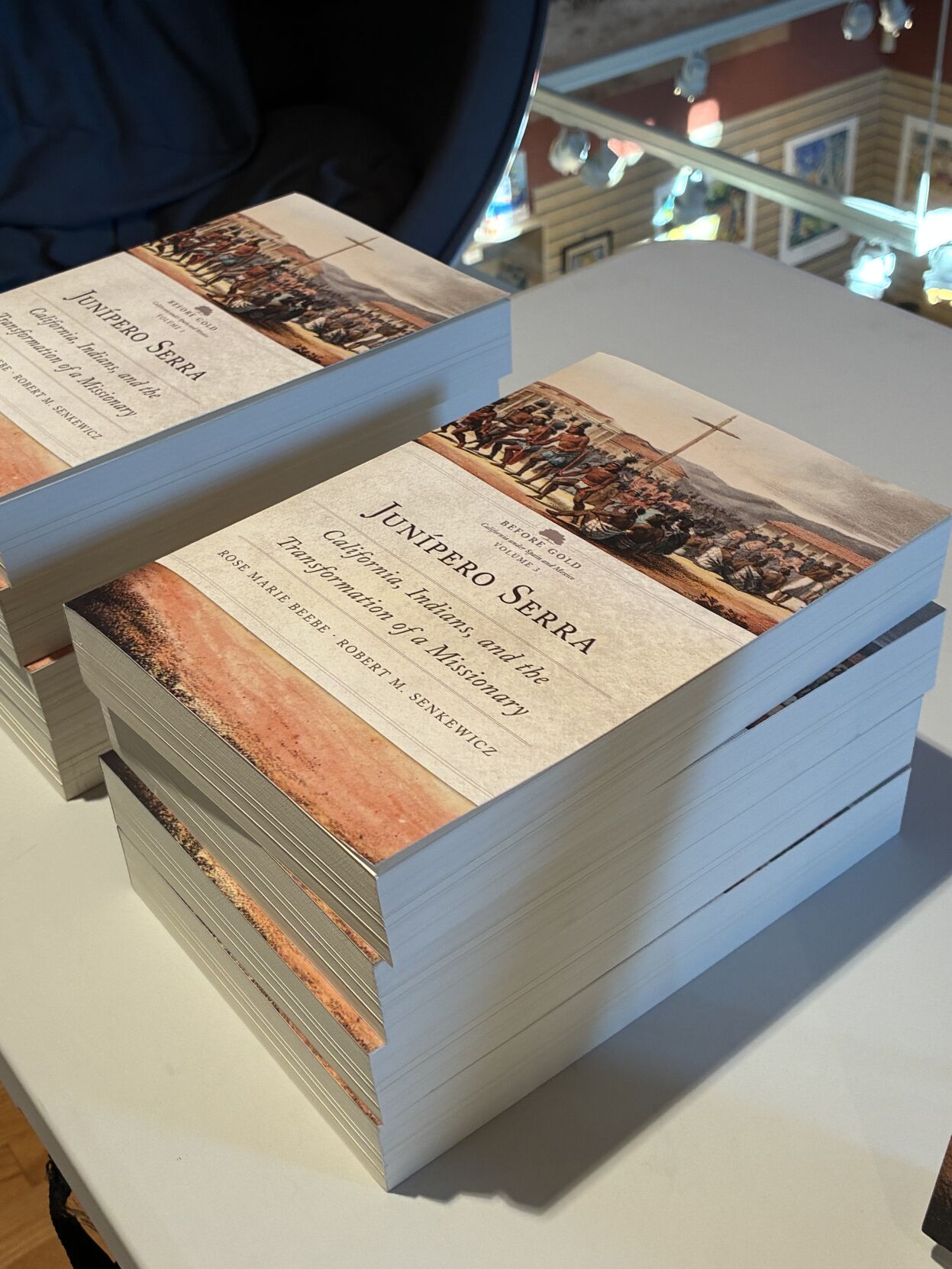
Serra’s writings were translated and published by Senkewicz and Beebe in “Junípero Serra: California, Indians, and the Transformation of a Missionary.” This lecture is part of a series hosted by the Los Altos History Museum in connection with its ongoing exhibit “The Spirit of ’76: Reflecting on America’s 250th.”
Senkewicz and Beebe emphasized the importance of reading Serra’s writings through a human lens. It is easy to discredit past figures because of the harm that they ultimately caused, but ignoring the basic fact that they were human ignores a portion of the historical context under which they lived, they said.
“He expresses a range of human emotions that we all can identify with,” Beebe said. “And he also was a man who could get angry very easily … he had quite the temper.”
Senkewicz started the lecture by drawing a parallel between the signing of the Declaration of Independence and the first mass held at what would become Mission Dolores in San Francisco. These two events occurred one day apart in the year 1776.
While separated by over 3,000 miles, colonists on either side of the continent heavily documented their interactions with Native Americans, though this documentation took on different tones.
Senkewicz explained that this difference comes from their differing ultimate goals: Spanish colonials in California aimed primarily to convert the indigenous population, whereas English colonials aimed to fully overtake the existing society in that part of the world, establishing their own in its place.
As a result, the language with which native peoples were referred to varied, with the Spanish missionaries referring to the Native Americans as “gentiles,” or non-Christians, and the English referring to the Native Americans as “savages,” or non-civilized.
Senkewicz added that these differing goals were a direct result of previous Spanish colonization in North and South America.
“What happened in the early period in the Caribbean, the Spanish really forced the native peoples to mine for gold for them … and some of the missionaries objected to that,” Senkewicz said. “The mission’s origin in the Caribbean was to protect the native peoples from the conquistadores.”
As these missionaries traveled into California, they continued to view conversion as a means of salvation, both in a religious sense and in the sense of protection from conquistadores.
Senkewicz further explained that as Serra moved north into modern California, he experienced non-Christian indigenous Americans for the first time, and his writings about them displayed some level of reverence.
In this same vein, Beebe pointed to a passage in Serra’s writings where he likened the non-Christian Native Americans that he encountered to Adam in the Garden of Eden.
“This passage, I believe, shows the affection that he feels for the people he encounters,” Beebe said.
Senkewicz added that Serra showed clear consideration of the indigenous cultures as a tool of conversion, relating Native American religious figures and stories to Christian theology.
“They were trying to discover aspects of that local culture that … could serve as breaches to Christianity – this is an old missionary strategy used in the New World,” Senkewicz said. “What those missionaries were trying to do was tell the people that Christianity could be built upon the local traditions and the local cultures.”
As a result, Senkewicz said, aspects of these indigenous cultures were preserved in a way that did not happen on the East Coast.
Both Senkewicz and Beebe noted that, despite the missionaries’ self-perceived saviorism, violence towards indigenous people at their hands was incredibly commonplace.
At the same time, they said, this kind of violence was a culturally standard legal and spiritual punishment, although it was more often applied to native peoples.
Additionally, this widespread normalization of violence towards Native Americans built upon itself, eventually leading to the Indian Removal Act and subsequent Trail of Tears under Andrew Jackson, Senkewicz said.
The goal of reading and teaching Serra’s writings is not to justify the violence enacted towards Native Americans, Senkewicz said. Rather, they are intended to provide context for California’s history.
Additionally, Senkewicz said, this is not a situation in which one version of colonization is less violent than another.
“We don’t think this is black and white,” Senkewicz said. “Both the Spanish and the English colonial project, whatever their aims were, they both resulted in massive native dislocation and massive native deaths … but we think that there are important differences between those systems.”