Enthusiasts, professionals and collectors from across the country congregated this weekend for 2026’s Vintage Computer Festival.
The festival, hosted by the Vintage Computer Federation (VCF) at the Computer History Museum in Mountain View, celebrates the evolution of technology by showcasing the products which paved the way for items that have become integral to everyday life: computers.
“It’s a geek fest for people that are into the early days of computers,” said VCF president Erik Klein. “We’ve (had) north of 70 exhibitors scattered around the museum that have machines from possibly as early as the ’60s, but certainly ’70s, ’80s, maybe even ’90s.”
Klein added that the true definition of a vintage computer is hotly debated. And, this conversation plays into the rapid development of computer technology over the past few decades.
“Generally, at our museum, we’ve adopted the (timeline of) 25 years, but as time goes on it’s all relative,” said Jeff Brace, VP and chairman of VCF. “Depending on your age, you grew up or used different computers, so what’s vintage to you may not be vintage to someone else … even iPhone 14 might eventually be vintage.”
It is especially important to showcase this technology because computers have become such an integral part of everyday life, Klein said.
“Computers today are a part of who we are. I don’t think there’s a way for our latest generations to separate themselves from computational equipment,” Klein said. “Understanding where we came from and understanding how we got where we are, where we’re ultra reliant on these little boxes in our pockets or on our desks is important to knowing our history in general.”
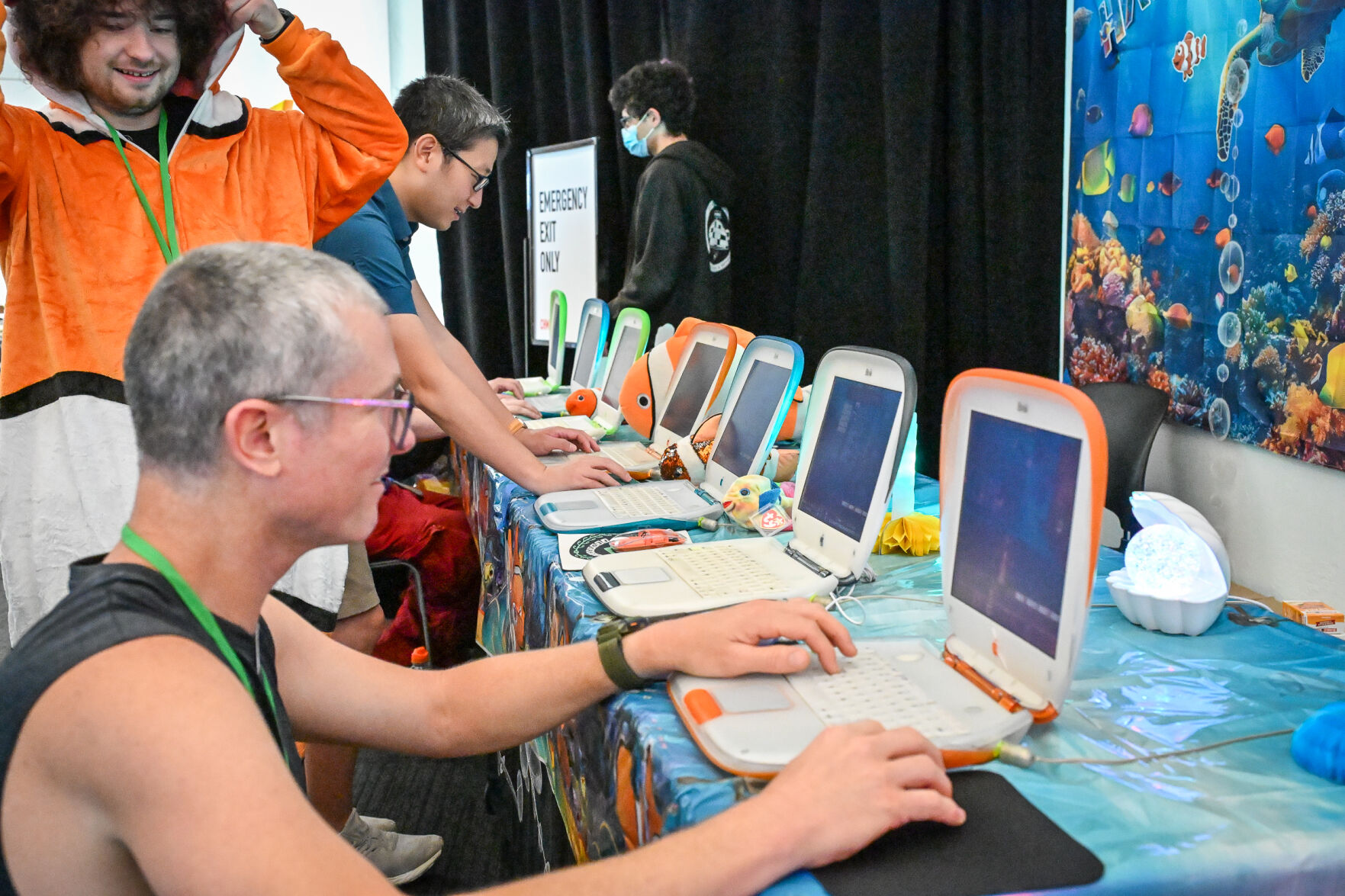
The festival included several hands-on exhibits demonstrating just that, displaying vintage tech products that were used in school, work, leisure time and beyond.
One display, hosted by the Museum of Art and Digital Entertainment located in East Oakland, featured an Atari 2600 where attendees could play Duck Hunt. The Atari 2600 is a video game console popular in the 1970s and ’80s, with a controller made up of one joy-stick and one button.
Another display showcased Apple’s eMate 300, a small laptop released in the late 1990s designed mainly for typing schoolwork.
For children and young adults at the Vintage Computer Festival, this technology may seem basic. But for young people in years past, it was incredibly advanced. And, this technology acted as a building block for everything available today.
Exhibitor and computer programmer Alex Kreis educated attendees on the TRS-80 Model 1 software and hardware. Kreis’ display showcased games that he wrote, programmed and sold to Radio Shack in the late ’80s and early ’90s.
“I like demonstrating the Radio Shack computer because that’s kind of what I grew up with and helped me establish my career in computers,” Kreis said.
The festival included more than personal consumer products. Event speaker and exhibitor Christian Liendo traveled from the East Coast to show what he called “a computer that people say does not exist.”
Liendo’s display was centered on a small, Maryland-based company’s program as an early example of central processing units (CPUs) being used in automated production. This came after the introduction of Intel 4004 in the early ’70s. The company was eventually bought by Warner-Swasey, and its program went on to automate large-scale industrial machines.
Liendo’s talk later that day focused on the same machine and its programming.
These are just a few of the many displays and topics featured at this year’s Vintage Computer Festival.
The Vintage Computer Federation launched in 2020, but festivals focused on vintage computing have been held since the ’90s.
The event in Mountain View is one of a handful of similar events hosted across the country. And, Klein said, they hope to continue expanding and utilizing vintage tech to educate new populations.
The festival’s goal is simple, as stated by VCF’s mission statement: “To preserve computing history through education, outreach, conservation, and restoration. We strive to accomplish this through family friendly hands-on activities at our museum, at regional and global events, and by fostering and nurturing the expansion of our on-line and in-person communities.”