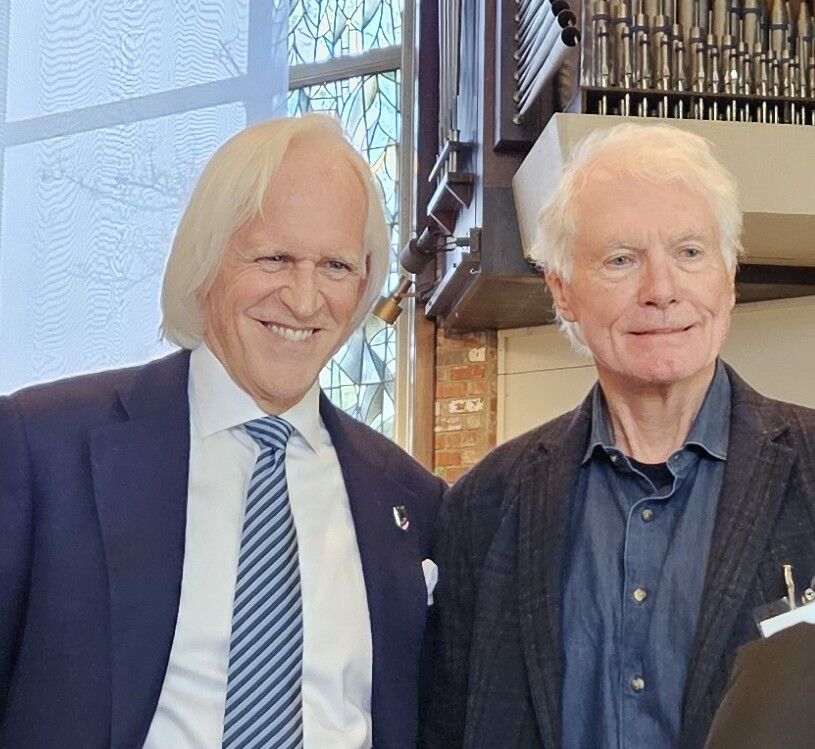
Robert Edsel, author of “The Monuments Men,” enthralled his audience at the Feb. 17 Los Altos Morning Forum with tales of how he came to write the book, the discoveries he made along the way, the heroism he learned about in doing his research and the profound sense of obligation he feels toward the men and women he met and heard about.
Edsel began his talk by thanking the veterans in the audience for their service. He went on to tell of how, after building a successful oil and gas business, he found himself at the age of 40 in possession of considerable money from the sale of the business and thinking, “I don’t want to be that guy who sits around at age 65 saying, ‘I always wanted to (fill in blank) but never got around to it.”
He began studying art and architecture, and one evening on the Ponte Vecchio Bridge in Florence, the question came to him: “How did all the art and sculpture in Italy survive the bombing and looting of World War II?” He asked a number of people – historians, museum curators and others – and their response was “I don’t know. I’ve never thought about it.”
Eventually, he resolved to find the answer, and ended by self-publishing “Rescuing da Vinci” to fill the gap, a book with 360 photos documenting the preservation of Italy’s art heritage.
During World War II, the Monuments, Fine Arts, and Archives Program (MFAA) was proposed by George Stout, conservator of art at Harvard, and authorized by Roosevelt to counter Nazi propaganda that the U.S. troops entering Europe would take away Europe’s art heritage. Given few resources other than the support of Generals Eisenhower and Marshall, the MFAA found and returned thousands of artworks, rare books and historic documents until it disbanded in 1957.
Edsel was just in time to interview some of the people who had been personally involved in rescuing Europe’s art heritage from the Nazis. One 90-year-old who had been uncommunicative in a nursing home came to alertness when Edsel showed him some of the pictures he had collected. He identified some of the uniformed men in the photos, talked with Edsel for four hours and at the end, told Edsel, “I’ve been waiting to talk to you all my life.” He died nine days later.
Edsel felt that he had been passed the torch.
In 2004, Edsel founded the Monuments Men and Women Foundation (MMWF) to collect mementos and information about the MFAA’s work. The foundation has also circulated information about still-missing works of art in the hope that some will surface from families unaware that their veteran’s “souvenirs” are of cultural value. The foundation has published a deck of playing cards that features still-missing artworks, and it works with U.S. museums to establish proper provenance for artwork acquired illegitimately. It has also provided information to curators of museums and libraries on how to preserve the artworks and documents in their care in case of a natural or political disaster.
Edsel gave examples of how Michelangelo’s statue of David and other classic Italian statuary were protected from bombing by brick encasements, and how da Vinci’s “The Last Supper” survived the destruction of the chapel in which it was painted by shieldings of scaffolding and sandbags.
The film “The Monuments Men,” produced by and starring George Clooney, elevated awareness of the importance of protecting cultural icons. Information gathered by the Monuments Men and Women Foundation has now been collected and is on exhibit in the National World War II Museum in New Orleans.
In researching “The Monuments Men” in the Netherlands, Edsel was told about the grave adoption program set up near an American military cemetery by the local citizens. General Eisenhower had promised his troops that they would not be left to be buried in enemy soil, and this cemetery is just over the border with East Germany. At the dedication of the cemetery, 40,000 Dutch people came to pay respects to their liberators. The Netherlanders promised that the 17,800 U.S. servicemen buried in the cemetery would not be neglected. Each of the graves has been adopted by a Dutch family and is carefully tended.
Edsel started the Forever Promise Project to find the families of the buried servicemen and connect them to the families who had adopted their grave. The project has connected 400 families to the adopting families.
Edsel closed his talk by asking, “Why don’t we have a grave adoption project in the U.S.? We need people to think about where our freedom comes from and what it has cost. This is the challenge of our time.”
For more information on the Morning Forum and its spring series, visit morningforum.org. For membership information, visit morningforum.org/2025-2026-Series-Subscription-new.