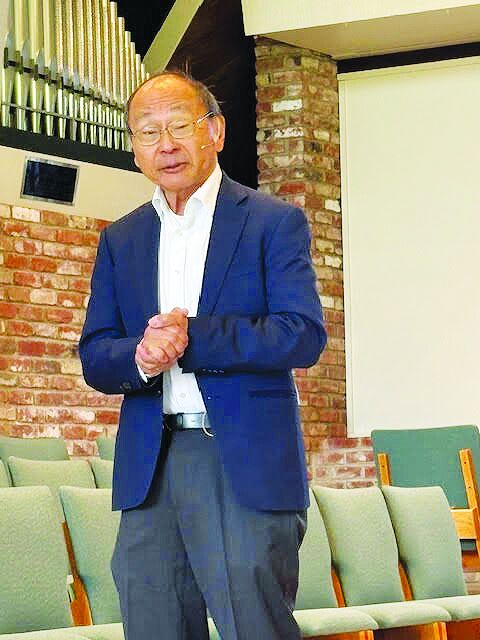
Dr. Francis Fukuyama, political scientist and international relations scholar, gave an informative but sobering talk to his Morning Forum audience on March 4 in which he explained that the “state of Democracy is not good,” internationally or domestically.
Fukuyama, a former Republican and self-described “centrist,” now holds a number of positions at Stanford and has written dozens of books and articles on issues like government bureaucracies and international politics.
Fukuyama is best known for his 1992 book, “The End of History and the Last Man,” which argued that the worldwide spread of liberal democracies would continue as time had proven it to be a better system of government than any other.
Fukuyama explained that by the mid-1970s there was a large rise in the number of democracies. With the collapse of the Soviet Union, the number of nations embracing western values of capitalism and democracy continued to increase, peaking in the first decade of the 21st century.
But then the global economic meltdown brought with it the spread of populist nationalism, Fukuyama said. Rulers in countries like Turkey, Hungary and India, who had been elected democratically, began exhibiting autocratic tendencies and ignoring the rules of law.
The waves of refugees from war-torn countries like Syria seeking asylum in Europe also led to a growth in the popularity of right wing politicians throughout Europe.
As in Europe, the success of the right in the 2016 and 2024 elections can also be attributed to American voters’ fear of unchecked waves of immigrants crossing our borders. Moreover, Trump’s administration has tapped into what Fukuyama described as a historical tendency, not apparent in other liberal democracies, for Americans to distrust government.
Conceding that our government bureaucracy is bloated and needs careful pruning, Fukuyama supports the mission of DOGE. But he stressed that Elon Musk is recklessly purging the government of competent, hard-working employees who pride themselves on public service.
Especially worrisome, said Fukuyama, is the firing of officials like the inspector generals, non-partisan appointees whose charge is to ferret out corruption in the government and thus save the taxpayers’ money, and the elimination of IRS employees, whose job it is to ensure that citizens pay their taxes.
Fukuyama explained that many feel that autocracies are preferable to democracies because autocrats don’t have to worry about bureaucracies or legalisms to get things done.
For example, studies show that China could have built the high-speed rail system to connect Los Angeles and San Francisco for $20 billion instead of the $100 billion that it would cost California.
Furthermore, Fukuyama believes the system will never be completed because California is “the worst place in the world to build anything.” Well-intended regulations created to protect the environment primarily give anyone the ability to block important projects with lawsuits.
Fukuyama conceded that we need to build infrastructure much more quickly. In the 1930s, the Golden Gate Bridge, the Bay Bridge and Hoover Dam were completed in less than four years. Such quick and efficient government action is almost unthinkable today.
To restore faith in the government, Fukuyama argued more politicians need to emulate leaders like Pennsylvania’s Governor Josh Shapiro. After a 2013 tanker truck crash and fire closed Highway 95, a major thoroughfare, Shapiro responded quickly and decisively. Help from federal and local agencies allowed the state to re-open the road after two weeks instead of what was predicted to take six months.
Fukuyama is most concerned about Trump’s refusal to join other members of the free world in condemning Russia’s war crimes; our president’s unwavering support for Putin has, the speaker said, single handedly “destroyed the liberal international order.”
Responding to those who defend Russia’s invasion of Ukraine because of Ukraine’s desire to join NATO, Fukuyama, argued that it’s understandable that most Eastern European countries which experienced the tyranny of Soviet rule want the security promised by NATO membership.
To illustrate the appeal of belonging to NATO, Fukuyama pointed to Sweden and Finland, the country that shares the longest border with Russia, and their decision to join the alliance after Putin invaded Ukraine. Once Finland became part of NATO, Russia withdrew most of its troops stationed along the Finnish border.
Trump’s determination to please Putin and “throw Ukraine under the bus” has terrifying international implications, the speaker warned. China will now be emboldened to take over Taiwan as it no longer worries that the U.S. under Trump will retaliate. Tyrants throughout the globe no longer have anything to fear from what was just a few months ago the world’s greatest defender of democracies.
America’s threat to withdraw from NATO, said Fukuyama, leads to the question of whether Europe, with the growth of rightwing factions of its own, can muster the forces and finances to combat Russia if Putin acts on his desire to take over more Eastern European countries.
Fukuyama acknowledged that we have more checks and balances on a powerhungry executive than most other democracies. But that system is being “sorely tested” as in his first six weeks in power Trump has issued a “blizzard of executive orders, many unconstitutional.”
Fukuyama believes that the Supreme Court will rule against some of the most egregiously unlawful of these orders. “However,” he admits, “I don’t know what will happen if Trump refuses to comply with court orders.”
The courts have always relied on “accepted norms” that assumed other branches of the government would obey the courts’ decisions. But authoritarian leaders, he explained, usually ignore legal norms.
The Morning Forum of Los Altos speaker series is held at the Los Altos United Methodist Church, 655 Magdalena Ave., and is also accessible via Zoom.
For more information, visit morningforum.org.