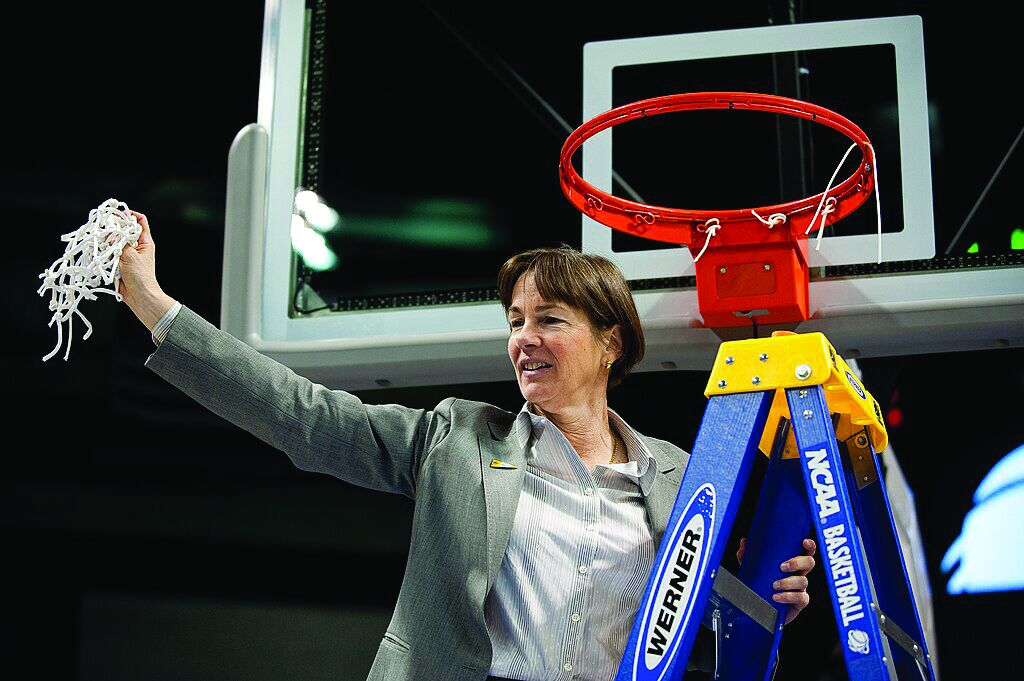
Former Stanford basketball coach Tara Van Derveer reflected on her long career and provided insight into the changing landscape of college athletics during a Feb. 15 Morning Forum meeting. Van Derveer coached her Stanford women’s basketball team to multiple national championships and the U.S. Women’s Olympic basketball team to a gold medal. Her talk helped mark the Morning Forum’s 75th year.
Van Derveer’s fascination with basketball began while taking her fourth grade physical education classes. At that time, before the passage of Title IX, there were very limited sports options for girls.
Van Derveer sharpened her skills in pick-up games with the neighborhood boys, during which she made sure of being selected onto teams by wowing them with her basketball skills.
After the passage of Title IX, which guaranteed equal sports opportunities for women, Van Derveer transferred from Albany College to Indiana University, where she could take coaching classes from revered basketball coach Bobby Knight. There she noted that while the men’s team had training tables and chartered planes for their games, the women’s team bought their own meals and rented a van for their travels.
Van Derveer had thought to go to law school after college, but her parents’ insistence that she coach her sister’s basketball team introduced her to the thrill of coaching. She later earned a master’s in sport administration at Ohio State. When she began coaching at Idaho, the women were expected to vacate the floor even if they had not finished their game before the varsity team was due to start. Van Derveer soon changed that expectation.
She returned to Ohio State as head coach, and by the time she ended her tenure there in 1985, the women’s games were pulling over 20,000 attendees.
Van Derveer moved to Stanford in 1986 despite her father’s warning that it would be “a graveyard job.” She was inspired by water polo coach Dante Dettamanti, whose teams had won five national championships. “If he can do it, I can do it,” she resolved. She also took inspiration from some of her players. She cited Angela Taylor, who despite riding the bench as a walk-on for most of a season, saw her role as “spreading sunshine.”
Jennifer Azzi showed heart and leadership by inspiring the team to donate money and clothing to beggar women in Ukraine. And Chris McMurdo showed Van Derveer how to set a high goal by saying as she was being introduced to Stanford “I want to make a difference in this world.”
In the Q & A session following her talk, Van Derveer noted that the women’s teams at Stanford routinely play against men in practice “so they can get better.” The issue of transgender athletes playing in competitive sports is overblown, she said. “There are 10 out of 510,000 athletes involved in NCAA sports who identify as transgender – it’s a miniscule percentage. An executive order banning guns would protect students a lot better.”
Van Derveer bemoaned how money has changed the landscape of college sports. She feels that the demise of the Pac-12, a decision “so sad” because it was “a great league, over 100 years old,” was because of the lure of massive media dollars offered to USC and UCLA.“It doesn’t make sense for Oregon and Stanford to be playing in the ACC,” she said. “I’m hoping it will be temporary, and in five to seven years there will be a new alignment.”
The payment of athletes for the use of their name, image, and likeness (NIL) is only fair, said Van Derveer. But some colleges have asked wealthy donors to set up a collective pool to provide extra cash for less celebrated athletes. These collectives operate outside the academic world and although they justify themselves as a form of NIL, it is outside the original intent. A collective can call an athlete at another school and offer him or her thousands of dollars to transfer.
Another variation in the name of NIL is “revenue-sharing,” part of a settlement to be finalized April 7 in House vs. NCAA. Only a couple of dozen schools actually make a profit from athletics, and this case will mandate that such revenue is shared among the athletes. Over $2.5 billion will be distributed among athletes who competed between 2016 and 2024 as back pay. However, there are no guidelines as yet as to how the money will be distributed. Title IX has not been held to apply.
“It’s disheartening,” Van Derveer said. “We’ve worked so hard, since Title IX, and now all this money is going to go into football and men’s basketball, and very little into women’s sports. … The message in sports is ‘steaks for the boys, and hot dogs for the girls.’”
Recruiting and team-building are also affected by recent changes. Each athlete must have a separate contract stipulating how collective revenue or revenue sharing would be applied in his/her case. And once an athlete is recruited to a specific school, he/she now has much more freedom to transfer afterward without having to sit out a year. A coach is not allowed to contact a player at another school, but nothing prevents a player from asking his/her high school coach to call a coach at another school and see if a deal would be offered.And the ready availability of social media only makes it easier for a player to imagine the opportunities would be better at a different school.
“Now you don’t get the commitment you have on great teams,” Van Derveer said. “It’s a disservice to the young players. Being a member of a team is such a wonderful experience. Young people, both boys and girls, deserve the opportunity.”