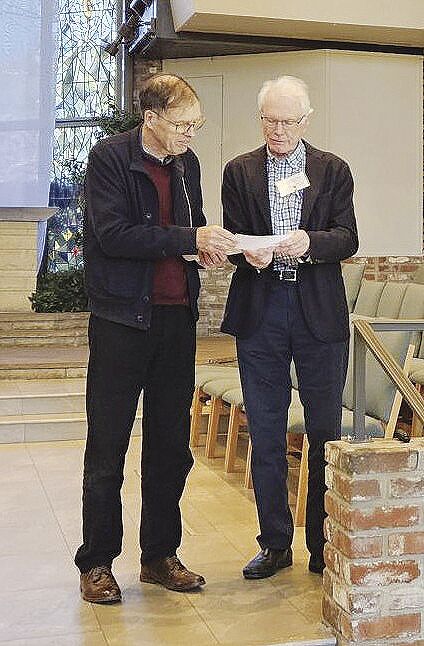
Archaeologist Ian Hodder, former director of Stanford’s Archeology Center and currently teaching at Koc University in Istanbul, led a Morning Forum audience on a guided video tour of the ancient village of Catalhoyuk on Jan. 7.
The village of Catalhoyuk, located in central Turkey, was occupied for more than 1,000 years beginning 9,000 years ago. At its height the village was home to about 8,000 people. Hodder spent 20 years exploring and excavating the site, which after some decades of neglect has now become a tourist destination with a state-of-the-art visitor’s center.
Hodder provided entry into a Neolithic home site through the magic of video, allowing the audience to feel what life may have been like in a civilization with cultural norms and rituals far removed from our own.
In Neolithic Catalhoyuk there were no streets, the houses crammed together with access by climbing over neighboring roofs and descending a ladder into the windowless living space.
Light was provided only from the oven and the hearth, both built of sun-dried bricks, so the darkness was deepened by smoke.
Unlike earlier settlements of the Paleolithic age, Catalhoyuk showed no evidence of annual meetings or ritual centers. Instead, rituals related to hunting and burial were brought into each home as part of daily life.
The northern corner of the space was devoted to ritual and to sleeping. The walls were decorated with art objects depicting bears and bulls, augmented by geometric designs which may have been associated with the ritual burial of community members beneath the sleeping platforms. The bodies of the dead were dried, possibly smoked, so that they were odor free.
Many were buried without their heads, the heads being reserved as ritual items and restored with clay facial features and paint. Some heads were later buried as companions to other family members.
The other three corners of the living space were devoted to production – cooking, weaving cloth from bark fibers, crafting utensils such as forks, spoons and knives from bone, wood, shells or obsidian, some of which was obtained by active trading with other communities.
Less utilitarian objects such as rings and intricate necklaces made from shell and bone were also found at the site.
Modern research tools allowed Hodder and his research team to study the diet and DNA of the buried individuals.
They found that, contrary to expectation, less than a third of the skeletons buried in a single home were related by DNA. They found also that the
residents of each home had slightly different diets from those in other homes, which made sense for a culture that was still primarily hunter-gatherer, although the community had domesticated sheep and farmed cereal grains.
The surrounding area, now arid, had been a wetland at the time Catalhoyuk thrived, with resources including fruit and nut trees, waterfowl and their eggs, and wild cattle. The wildlife also included leopards and bears.
Wall art in some of the houses shows hunters sporting leopard skins as loincloths and capes; the leopard was evidently revered as a powerful totem. The hunters are shown first baiting, then killing a deer or bear or bull, and there is evidence of community feasting at the end of a successful hunt.
A number of female iconic images have also been found at Catalhoyuk. These images emphasize the woman’s buttocks and breasts, and the best known shows a massive woman sitting on a throne guarded by leopards.
This, plus DNA evidence that shows family relationships within a house passed down through the matriarchal line, gives rise to the speculation that Catalhoyuk was a matriarchal society. Hodder feels, however, that other evidence indicates that the two genders shared most roles equally; men and women ate the same food and were buried in the same way. Special diet and status was given to the aged.
Some houses seemed to accumulate more burials and ritual items than others, with DNA evidence that non-related bodies were accepted. However, at some point these houses were burned, possibly to prevent any one family or social group from becoming too important.
DNA studies also imply that children were often fostered out to non-biological parents, which would also prevent any one family from gaining dominance. Hodder pointed out how different this social organization is from modern Western and Asian societal norms in which family connections are crucial in assigning property, social prestige and often political power.
He characterized Catalhoyuk society as being “aggressively egalitarian.”
In the Q&A session following the talk, Hodder noted that the DNA evidence of Catalhoyuk indicates that 80-90% of modern Turks are descended from the same ethnic background as the Neolithic people of Catalhoyuk. This conclusion goes against the popular Turkish origin myth that modern Turks originated in Central Asia and as a mounted army drove out the native population of Anatolia.
In discussion after the talk, Hodder noted that the current government of Turkey has very mixed feelings about the discoveries at Catalhoyuk.
On the one hand, the Turks are proud of the discovery and eager to make it a tourist destination; on the other hand, the time frame of the Neolithic village contradicts some conservative Islamic ideas about the age and origin of Turkish civilization.
At least one book offered for sale at the center’s store has been banned. “The Turks love the site, but you have to tell the right story about it,” Hodder said.
Morning Forum of Los Altos is a membership lecture series held Tuesdays at the Los Altos United Methodist Church. For more information, visit morningforum.org.