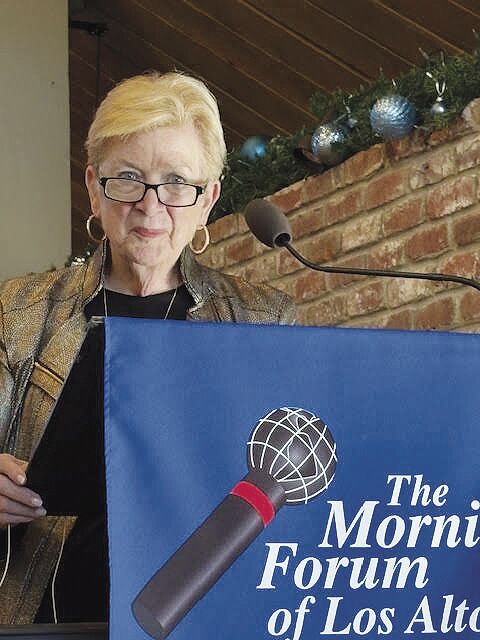
Jonna Hiestand Mendez dazzled her Morning Forum audience Dec. 3 with a fascinating and often humorous account of her 27 years with the CIA.
Mendez’s work as an agent and an expert in covert photography and disguise took her to hot spots around the world including Moscow, East Germany and Cuba. On her retirement, she was awarded the CIA’s highest honor.
Mendez is the author of five books, including three with her late husband, Tony Mendez; one of them, “Argo,” described the amazing rescue, led by Tony, of six American diplomats from Iran during the 1979 hostage crisis. The Oscar-winning film “Argo” was based on that rescue.
Mendez’s most recent book is “True Face: A Woman’s Life in the CIA.” Bored during COVID, she originally meant to just write a memoir for her son, who was born after she retired from the CIA, so he would know what her earlier adult life was like. After all, she said, “when you leave the CIA, you can’t take anything with you but your brain and your memory.”
But, she explained, “my editor also wanted me to cover the experiences of other women in the agency and describe the misogyny common in the CIA at the time.” Mendez went on to say that women had no one to complain to so they just ignored the slights and insults.
Mendez was raised in Wichita, Kansas, and planned to be a teacher. But when she was 20, she went to Italy to attend her best friend’s wedding and decided to stay in Europe. Although she knew no German and had neither bank experience nor a work permit, she applied for work at Chase Manhattan in Frankfurt. Despite her lack of credentials, she was hired.
She soon married her first husband but didn’t know he was an agent until after their wedding. Married to an agent, she was qualified to get a job as a CIA “contract wife.” She credits the skills she learned in her eighth grade dictation class for earning her the job offer.
She quickly climbed the ranks, becoming an undercover agent with posts throughout the world. Next, she joined the Office of Technical Service and worked overseas as a specialist in undercover photography. She taught assets how to use spy cameras, pens that contained an eight-lens camera.
The pens, easily tucked into pockets, purses and even fake pregnancy lumps, allowed agents to take pictures without detection. Putin’s future plans were passed on by photographs of top secret documents covertly photographed through an asset’s “pen.”
Working with the Russian assets was both the most challenging and most stressful part of the job, Mendez said. The KGB was “on top of us all the time. We were protected by diplomatic immunity but if assets were caught with these devices they were often executed.”
Mendez also described why the technical branch of the CIA and disguise experts like her husband have such a collaborative relationship with Hollywood. Both the film industry and the CIA are “magic builders who must rely heavily on disguise and illusions. Impressed with the disguises created for “The Planet of the Apes,” Tony became good friends with its make-up artist, John Chambers, whom he later enlisted to help with disguises in the Iran hostage rescue.
Mendez explained how such tricks and devices have played an important role in keeping assets effective and safe. Since so much of the spy business involves following and eluding the other side, Hollywood specialists designed dolls that could be blown up to look like the passengers, i.e., assets being followed by the KGB. The real passenger would slip out of the car, but the dolls, previously hidden in the driver’s briefcase, would be quickly blown up to create the illusion that the original passenger was still in the same seat.
As is portrayed in the film “Argo,” Tony, a talented artist, was invaluable as a counterfeiter. Everything design and disguise experts like Tony and Jonna created, she said, “had to look like something else.” To illustrate the art of this deception, Mendez showed slides of a walnut containing a tiny piece of paper with a coded message; a dead, hollowed-out rat velcroed shut so it could contain any number of items like medicine for assets’ children, emeralds and, of course, coded notes; and an old flattened-out milk carton, containing what looked like “sick,” actually plaster of Paris. Since few people want to handle dead rats or vomit, both were clever vehicles for passing on items and messages.
Mendez encouraged audience members interested in learning more about these ingenious tools to go to the International Spy Museum, in Washington, D.C., where separate exhibits are dedicated to celebrating both Jonna’s and Tony’s contributions to the intelligence community.
When asked whether current and former CIA personnel are terrified of what will happen to the agency under the new administration, Mendez said emphatically, “YES!!!! All caps, many, many exclamation points.”
Despite the glamour portrayed on TV shows and movies, being a spy is not a great job for many, Mendez concluded. The pay is lousy, you have to be able to keep secrets, even spouses can’t know what you do, and you can’t expect a pat on the back. Even after Tony’s team successfully rescued the diplomats from Iran, no one from the agency said “good job.”
Yet Mendez’s talk made it clear that her career was as exciting, creative and successful as any job could be. She clearly had a life that took her literally and figuratively further away from Kansas that any young college girl could imagine possible.
Morning Forum is a membership speaker series held both in person and online. For more information, visit morningforum.org.