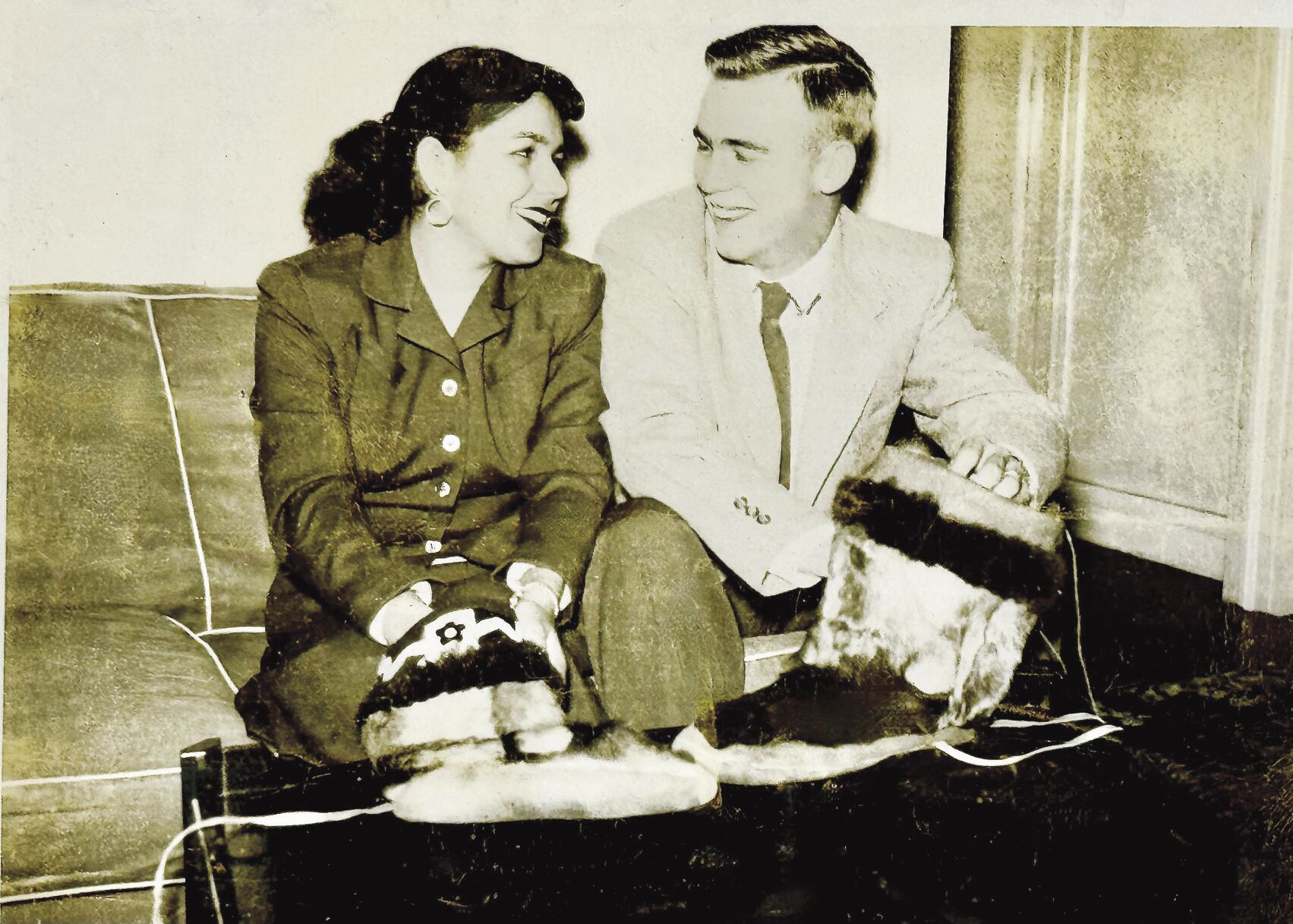
It was more than 70 years ago when Gilbert Newcomb and Shirley Vernetti first laid eyes on each other at a remote trading post in the chilly Alaskan interior.
The 19-year-old Gilbert was working for the U.S. Coast and Geodetic Survey when bad weather and some bad meat made him terribly ill. His co-workers brought him to the trading post, at the intersection of the Koyukuk and Yukon rivers and sent for a nurse. “In came this most striking woman,” Gilbert described.
The feeling was mutual. It was love at first sight.
Despite their busy schedules, Gilbert and Shirley made as much time as they could for each other. Shirley joined a flotilla with 27 guys just so that she could spend time with Gilbert. And later, when he was stranded in some foul weather, she came along in another boat and rescued him.
At the end of the summer of 1953, he took on an extra job storing equipment at the University of Alaska at Fairbanks just so he could spend a little more time with Shirley. It was not long before he popped the question.
“They spent very little time together prior to their engagement,” noted daughter Libby. “We’re talking days to maybe a few weeks.”
The wedding chapel was 18 miles away from the trading post, accessible only by dog sled. But that wasn’t stopping them. On Jan. 2, 1954, they were married.
Fast forward 70 years. Their south Los Altos home on Jan. 2, 2024 is inundated with members of their large family – the Newcombs had 10 children and numerous grandchildren. Shirley and Gilbert, now 92 and 90 respectively, are remarkably spry, upbeat and thankful for the lives they’ve led. They’ve had the good fortune of living in idyllic neighborhoods, first in Camden New Jersey, for 10 years, then California. They moved to their current home in south Los Altos in 1971 and have been there ever since.
Different backgrounds
It seemed the Gilbert and Shirley were destined to connect despite originating from very different parts of the country. Gilbert was originally from the small town of Starke, Florida. Shirley was one of just a few women working at the Koyukuk trading post. Her dad, an Italian immigrant drawn to Alaska by the promise of gold, eventually made a living as a trapper and founded the trading post. Her mother, a school teacher, was half Scottish, half Native American.
Gilbert eventually made his way to Alaska by accepting jobs that had him working in the great outdoors. By the end of high school, he said the U.S. Department of the Interior offered him a job that took him to Gallup, New Mexico.
“Now I’d never been out the state of Florida and I’d never seen snowflakes. I’ve never seen a mountain,” Gilbert said. “So I said yes.”
His work also took him to Utah, Arizona and Colorado. “And boy, did I fall in love with the west.”
He started his secondary education at University of Florida in Gainsville before getting a call to do work in Alaska. Naturally, he said yes.
Gilbert did survey work through a triangulation process – using trigonometry to determine a point by measuring angles from known points. The Koyukuk trading post was one of the known points. The work involved traveling hundreds of miles, often in freezing temperatures. Shirley recalled one time when the temperature dropped to 70 below zero.
“I didn’t know (how cold it was) until we turned on the radio,” Shirley said. “I kept putting on socks – after 50 (below), it’s all irrelevant.”
Besides their youthful good looks, both possessed the same active approach to life – they were always working and they were close in age. Shirley was going to nursing school, while Gilbert was pursuing an engineering degree.
After getting married, Gilbert was drafted into the Army. He was stationed at Fort Richardson in Alaska. Both he and Shirley attended the University of Portland where Gilbert received his engineering degree. Later, he earned his master’s in electrical engineering at Drexel University in Philadelphia.
In the 1960s, Gilbert was involved in the development of “airborne aerospace telemetry recording systems,” according to the Institute of Electrical and Electronics Engineers, that led to the design of the Gemini Spacecraft recording system. With RCA, in Camden, N.J., he worked with digital recording systems using magnetic and laser technology. With Environmental Measurements in San Francisco, he worked on development of correlation techniques and their application to the measurement of air polluting gases.
Family matters
Of the Newcombs’ 10 children. Five daughters are still alive. Two of their daughters, Libby and Ella, were present during the Town Crier’s interview with the couple last week. Gilbert and Shirley were full of fond memories as they talked about their lives. Gilbert articulated a chronology of their various travels, while Shirley frequently interjected colorful remarks. They passed around old photos and produced a box of pelts as they told stories of trapping beavers in Alaska.
Gilbert marveled at the chance happenings during their lives that led to wonderful turning points. For instance, he remembered driving by the house in Los Altos for the first time. “There were these toys and a for-sale sign next to them,” he said. So Gilbert knocked on the door. “Which is for sale, the house or the toys?” he asked the former owner. “The house,” came the answer. They bought it.
Gilbert also had a lifelong friend, Lee Langan, who connected him with jobs in both Alaska and California. Langan, an accomplished engineer, journalist, photographer and philanthropist, died last year. Langan, who founded the Environmental Measurements, lured Gilbert to his company.
Gilbert’s work had him traveling a lot, leaving Shirley to the day-to-day operations of the large family.
“They have a lot of respect for each other,” Ella said.
They were both asked more than once what was the secret to their long marriage, but an answer did not come readily.
Shirley noted, “We were always so busy we never stopped to think about it.”