A global shift to a vegetarian diet would not only be a healthier choice, it might also save the planet.
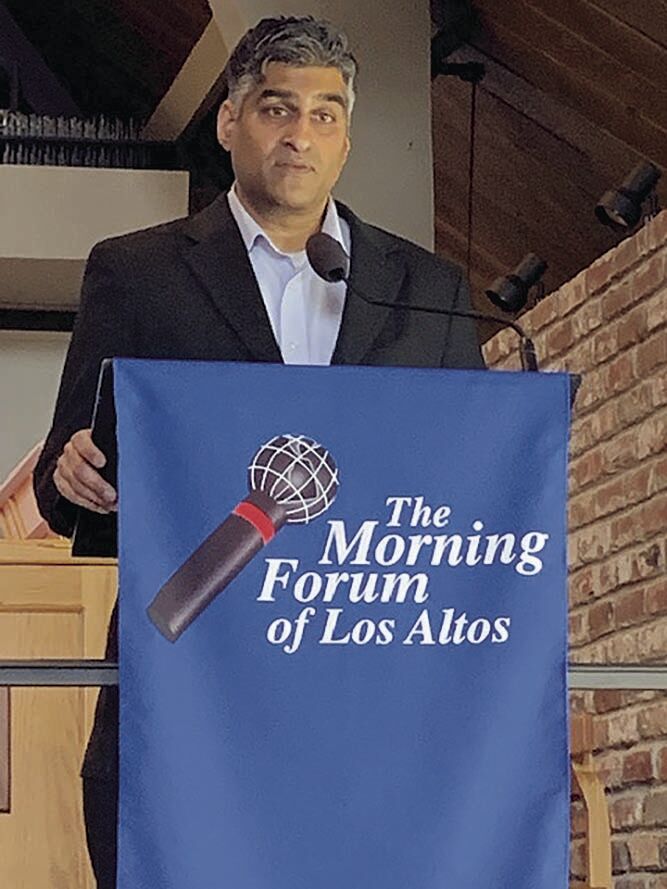
That was the message delivered by engineer, activist and entrepreneur Mohan Gurunathan during his lecture “The Earth on Your Plate: How Diet Can Transform the Earth and Your Health” before the Morning Forum of Los Altos Feb. 21.
Gurunathan, who has worked in Silicon Valley the past 20 years, earned a Bachelor of Science and a master’s degree in electrical engineering and computer science from MIT. He played a leading role in convincing the city of Mountain View to include a plant-based diet promotion as part of its sustainability plan.
“We are living in the most advanced civilization that has ever existed,” he said. “But we are at a turning point. The actions we take will determine whether, 50 years from now, we go into a darker period due to environmental issues. Agriculture is responsible for some of our biggest challenges.”
Gurunathan said people have been taught that protein means meat, which is a fallacy, a myth. All the proteins people need can be found directly in the plants themselves. He added that 41% of the U.S. land mass is used for feeding livestock, and a much smaller amount of land is used to grow fruits, vegetables and legumes that feed people directly.
It is incredibly inefficient to use so much land to grow food to feed the animals and then eat those animals, Gurunathan said. Approximately 77 billion animals are slaughtered globally each year for food, 10 times the human population of the world.
“This is so wasteful, but we rarely give it a thought when we buy a burger or ham sandwich,” he said.
Animal agriculture leads to multiple problems, he said. Concerning climate change, global animal agriculture leads to an estimated 28% of all greenhouse gas emissions, exceeding the emissions of all forms of transportation combined. How does this happen? Gurunathan listed the causes: deforestation, methane gas, poop, fertilizer and all of the energy it takes to raise and slaughter the animals. Regarding deforestation, he added that trees are our best friends to reduce the amount of carbon in the air.
The meat and dairy industries use one-third of the Earth’s fresh water, said Gurunathan, noting that domestic water use in the U.S. is 5%, while animal agriculture uses 55%. The resulting enormous amount of poop pollutes the water system because it isn’t regulated by laws.
Globally, approximately 90% of the fish stocks are either fully depleted or are being overfished, according to Gurunathan.
“At this rate, we won’t have any fish left within 50 years,” he said. “Fish farming is destructive to the environment.”
Dietary shift
Gurunathan explained how the meat and dairy industries have heavily influenced U.S. food policy for decades. These industries are subsidized by the U.S. government annually with $38 billion, he said, while fruits and vegetables are subsidized with $17 million, or just 0.04% of the meat and dairy industries.
He stated that studies show that people cannot stop climate change without global diet change – we need to eat 90% less beef, 90% less pork and 50% less eggs, and drink 60% less milk. Plant-based diets can reduce heart disease risk by 40%, cancer by up to 40% and can help reverse Type 2 diabetes, Gurunathan added.
In summary, he said, the U.S. government is promoting and subsidizing foods that destroy people’s health as well as the environment. A dietary shift would be profound and transformational.
What is the good news? Gurunathan said there is one simple solution to these many problems: Whenever you can, choose to eat plant-based foods. Two ideas to consider are to choose one meal a day to eat plant-based, and choose two days per week to not eat animal products. Replace cow’s milk with a plant-based milk. At a restaurant, try the vegetarian option. Try the plant-based meat and cheese alternatives. Use the internet to find vegan recipes, which exist for every food.
Most importantly, Gurunathan advised, teach others about switching to a plant-based diet.
The next Morning Forum lecture is “The Origins of Authority in Ancient Chavin de Huántar, Peru,” with speaker John W. Rick, associate professor emeritus of anthropology at Stanford University, scheduled 10 a.m. Tuesday at Los Altos United Methodist Church, 655 Magdalena Ave.
To join Morning Forum and for more information, email Shar Thorson at [email protected] or visit morningforum.org.