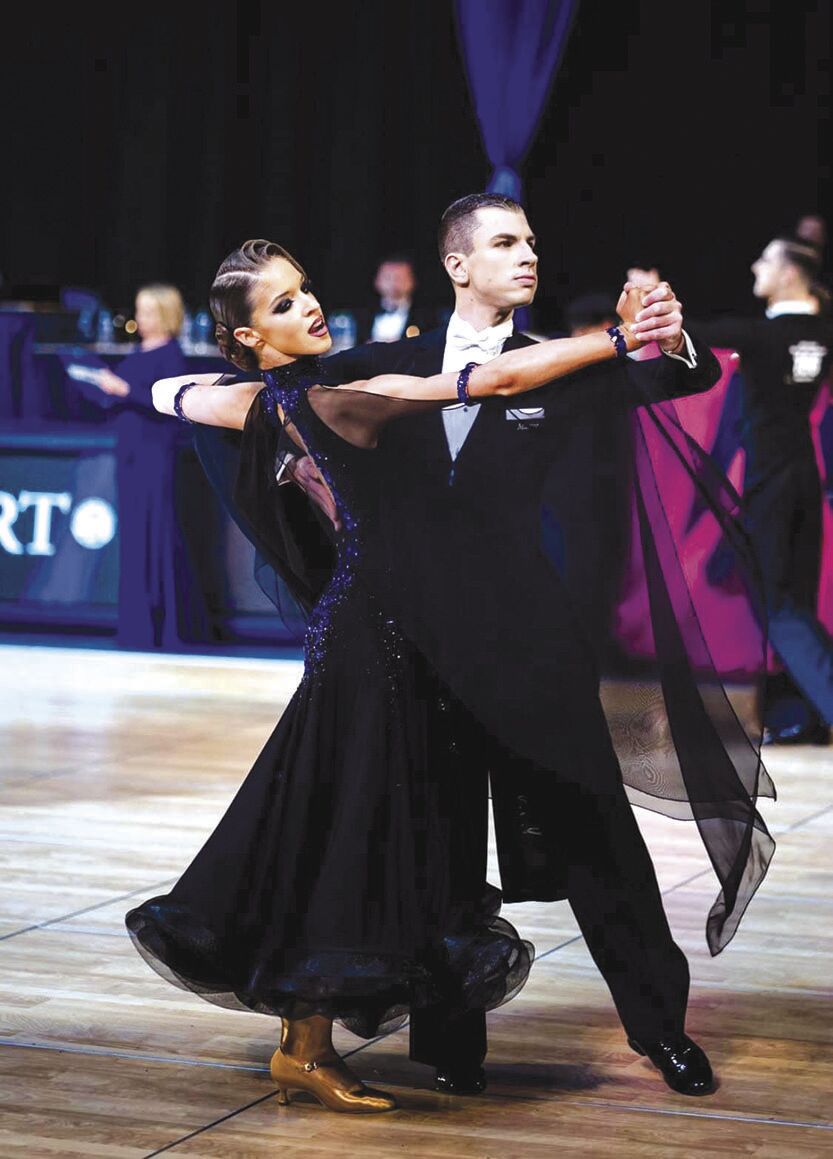
Back in February, dance partners Tais Zhukova, a Mountain View resident, and Arthur Nabok were deep in the throes of chaos that comes with preparing for a competition.
The U.S. National Amateur DanceSport Championships in Utah in March would be their first large ballroom dance competition as a couple, and they were practicing seven hours a day, six days a week. The two already had a lot on their plates between teaching and training, but global circumstances would shake their plans.
The pair met in person for the first time approximately six months prior to the competition. Nabok, a lifelong competitive dancer and teacher, had freshly returned to the U.S. after spending some time in Poland and his native Ukraine – a home country he shares with Zhukova. He and Zhukova had some online conversations about a potential dance partnership, but things quickly came together once they danced together for the first time.
“We weren’t thinking about who we would compete against or about the difficulty of the circumstances we were up against as a new couple in a foreign country, or how other people don’t have to worry about leaving their relatives behind – we just took it day by day,” Zhukova said.
For ballroom dancers, partnership resembles less a personal relationship than a business commitment. Couples not only consider how well they dance together, but also how they get along, their finances, travel arrangements and scheduling.
The life and schedule of ballroom dancers is hectic and demanding. Zhukova splits her time between San Francisco and Los Altos, driving back and forth up to six days a week to teach at Arete Dance Center in Los Altos in the morning and then spending the second half of her day training with her coaches at Sukachov Dance Academy and rehearsing with Nabok in San Francisco. Over the past year, she has driven nearly 30,000 miles.
News of the war
On Feb. 23, just two weeks before the national competition, Zhukova received a call from her parents that the Russian war on Ukraine had begun. Her parents live in the Bay Area, but her cousins, aunts, uncles, grandparents and friends were stuck in different parts of Ukraine.
She was shocked that the other shoe had finally dropped, as she had been hearing talk of conflict for years without anything major happening.
“I didn’t think it was important, because so many times American people have asked me, ‘What’s going on in Ukraine?’ And I always said, ‘It’s going to be fine; it’s been going on for almost 10 years.’ But this time it was different,” Zhukova said.
The dance partners were in the middle of rehearsing when they received word of the war. Rehearsal time is precious when leading up to a competition, but Zhukova and Nabok spent the first couple of hours reading the news and figuring out the logistics of keeping their families safe.
The majority of Nabok’s family, including his parents, live in unsafe parts of Ukraine. He takes care of his family financially, but he was also working overtime to help his family find safety.
They began to question whether or not the competition was still worth it.
“It was a lot of silence, a lot of sitting and texting family,” Zhukova said. “And then in the next three days, I mean, there are only so many times you can ask, ‘Hey, how’s your family?’ ‘Yeah, it’s really bad news.’ After a while, even though it’s still going on, it gets old. So we would just come into practice and almost pretend that it’s not there. And we wouldn’t talk very much, because you really can’t talk about anything fun or happy because then you feel guilty.”
Success in adversity
Regardless of the extreme stress they were under, Zhukova and Nabok went through the motions – and their attitudes began to shift. They realized there was no sense in abandoning their aspirations.
Zhukova said her dancing even became a source of hope and escapism for family members abroad seeking happy news and inspiration.
They also felt empowered by the active Eastern European community within the dance scene, which sponsored fundraisers and collected supplies to send to people in need in Ukraine. Arete Dance Center held a fundraiser for Ukraine to which Zhukova and Nabok donated a private dance lesson.
Because they were such a new partnership and they had both been out of the competitive scene for a few years, Zhukova and Nabok went into the competition without expectations, but they reached the final round and, to their surprise, placed fifth nationally.
“We were so proud to bring the result home, and we felt like even though our placement didn’t help our families in Ukraine in a direct way, they felt better knowing that even though their situation was difficult, they have family who were safe and that they could be proud of,” Zhukova said.
Since then, Zhukova and Nabok have continued to perform well in smaller competitions, bringing home the gold at this year’s Portland Open DanceSport Competition and the Dance Stars Festival in Burlingame. Several of their family members remain in Ukraine, but the pair hope their story serves as encouragement to those back home.
“We hope that our story might inspire people to stay united and to bring some feeling of understanding to other dancers whose families are affected by this awful war just like ours are,” Zhukova said.