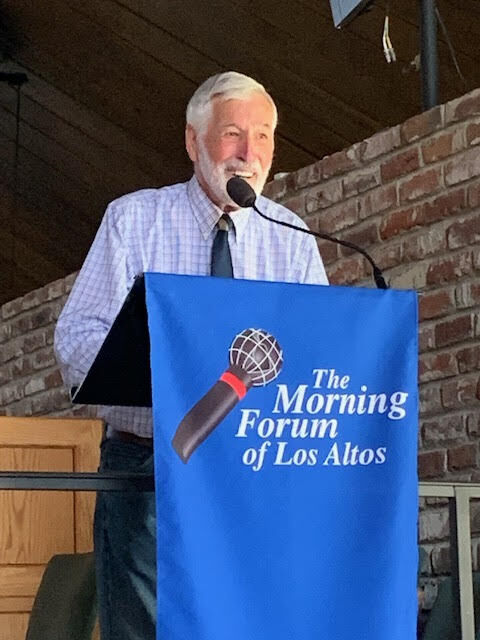
Retired teacher and art collector Tim Farrell highlighted the work and social importance of English artist William Hogarth during his Morning Forum of Los Altos presentation, “Gin, Sin, Sex in the City: William Hogarth’s London,” March 1.
Over the years, Farrell, a Los Altos resident and former president of Morning Forum, has amassed a large collection of Hogarth’s etchings and engravings.
Farrell pointed out how gin, sin, sex and the city were the subjects of hundreds of Hogarth’s graphics and were his statement about how decrepit and damaged London society had become and how little was being done to correct the problem. He discussed his fascination with Hogarth and his body of work and how his search for more to collect both enlightened him about the artist and illustrated the dire social situation of the time.
Hogarth (1697-1764) began as a portrait painter but later in his career used etchings and engravings as an inexpensive way to make art collection possible for those without significant means. His skill as a silversmith, Farrell said, gave him the talent to develop etchings and engravings that could be reproduced and sold at a much lower cost than oil paintings.
According to Farrell, Hogarth was, especially in his graphic works, a moralist and social critic. Farrell showed several of Hogarth’s works that depicted the immense problems with overconsumption of gin, which, he said, afforded the “quickest, most complete and least costly means of intoxication.” A slogan of the time: “Drunk for a penny, dead drunk for two pence.”
Both gin and beer were abused, Farrell said. In most of the prints, he pointed out both the consumption and the graphic physically destructive results of alcohol abuse.
Often, Hogarth’s pictures included the effect on accompanying children as well as the destruction of the drinker. Hogarth illustrated the precipitous decline of excessive drinkers, Farrell said, often with a series of prints, each one showing a lower degree of degradation and the last being complete personal destruction.
A number of the prints clearly identified the drinkers, Farrell noted, adding that Hogarth wanted to make an example that might encourage change. Farrell said that change was not often in evidence.
Farrell discussed how Hogarth’s sequential art prints made him a forerunner of the modern graphic novel. One famous example Farrell showed was “A Harlot’s Progress,” a series of prints that traced the decline of a “good” country girl to a ruined prostitute, thanks to gin. Often these types of prints showed characters who were recognizable at the time. Farrell said Hogarth used the prints to make a statement about well-known public figures, as well as to make observations about less well-known and less-prosperous citizens.
Farrell’s collection of Hogarth prints and his commentary were a window into another political time. Although amusing, Farrell said the prints were clearly an attempt to change or at least question the effect of questionable behavior in the society of the time. The problems Hogarth illuminated do not end in Hogarth’s time, he added.
Morning Forum of Los Altos is a members-only lecture series that meets the first and third Tuesdays of the month at Los Altos United Methodist Church. For membership details and more information, visit morningforum.org.