Los Altos resident Ruti Zisser came to this area for technical work, as a product manager by day, but the startup she hatched in her garage emerged from a much older family trade – the love of drape and detail that had been shared by her mother and grandmother before her.
Zisser’s chain of boutiques and fashion label, Ruti, started as a tiny import business based out of her home. She missed the fashion of her native Israel and loved to dress others, which she did for two years.
“When I moved to the States, I missed it very much, so I decided to bring my favorite items that I feel fit the women in the area,” she said.
In 2010, she expanded to an eponymous brick-and-mortar boutique at Palo Alto’s Town & Country Village. After opening her second store and seeing her business grow, she concluded that she wanted to be able to offer very specific pieces, responding to what she was hearing from customers in the shop. That’s when she started producing her own line.
In the genes
Zisser’s ancestors were seamstresses and tailors, and during World War II they relied on their skills to survive as a Jewish family in Germany.
“My grandmother was really, really good at that. She was the one who did the clothing for Eva Braun, the lover of Hitler – she was very, very talented, and this was one way she survived,” said Zisser, whose family immigrated to Israel after the war.
Her parents, Zisser recalled, thought she “could do so much more,” so she steered a more technical course for her first decades of life until “I found my way back.”
Today, she has independent shops across the U.S., an e-commerce presence and is hosting her first fashion show, at her Belmont design studio, Thursday night.
The event aims to capture some of the energy of the Fashion Week currently underway in New York, showing customers where the new collections begin in the studio and showcasing familiar pieces in a fully styled context.
The Ruti look rests on a triangle of “cool, comfortable and flattering,” Zisser said. Her personal interest in the pieces is reflected in commentary she pens for the Ruti website, describing, for instance, her discomfort with one-dimensional business suits that present a corporate feel but forget the rest.
Paired as a three-piece suit, her Brighton short vest ($249), vegan suede Otto jacket ($279) and vegan suede Sadie straight pants ($249) in light black with very light stripes seek the “cool” in attire that’s office appropriate but intensely updated. The fitted vest dresses down with jeans or tucks underneath the jacket, which is long enough to “cover exactly what you want it to cover.”
Designing for locals
Producing a look specifically informed by her peers in the Los Altos area led Zisser to a very specific take on feminine, professional cool.
“They are more confident, so they don’t have to wear a big brand to feel good about themselves, they don’t need to wear a Prada bag with a huge Prada sign on it,” she said. “This is what I like about this area so much – people are so confident, they don’t need to show off anything and I can wear what I want, the way I want it.”
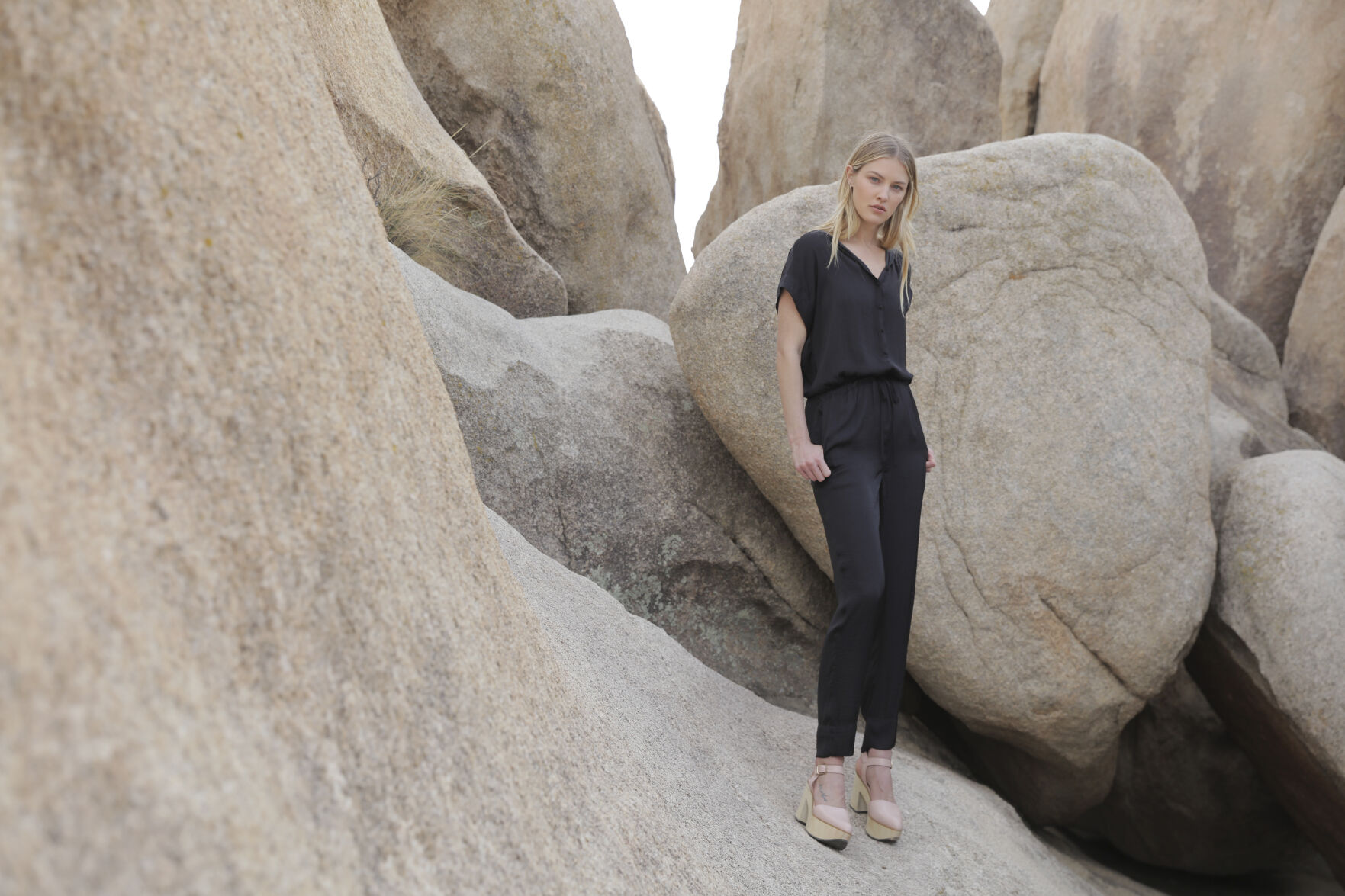
On her blog, the creative designer has penned a defense of the jumpsuit, citing its history as a practical working garment for women in previous generations. Her belted, hooded jumpsuit ($203) can be bloused on top to fit specific figures, and the sleek gray-black fabric can pair with sneakers or heels.
“We are in the Bay Area, but a lot of people still need to have a dress code for work, and some of them still need to wear a suit for meetings,” Zisser said. “I have a specific customer, it’s inspired by her – she showed me one of the suits she wears to a board meeting.”
Concept-to-table
Looping a design process from in-boutique conversations and client relationships back to vision boarding and plans for the next piece to design is part of the strategy Zisser and her company’s president, Sharon Segev, planned for a vertically integrated fashion business. Segev, Zisser’s husband, described a “concept to table” process.
“Fashion itself is a very tough business, retail itself is almost an impossible mission,” Segev said.
He added that using technology to inform how they build a label gives them an edge in an industry that has been slower than some to adapt to new tools. The mission at Ruti, from a business perspective, was “how to make a boutique business scalable.”
They used local architects to design unique-feeling boutiques at their locations in San Francisco, Berkeley, Southern California and Dallas, with new ones opening on Madison Avenue and in Scottsdale this fall.
“A boutique by definition is a one-off experience – when you go to Paris and speak with the owner, she’s been there for 40 years, she buys the clothing for a specific need and specific clients,” Segev said. “We need to create something like that, that can scale.”
Gathering, organizing and using that kind of customer information and client feedback became a central mission for Ruti, as did finding ways to pair customers with stylists who know and remember their tastes, needs and budget – and can pass that information from person to person.
Stitch Fix understands your budget, and Amazon knows what you bought and are likely to buy again, Segev said.
“We have a bigger role, which is also to help your taste – to wear what is appropriate for you,” he said. “We want to make sure that you are fashion updated, you wear the thing that will help you the most to achieve your goal and to feel comfortable with your body. In order to do that, we need to understand you much more.”
They open very small spaces – their Palo Alto location is only 500 square feet, smaller than the bathrooms at Nordstrom, by Segev’s calculation. They use new shipping features and other inventory management to move needed pieces in and out of the shop and to customers’ homes in hours, not days.
For more information, visit ruti.com.