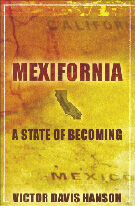
“What is new is not so much the increased volume of immigration, but a growing despair and uncertainty over how – or even whether – to assimilate the arrivals into the fabric of the United States,” says Victor Davis Hanson, author of “Mexifornia” (Encounter Books, 2003).
In his hometown of Selma, near Fresno, Hanson grew up surrounded by Mexican immigrants, many of whom are now his friends, relatives and stalwarts of the town infrastructure. In the 1950s, they were pushed to learn English and United States history, and to assimilate.
“Assimilation … through both intermarriage and shared consumerism, works.” Now, Hanson warns, immigrants are encouraged to keep their native culture and not assimilate.
“Our social problems are hardly white on Mexican, but often … the struggle by second- and third-generation Americans of Mexican ancestry who run our schools, police our streets and manage city government to cope with thousands of break-ins yearly, vandalism, hit-and-run accidents, … and public schools and hospitals that are overflowing with clients who speak little English and have little capital, but expect instantaneous American-style service,” Hanson says in his book.
As a fifth-generation orchardist in Selma and a classics professor at California State University at Fresno, Hanson has seen these changes firsthand.
He makes a convincing point that immigrants would benefit from learning English, math and the basics of American culture; but fails to mention anything that California could learn from Mexico. Has he never traveled to Mexico and found some pleasant quality of life that he would have liked to bring home? He considers family loyalty antithetical to our meritocracy. It’s true that nepotism is a bad practice in government, but family loyalty itself is not negative.
Hanson surprises the reader with a great conclusion. He finds the solution to assimilation in the globalization of pop culture, “the only tool we possess to prevent racial separation and ethnic tribalism … videos, bestsellers, Internet surfing, TV shows and magazines … a shared addiction that inexorably builds affinity across racial lines.”
He considers the globalization of pop culture, “homogenizing, leveling and so in a weird sense, democratic at the most basic, popular level.
“What a war the new popular culture has inadvertently taken up through the purpose of its own naked greed – no less than an assault on the age-old class, race and gender hierarchies that were previously thought to be innate to, and unassailable within, the human condition!”