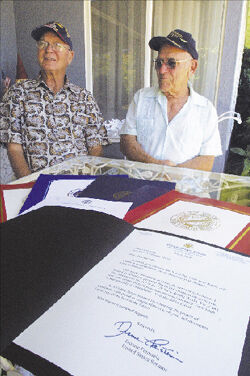
Alfred Galedrige and Donald Heffelfinger lagged a bit behind their classmates when they picked up their high school diplomas – about 60 years.
The two weren’t buying time to cram for SATs. Instead of walking with their classes, Galedrige and Heffelfinger marched separately into U.S. Navy recruiting offices and enlisted. As young sailors, they fought in the Pacific Theater of World War II. In fact, both men saw the Japanese attack Dec. 7, 1941. On July 14, in a special ceremony for war veterans at the Santa Clara County Office of Education, they finally got their diplomas.
Galedrige said he never dreamed he would see his.
“It was too late to go back to school after the war. I had to go to work, you know,” said the man who was the “Al” in Al’s Barber Shop at 365 Central Plaza in Los Altos for 58 years.
Now 78, the hale and garrulous Galedrige looks as though he was sent over by central casting to play the role of grandpa. He babies his standard roses and petunia borders, keeps his lawn smooth and green, a couple of dozen lemons down from his tree with practiced movements. He golfs with friends, making a day of it in Hollister. Anybody wanting news, opinion or advice can still find him on Fridays and Saturdays at the barbershop where he cut it close for four generations.
The 83-year-old Heffelfinger has had some health problems – “I got two iron knees and a heart that’s just been overhauled” – but rides a stationary bike and walks on his treadmill to strengthen himself. Not that he isn’t wiry already.
Estelle, his wife of 56 years, when asked for Heffelfinger, said, “He’s here, but he’s under the car” – servicing his daughter’s automobile. Despite some setbacks, Heffelfinger retains his game spirit and salty wit. If you’ve seen the musical “South Pacific,” you’ve seen Heffelfinger. He’s the guy leading the men in “Nothing Like a Dame.”
Dec. 7, 1941
At Kaneohe Naval Air Station on the windward side of Oahu, Machinist Mate 1st Class Heffelfinger was preparing his PBY Catalina Patrol seaplane for another 14-hour reconnaissance flight when the first wave of the Imperial Japanese Navy hit the base at 7:55 a.m. At first, the men at work on their planes did not realize what was happening.
“I saw one plane on fire, and I thought, ‘Some guy’s fallen asleep with a cigarette in his mouth.’ Three of us headed down to the ramp, then I saw a plane with a big red dot and I thought, ‘Oh, boy,’ and started running for the hangar. They missed me by an inch,” Heffelfinger recalled.
A moment later, he witnessed death for the first time when another sailor, trying to reach the hangar behind him, was strafed at the door.
“I was a 20-year-old kid,” Heffelfinger said, “not even dry behind the ears.”
The 16-year-old Galedrige watched the action from his hillside home.
“I saw the first dogfight over Honolulu,” he said. “Six planes got up there over Kaneohe. I was in my cucumber patch, killing Japanese beetles.”
A few minutes later came the attack on Pearl Harbor, on the south side of the island, for which Galedrige had a ringside seat.
“The sky filled with black smoke and fire, and all these planes were diving. I ran and grabbed my binoculars and watched for three hours,” he said. “The next day, everyone got a pick and a shovel and built a bomb shelter – it was mandatory. I thought, ‘I could get paid for doing this,’ and quit school right then and joined the U.S. Engineers.”
Growing up fast
Heffelfinger was a student at San Jose Technical High School and only a few months shy of graduation when he enlisted in 1940 “for six long years” in the Navy.
“I couldn’t find a job for love nor money,” he said. “It was just after the Depression. Jobs were scarce and pay was low. In the Navy, at least, I had a nice place to sleep and eat and clothes.”
Heffelfinger served onboard a ship during his first year in the Navy.
“We had orders to shoot Japanese a year before Pearl Harbor, so (U.S. authorities) knew, but they didn’t know when,” he said.
After his first year, Heffelfinger was assigned to a seaplane squadron. He was the “plane captain” – “the guy who made sure the plane was ready to take off every morning for 14 hours in the air every day.”
“At 100 mph, I saw a lot of ocean,” Heffelfinger said wryly. “After the war started, I cooked and slept in that airplane – I stayed in that seaplane.”
Heffelfinger’s squadron fished fighter pilots and torpedo pilots out of the brink. The 12 to 14 men in each seaplane spent their days looking for the enemy. When they encountered enemy ships or planes, they shot or torpedoed them, Heffelfinger said.
“We didn’t have many bombs, and we had to account for all of them,” he said.
Heffelfinger survived three seaplane crashes.
“I almost lost my life one time,” he said. “Seaplanes play submarine – kind of fold up when they hit the water at 100 mph. We went underwater. I was talking to St. Peter when I popped out of a crack in the hull and came to the top, and somebody grabbed my hair.”
He was also in a botched landing at Fiji. The floats attached to the wings “dug into the water and spun us around like a top – the wing was under the plane. It flips real fast, you’re underwater real fast. I’m back there bailing like the devil, up to my knees, and I think, ‘The hell with this.’ So I ran out on the wing to balance the plane and saved us from drowning. Then somebody had to go out and get that bombsight out. The government is real fussy with those bombsights.”
Heffelfinger said, “I had a lot of fun when I first started with the squadron. I used to cook their breakfast on a two-burner stove with some dirty so-and-so screaming at me for his breakfast. Even today, I wonder how I did all that – I was chief cook and bottle washer.
“It’s been a great life, though. I can’t kick at all. I’m just happy to be here – I’ve come so close so many times to not being here.”
Heffelfinger said the war “made a man out of me: I didn’t take no stuff off anybody, I just felt better, a little stronger. When the war started, you were on your own. If you weren’t watching what you were doing, you were shot.”
He is modest about his war honors.
“I don’t know what medals they are,” he said. “They gave me some stuff at this reunion – I don’t know what they are. I’m not a heroic guy. I just did my job and lived through it.”
From beetles to bombs
Out in the middle of the Pacific Ocean, the Hawaiian-born Galedrige grew up surfing.
“I used to surf with Duke Kahanamoku and his sister Ann and his brother Sam,” he said. “I had a carefree life – I never owned a pair of shoes before I was 16 years old.”
Galedrige was in the 10th grade when the war started. When his family was evacuated from Oahu in 1942, they returned to his grandparents’ ranch in Mountain View, and Galedrige entered Mountain View High School.
“I joined the Navy the day I turned 17,” Galedrige said. “I saw what happened. I said, ‘I gotta get after those guys.’ Three hundred and eighty-five planes hit us in three hours that day.”
Seaman 1st Class Galedrige served on a converted rocket gunboat for two and a half years.
“The gunboats were the first wave in an invasion,” he said. “We’d take the Marines in and give them fire cover for as long as it took.”
It was five days and nights at Guam: 3,000 rounds of 40 mm anti-aircraft ammunition, four men per gun – two were loaders. Galedrige was the tracker.
“All that duck hunting I did helped out,” he chuckled.
He called Iwo Jima the worst battle he took part in. His gunboat was part of an underwater demolition team. Twelve ships took in underwater mines two days before the invasion, he recalled.
“Every ship was blown out of the water. We lost a lot of men,” he said.
He added quietly, “It seems like it happened yesterday, regardless of how many years go by. You relive it all the time in your mind.
“Two and a half years seem like a hundred. You wonder from day to day whether the next day will be the last. We were having dinner one day when five torpedo bombers came in under the radar. We did shoot down one of the planes, but it cut the ship next to us in half.”
Galedrige was awarded the Asiatic-Pacific Campaign medal, and his unit received the Presidential Unit Citation with Silver Star for its heroics at Iwo Jima.
Did he want it?
Heffelfinger had lived in San Jose as a youngster and always liked this area. After the war, he went to work for a Buick dealership in Mountain View as a lube man, then trained to be a mechanic and eventually became service manager. He also became a Mason and a Shriner – “the whole ball of wax.”
He tried as a young man to complete the requirements for high school graduation but had been stalled by dyslexia. He was surprised to learn he was finally getting his diploma.
“I didn’t know I was going to get it,” he said. “They called and asked me if I wanted it.”
Galedrige was determined to get his high school diploma after hearing about Operation Graduate on “Larry King Live.”
He drove over to his old high school and asked Principal Patricia Hyland how to go about it. She did a little checking and sent him on to the County Office of Education.
On July 14, in the presence of 130 guests, Galedrige, Heffelfinger, and 13 other war veterans from the Peninsula graduated belatedly but gladly.
In addition to unusually attractive diplomas, the new graduates received personal letters from Gov. Arnold Schwarzenegger and Sen. Dianne Feinstein, among others.
“It was a beautiful ceremony,” Galedrige said.