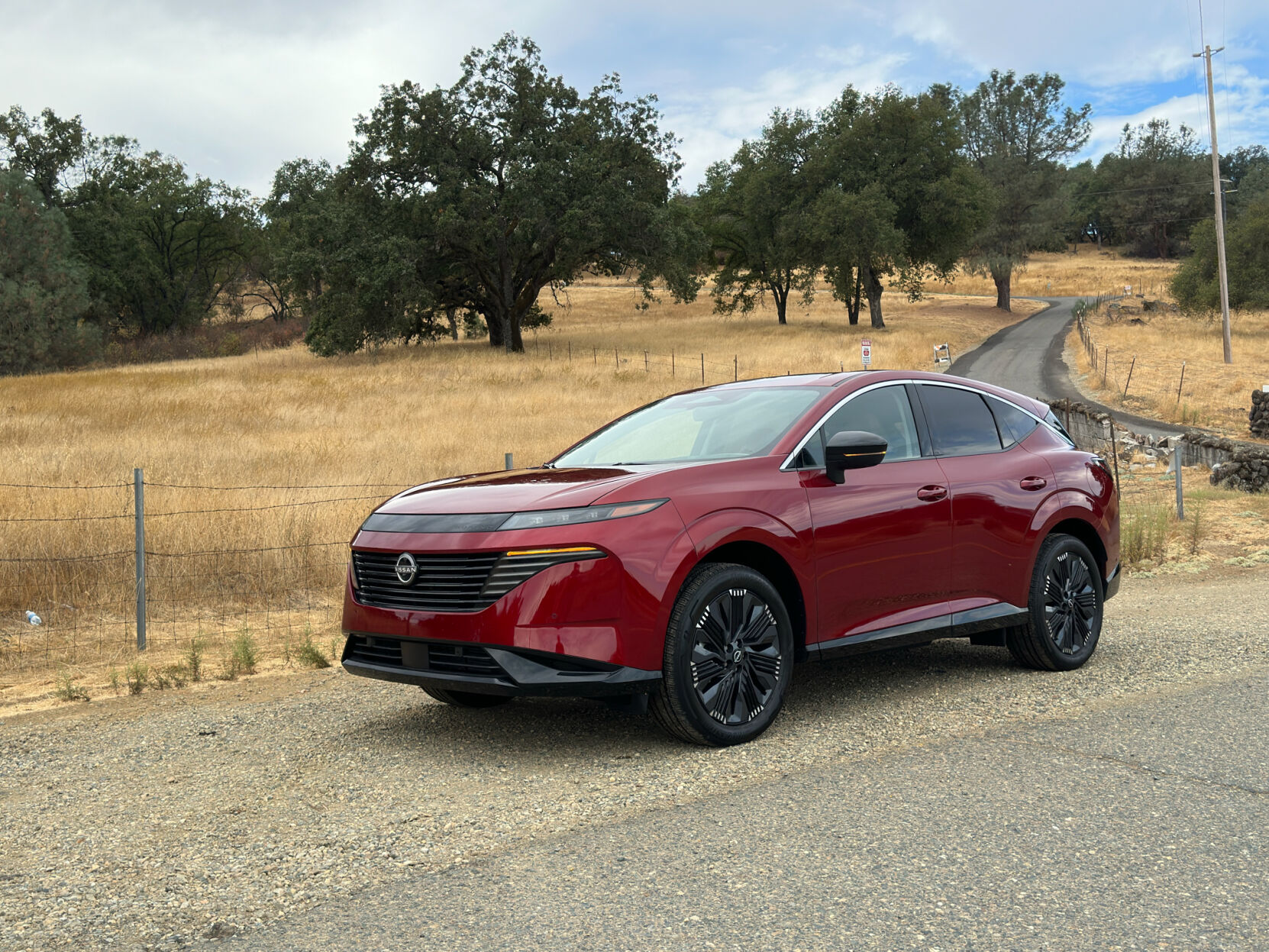
The Nissan Murano is all-new for 2025. That’s a very good thing, because, with only a handful of running updates, the 2024 Murano was the same as the 2015 Murano.
Ten years is a long time in absolute terms. In the automotive world, it’s an eternity. The world the ’25 Murano enters bears little resemblance to the one Gen 3 arrived in a decade ago. And Nissan, while sticking to the two-row, five-passenger crossover SUV formula, started fresh for the new Murano.
The beyond-venerable 3.5-liter V6 that powered so many Nissans and Infinitis in the first quarter of this century is now gone, replaced by a 2.0-liter dual overhead cam 16-valve turbocharged four-cylinder engine. Horsepower is lower in this engine (241 to the old six’s 260), and torque is only mildly improved, from 240 lb-ft to 260.
The old continuously variable transmission is gone, making the Murano feel like it has a bit more oomph, but it really doesn’t. Zero to 60 is still about seven and a half seconds, and fuel economy hasn’t changed much either. What was 20 mpg city/28 highway is now 21 mpg city/27 highway for AWD models like our tester.
The four is noisier and less refined than the old V6, and selecting sport mode just elevates the shift points, prolonging the noise. The ride is comfortable, and the handling is capable, but the steering is numb.
There’s 32.9 cubic feet of cargo space behind the rear seats and 63.5 with those seats folded down. That works out to an incremental improvement with the second-row seats in place (0.8 cubic feet), but a loss of 3.5 cubic feet from last year with the second row folded.
And somehow, rear seat legroom has shrunk from the last generation – it’s now 36.3 inches, as opposed to the previous generation’s 38.7 inches.
And these losses in cargo and passenger space metrics are despite the car having grown a 10th of an inch in overall length and 2.6 inches in width.
The cockpit is where improvements can’t be denied. It’s a decade’s worth of advancements in one fell swoop, with a cleaner design and better visibility.
There are three trim levels of the Murano: SV (base price $40,470), SL ($46,560) and Platinum ($49,600). All-wheel drive is optional on SV, standard on SL and Platinum.
Our tester was the Platinum, and with destination, the starting price is $50,990. That brings a long list of standard equipment including selectable drive modes, a comprehensive suite of active safety features, dual-zone automatic climate control, semi-aniline leather-appointed heated and ventilated front seats with massage function, heated leatherette-wrapped steering wheel with power tilt and telescope, wireless device charging, customizable 64-color ambient lighting, a hands-free power liftgate, second-row door sunshades, heated rear seats, a connected garage door opener, head-up display, rain-sensing wipers, power-folding outside mirrors, a 12.3-inch touchscreen with a Bose premium audio system, wireless Apple CarPlay and Android Auto, Google built-in, Alexa built-in, a wi-fi hotspot, 21-inch alloy wheels, automatic headlights, LED headlights, daytime running lights and tail lamps and a panoramic moonroof.
Our tester had a few extra-cost options. The Scarlet Ember Tintcoat paint was $425, carpeted floor mats and cargo mat with seatback protector and cargo blocks were $510, an illuminated cargo scuff plate added $505, exterior ground lighting was $675, panoramic headliner illumination was priced at $430 and illuminated kickplates put another $415 on the tab. Bottom line on the window sticker: $53,950.
The Murano was absolutely overdue for a new generation. Apart from style, it’s hard to identify any area where the new one moves the ball, and in small ways, it’s lost some ground.